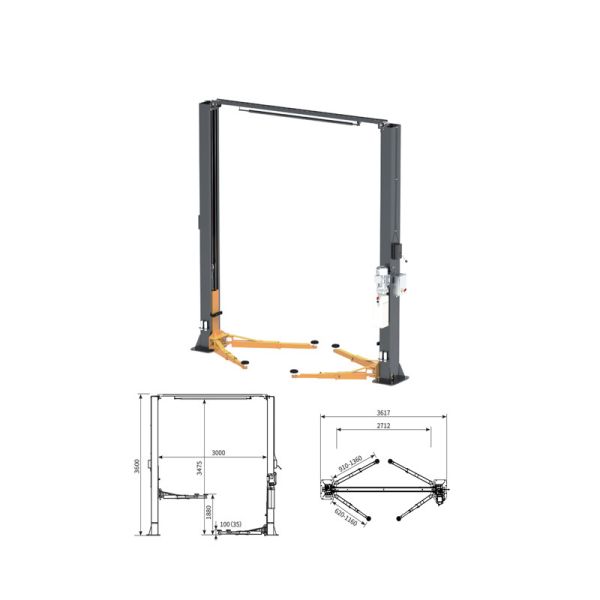
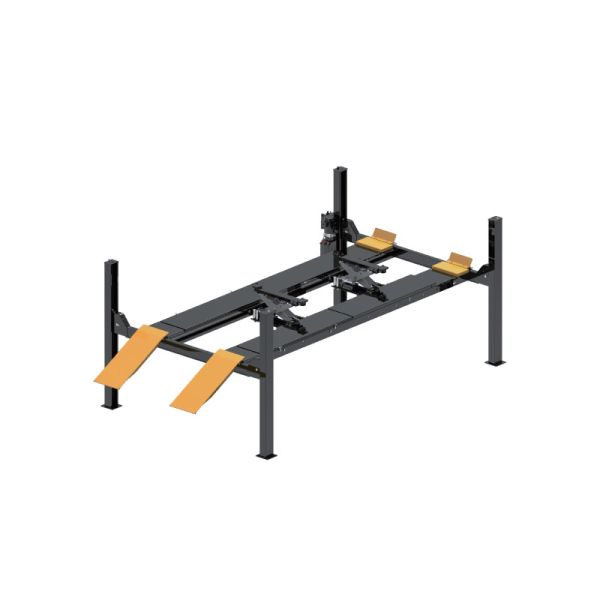
The YD07-007 Two-Post Car Lift is a heavy-duty equipment designed specifically for "safety and efficiency upgrades in professional auto repair scenarios". Addressing the pain points of traditional two-post lifts such as "cumbersome unlocking, easy collision on the vehicle top, and messy pipelines", it takes "4200 kg high load capacity + single-point mechanical lock release + in-column hoses" as the core, combined with stable dual-cylinder drive and overhead emergency stop protection to achieve the core needs of "stable heavy-load lifting, convenient operation, and vehicle protection". It is suitable for auto 4S shops, large auto repair shops, commercial vehicle repair stations and other scenarios. Its core advantages are as follows:
-
4200 kg High Load Capacity + Dual-Cylinder Synchronous Drive, Stable Support for Medium-Heavy Vehicles
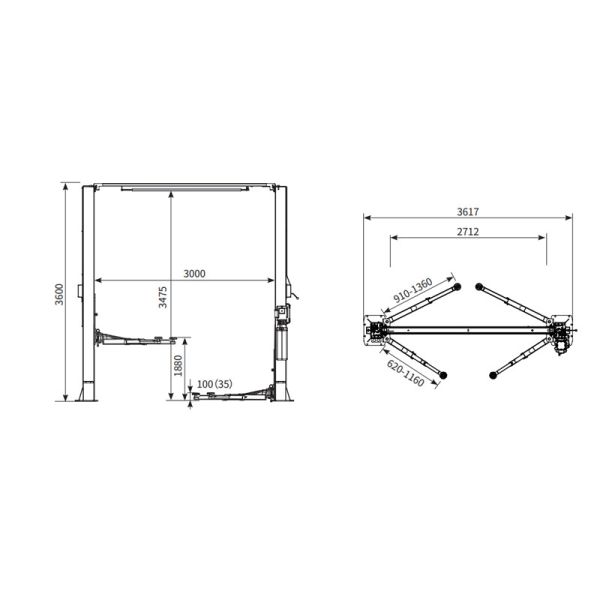
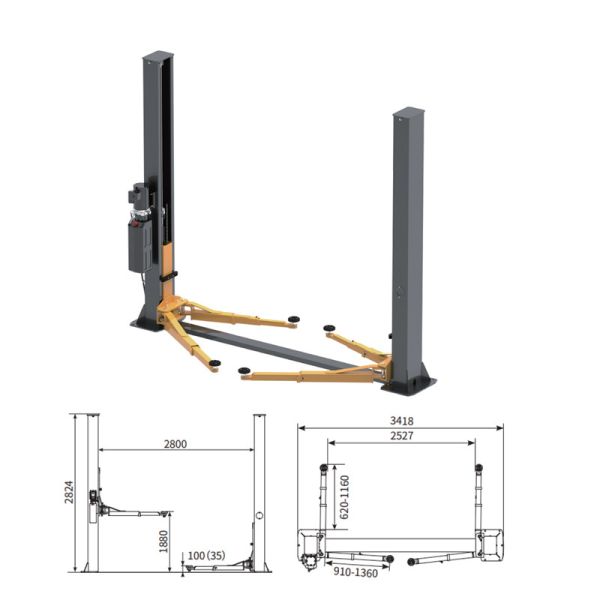
The two columns are made of Q355 low-carbon alloy steel plates with a wall thickness of 14 mm (2 mm thicker than ordinary lifts). Key welded joints are tested by X-ray flaw detection, with a tensile strength of 530 MPa. The maximum deformation of the columns is only 0.25 mm under the rated load of 4200 kg, which can stably support light-duty trucks (about 3000-3800 kg), medium-sized SUVs (about 2000-2800 kg) and medium-to-large sedans (about 1800-2200 kg); the dual hydraulic cylinders (85 mm in diameter) precisely control lifting and lowering through a synchronous valve, with a lifting speed of 9 mm/s. It only takes 21 minutes to lift from 100 mm to 1880 mm, which is 15% more efficient than ordinary two-post lifts. During lowering, the throttle valve controls the speed at a constant rate (minimum 3 mm/s) to avoid vehicle jolting.
-
Single-Point Mechanical Lock Release + Convenient Operation, Reducing Labor Intensity
The innovative single-point mechanical lock release design allows technicians to unlock the locks on both columns simultaneously by operating the unlock handle on one side, eliminating the need to move back and forth between the two sides. The number of operation steps is reduced by 50%, especially suitable for "single-person operation" scenarios during maintenance; the unlock handle adopts an ergonomic design (grip distance 120 mm, anti-slip pattern), requiring only 80 N (about 8 kg force) for a single unlock, which is 40% less labor-intensive than traditional double-sided unlocking, reducing wrist strain for technicians during long-term use.
-
In-Column Hoses + Overhead Emergency Stop, Protecting Vehicles and Enhancing Aesthetics
The columns adopt an "internal hose" structure, with hydraulic hoses and cables built inside the columns, no external pipelines exposed. This not only prevents pipelines from being corroded by oil stains and damaged by vehicle collisions during maintenance, but also makes the overall appearance of the equipment neat (60% more aesthetically pleasing than lifts with exposed pipelines), while reducing the risk of pipeline entanglement; an emergency stop switch is equipped on the top. When the lifting height is close to the vehicle top (about 125 mm from the top, corresponding to the limit switch height of 3475 mm), the switch automatically triggers to stop lifting, or technicians can manually press the emergency stop to prevent the vehicle top from colliding with lift components, avoiding paint scratches and component damage.
-
Adjustable Foot Pads + Wide Support Arms, Full-Scenario Adaptation
The foot pad height is adjustable (range 30-100 mm), combined with the bottom anti-slip pad (friction coefficient ≥ 0.98). Even if the floor flatness error is ≤ 8 mm (e.g., local depression on cement floors), the equipment can be kept level by adjusting the foot pads, adapting to more than 90% of non-standard floors; the three-stage arm (620-1160 mm) and two-stage arm (910-1360 mm) are telescopic and adjustable, covering vehicles with wheelbases of 2600-3500 mm. Combined with height-adjustable foot pads, they can accurately align with support points of different chassis heights (100-220 mm), adapting to medium-to-large sedans, medium-sized SUVs, light-duty trucks and other vehicle types.
-
In-Depth Maintenance of Medium-to-Large Sedans in Auto 4S Shops
When 4S shops perform transmission maintenance on Mercedes-Benz E-Class and BMW 5-Series (about 2000 kg), the 4200 kg load capacity fully covers the vehicle weight; the maximum lifting height of 1880 mm lifts the chassis 1780 mm off the ground, allowing technicians to operate while standing upright; the single-point mechanical lock release enables a single person to complete unlocking without the assistance of a helper, shortening the maintenance time per vehicle from 100 minutes to 75 minutes. The overhead emergency stop switch prevents accidental collision damage to the vehicle top during maintenance, adapting to the needs of "precision maintenance of high-end vehicles".
-
Bulk Maintenance of Light-Duty Trucks in Large Auto Repair Shops
When large auto repair shops perform chassis maintenance on JMC Kaiyun and Foton Ollin (about 3500 kg), the dual-cylinder synchronous lifting ensures stable lifting and lowering of the trucks; the adjustable foot pads adapt to slight unevenness of the workshop floor, and the two-stage arm is adjusted to a length of 1300 mm to adapt to the long wheelbase of the trucks; the drive-through width of 2712 mm allows trucks to drive directly between the two columns without repeated position adjustment, shortening the maintenance time per vehicle from 50 minutes to 35 minutes, adapting to the "efficient bulk maintenance of light-duty trucks" scenario.
-
Multi-Vehicle Services in Commercial Vehicle Repair Stations
When repair stations undertake maintenance of both medium-sized SUVs (e.g., Toyota Highlander) and light-duty trucks, the 4200 kg load capacity covers both vehicle types; the three-stage arm adapts to the short wheelbase of SUVs (adjusted to 800 mm), and the two-stage arm adapts to the long wheelbase of trucks (adjusted to 1200 mm), eliminating the need to replace equipment; the 220V/380V dual voltage adapts to different power supply circuits of the repair station (380V for workshops, 220V for temporary workstations), reducing equipment investment costs by 55% compared with purchasing two lifts, adapting to the "comprehensive maintenance of multiple vehicle types" needs.
-
Beauty and Maintenance of Medium-Heavy SUVs in High-End Auto Repair Shops
When high-end auto repair shops perform chassis armor spraying on Volkswagen Teramont and Lincoln Aviator (about 2600 kg), the in-column hose design prevents pipelines from adhering to paint; the overhead emergency stop switch prevents collision damage to the roof rack due to excessive lifting; the lift is raised to a height of 1500 mm (locked by the safety lock), allowing technicians to spray chassis armor evenly around the vehicle, improving spraying efficiency by 30%, adapting to the "precision beauty of high-end SUVs" scenario.
A1: Yes. The total height of the lift is 3600 mm, leaving a top gap of 200 mm (3.8 meters - 3.6 meters), which fully meets the space requirements for equipment operation (no protruding components on the top during lifting) and technician operation (head distance from the top ≥ 300 mm when standing); if there are overhead pipelines (diameter ≤ 100 mm) in the workshop, the equipment can be installed in the gap between the pipelines, using the 3000 mm column inner width to avoid pipelines, without modifying the workshop overhead structure.
A2: Failure is mostly caused by jamming of the unlock cable or clogging of impurities in the locking mechanism. Troubleshooting steps: ① Lower the support arm to the lowest position and turn off the power; ② Remove the side cover of one column, check if the unlock cable is bent (cable stroke should be ≥ 150 mm), and replace it with a spare cable (1 included in accessories) if bent; ③ Blow off dust and oil from the locking mechanism with compressed air (pressure 0.6 MPa), and apply 2# lithium-based grease; ④ Manually pull the unlock handle to test. If both columns unlock synchronously, the fault is resolved. It is recommended to maintain the unlock mechanism every 6 months.
A3: The floor needs to meet two requirements: ① Load capacity ≥ 1000 kg/㎡ (200 mm thick C30 cement hardened floor with Φ12@200 reinforcement is recommended); ② Flatness error ≤ 8 mm (measured with a 2-meter straightedge). If the error exceeds the range, it can be compensated by adjustable foot pads (maximum adjustment 100 mm); during installation, a level should be used to calibrate the equipment (tabletop level error ≤ 1 mm) to avoid vehicle tilting during lifting. The manufacturer can provide floor survey and guidance services.
A4: Oil leakage is mostly caused by aging seals. Handling steps: ① Lower the support arm to the lowest position and release the pressure of the hydraulic system; ② Remove the connecting bolts at both ends of the cylinder (torque 25-30 N·m) and take out the cylinder piston rod; ③ Replace the seals (seal kit included in accessories, made of oil-resistant nitrile rubber), and apply hydraulic oil to the seal surface for lubrication during installation; ④ Reassemble the cylinder, add 32# anti-wear hydraulic oil to the oil tank scale line, and test with 3 empty lifts. The oil leakage phenomenon is resolved. It is recommended to check the seal condition every 18 months.