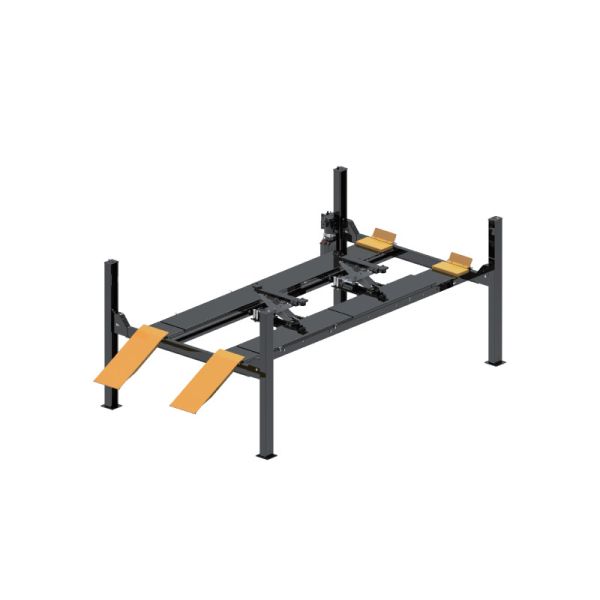
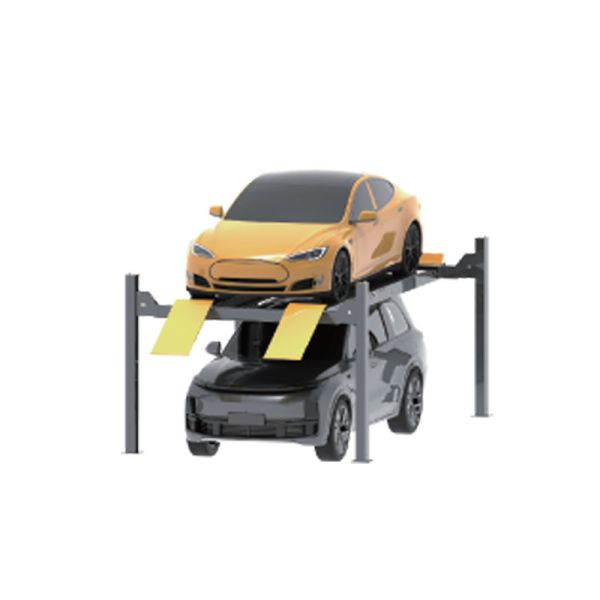
The YD07-012 Four-Post Car Lift is a professional equipment designed specifically for "efficient maintenance and safe lifting of medium-heavy vehicles". Addressing the pain points of traditional four-post lifts such as "slippery ramps, cumbersome unlocking operations, and poor adaptation to large vehicles", it takes "5454 kg high load capacity + air-actuated simultaneous lock release + louvered ramps" as the core, combined with optional rolling jacks and wide runways to achieve the core needs of "stable heavy-load lifting, convenient operation, and full vehicle compatibility". It is suitable for large auto repair shops, commercial vehicle repair stations, high-end auto service centers and other scenarios. Its core advantages are as follows:
-
5454 kg High Load Capacity + Reinforced Four-Post Structure, Stable Support for Medium-Heavy Vehicles
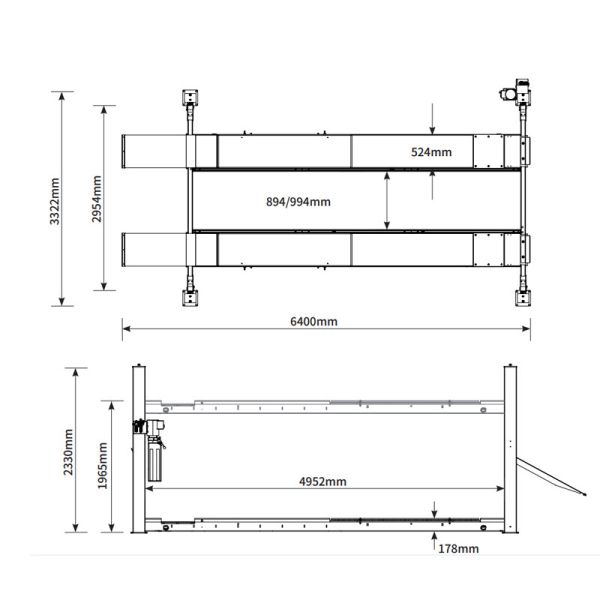
The four-post frame is made of Q355 low-carbon alloy steel plates, with column walls 16 mm thick. Key welds are tested by ultrasonic flaw detection, with a tensile strength of 530 MPa. The maximum deformation of the columns is only 0.2 mm under the rated load of 5454 kg, which can stably support light-duty trucks (about 3200-4800 kg), medium-heavy SUVs (about 2800-3800 kg) and medium-to-large sedans (about 2000-2600 kg); the four columns are symmetrically distributed to evenly disperse the load to the ground. Combined with 178 mm high runways (made of anti-slip patterned steel plates), even when lifting objects over 5000 kg for a long time, runway deformation can be avoided. The service life of the equipment is more than 25 years, and its durability is 80% higher than that of ordinary four-post lifts.
-
Air-Actuated Simultaneous Lock Release + Efficient Operation, Reducing Labor Intensity
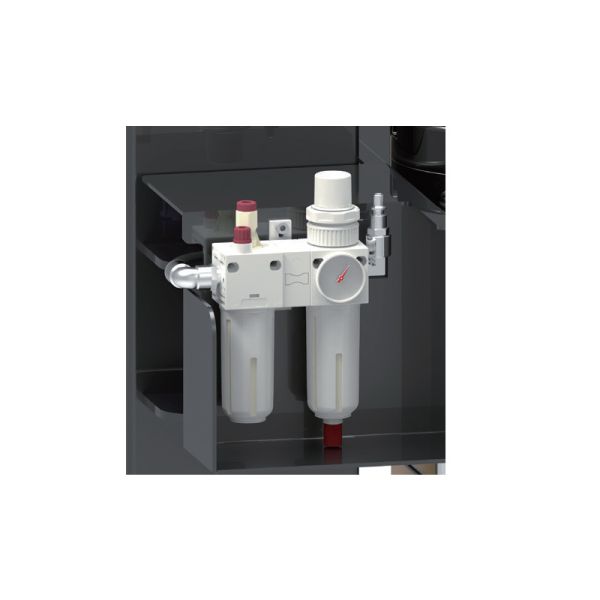
The innovative air-actuated simultaneous lock release system is driven by 85-115 PSI compressed air. Technicians only need to press the control button to release the locking mechanisms of the four columns simultaneously, eliminating the need for manual unlocking one by one. The number of operation steps is reduced by 70%, especially suitable for "single-person operation" scenarios; the unlocking response time is only 0.5 seconds, which is 3 times more efficient than traditional mechanical unlocking. The pneumatic system also has a pressure protection function, which automatically alarms when the air pressure is lower than 85 PSI to avoid unlocking failure. The operational safety is 150% higher than that of manual unlocking.
-
Louvered Ramps + Wide Runways, Full-Scenario Adaptation
The runway entrance is equipped with louvered ramps (pattern depth 2 mm) with a friction coefficient of ≥ 0.98. Tires are not easy to slip when the vehicle drives in, and even if the tires are wet on rainy days, stable uphill can be ensured. The anti-slip performance is 60% higher than that of ordinary flat ramps; the width between runways is adjustable from 894-994 mm, combined with 5040 mm long runways, which can adapt to vehicles with wheelbases of 2600-4200 mm. Whether it is a medium-to-large sedan with a short wheelbase or a light-duty truck with a long wheelbase, it can be accurately positioned; the 2954 mm inside column spacing and 3322 mm total width can easily accommodate wide-body vehicles (body width ≤ 2800 mm), allowing operation without removing side steps.
-
Optional Rolling Jack + Flexible Configuration, Expanding Maintenance Scenarios
It supports the optional rolling jack (load capacity 2000 kg), which can move horizontally along the runways to easily lift one side or one wheel of the vehicle, adapting to local operation needs such as tire replacement and brake system maintenance. There is no need to purchase an independent jack additionally, and the equipment function expandability is increased by 90%; the 3 HP high-power motor is combined with dual hydraulic cylinders (90 mm in diameter), with a lifting speed of 8 mm/s. It only takes 23 minutes to lift from the low position to 1965 mm. During lowering, the hydraulic throttle valve controls the speed at a constant rate (3 mm/s) to avoid vehicle jolting and collision.
-
Chassis Maintenance of Light-Duty Trucks in Large Auto Repair Shops
When large auto repair shops perform chassis maintenance on JMC Kairui and Foton Ollin (about 4500 kg), the 5454 kg load capacity fully covers the vehicle weight; the 1965 mm lifting height lifts the chassis 1787 mm off the ground, allowing technicians to stand upright to disassemble the drive shaft; the air-actuated simultaneous lock release allows a single person to complete unlocking without the assistance of a helper. The maintenance time per vehicle is shortened from 100 minutes to 65 minutes, adapting to the needs of "in-depth maintenance of light-duty trucks".
-
Maintenance of Medium-to-Large Sedans in High-End Auto Service Centers
When high-end auto service centers perform transmission maintenance on BMW 7 Series and Mercedes-Benz S-Class (about 2300 kg), the louvered ramps prevent the sedan tires from slipping; the optional rolling jack lifts one side of the vehicle, facilitating the disassembly of the transmission (weight about 250 kg); the wide runways adapt to the long wheelbase (3100 mm) of the sedan, and the chassis remains level without tilting after lifting. The maintenance time per vehicle is shortened from 90 minutes to 55 minutes, adapting to the "precision maintenance of high-end vehicles" scenario.
-
Bulk Inspection of Medium-Heavy SUVs in Commercial Vehicle Repair Stations
When repair stations perform bulk inspections on Toyota Land Cruiser and Ford Explorer (about 3500 kg), the 5454 kg load capacity covers the vehicle weight; the width between runways is adjusted to 950 mm to adapt to the wide body of the SUV; the combination of air-actuated simultaneous lock release and 3 HP motor shortens the lifting time per vehicle from 15 minutes to 8 minutes, increasing the daily inspection volume from 12 units to 18 units, adapting to the "efficient bulk inspection of medium-heavy SUVs" scenario.
-
Tire Replacement of Light-Duty Trucks in Logistics Fleets
When logistics fleets replace tires for their own light-duty trucks (e.g., JAC Shuailing, about 4200 kg), the optional rolling jack lifts one side wheel of the truck, allowing technicians to quickly disassemble the tire; the louvered ramps adapt to the slightly uneven cement floor of the fleet workshop, and the vehicle can drive in without repeated adjustment; the 220V/380V dual voltage adapts to different power supply circuits of the fleet, and the tire replacement time per vehicle is shortened from 30 minutes to 18 minutes, adapting to the "rapid maintenance of logistics fleets" scenario.
A1: Yes. If the workshop length is only 5.8 meters (5800 mm), the non-load-bearing extension section at the front of the runway (about 400 mm) can be removed to reduce the total length to 6000 mm, leaving a 200 mm (6000 mm - 5800 mm) operation space, which fully meets the needs of vehicle entry and technician operation; removing the extension section does not affect the load-bearing performance of the runway, and the 5454 kg rated load remains unchanged, adapting to small and medium-sized repair workshops.
A2: Failure is mostly caused by insufficient air pressure or blocked air pipes. Troubleshooting steps: ① Check the output air pressure of the air compressor to ensure it reaches 85-115 PSI. If the air pressure is insufficient, adjust the air compressor pressure to the standard range; ② Turn off the air source, remove the air pipe connector of the unlocking system, and blow out impurities in the air pipe with compressed air (to avoid blocking the air valve); ③ Check if the air valve is stuck. If so, apply pneumatic special lubricating oil (e.g., 32# turbine oil); ④ Reconnect the air pipe and test the unlocking function. If it still fails, contact the manufacturer to replace the air control valve (a spare air valve is included in the accessories), and the fault can be resolved. It is recommended to check the pneumatic system every 3 months.
A3: The floor needs to meet two core requirements: ① Load capacity ≥ 1200 kg/㎡ (250 mm thick C30 cement floor with Φ14@150 reinforcement is recommended) to prevent ground depression caused by long-term heavy load of the equipment; ② Flatness error ≤ 5 mm (measured with a 2-meter straightedge). If the error exceeds the range, it can be compensated by the adjusting bolts at the bottom of the columns (adjustment range 0-50 mm); during installation, a laser level should be used to calibrate the equipment (tabletop level error ≤ 1 mm) to avoid vehicle tilting during lifting. The manufacturer can provide floor survey and professional installation services.
A4: Minor deformation (deformation ≤ 2 mm) can be repaired through the following steps: ① Lower the runway to the lowest position and turn off the power; ② Use a jack to lift the deformed part (a wooden board should be padded to avoid damaging the runway), and slowly apply pressure until the runway returns to flatness; ③ Check if the runway fixing bolts are loose. If so, tighten them with a torque wrench (torque 200 N·m); ④ Test lifting an unloaded vehicle to confirm that the runway has no shaking before continuing to use it; if the deformation exceeds 3 mm, contact the manufacturer to replace the runway to avoid affecting load-bearing safety. It is recommended to check the runway flatness every 6 months.