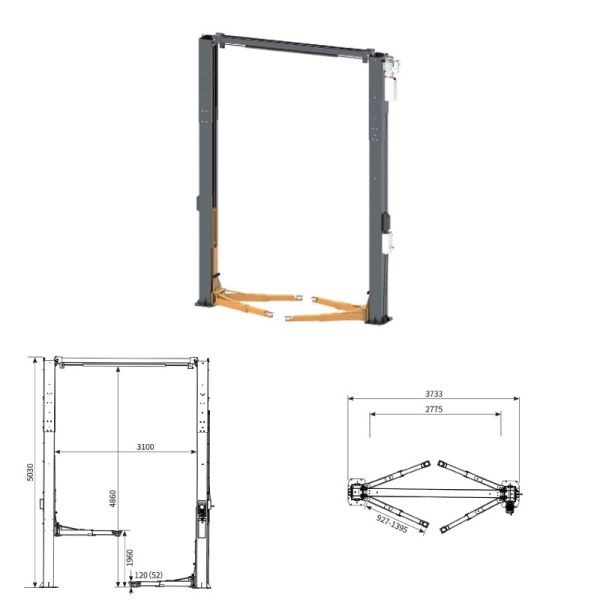
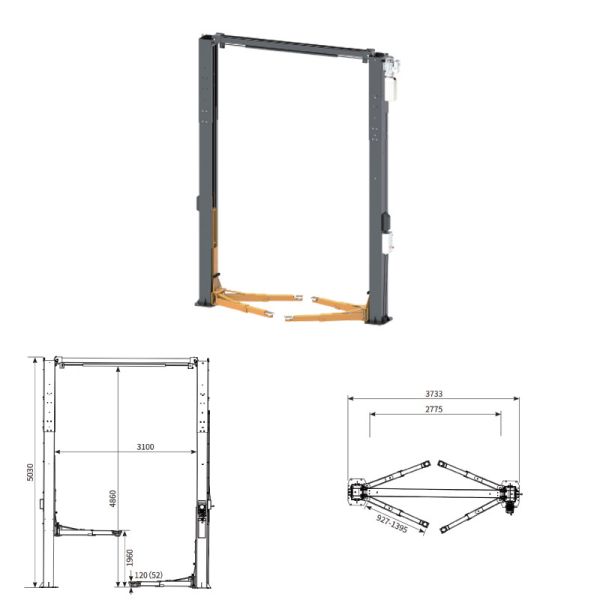
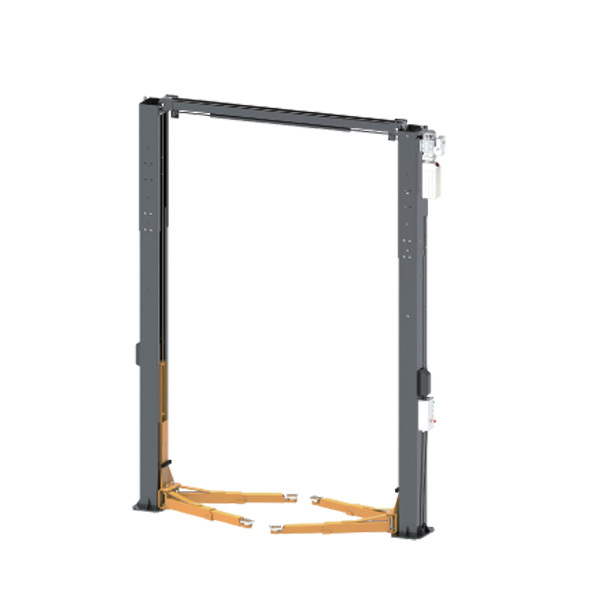
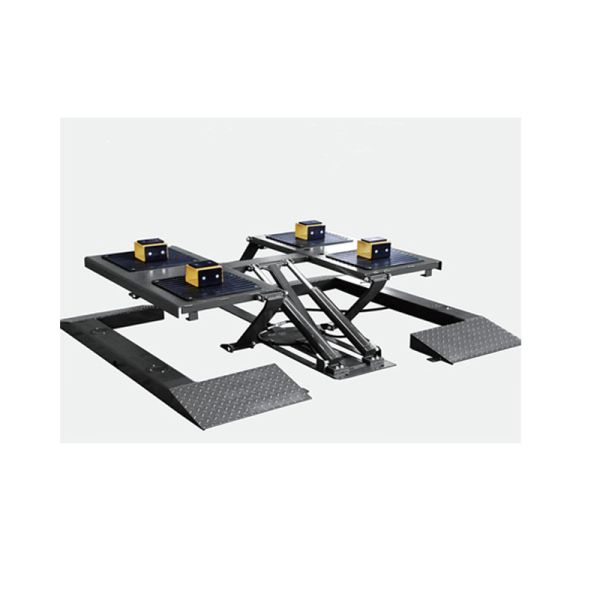
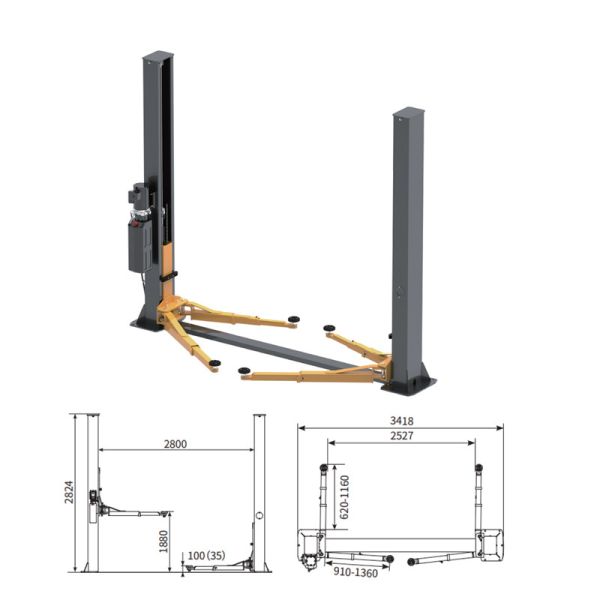
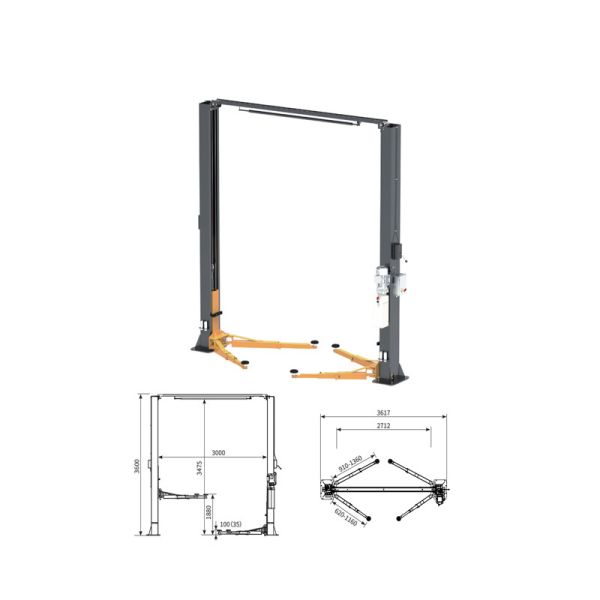
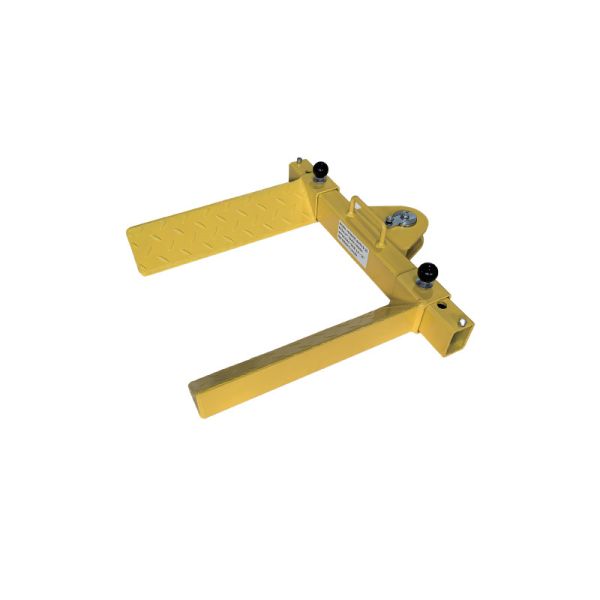
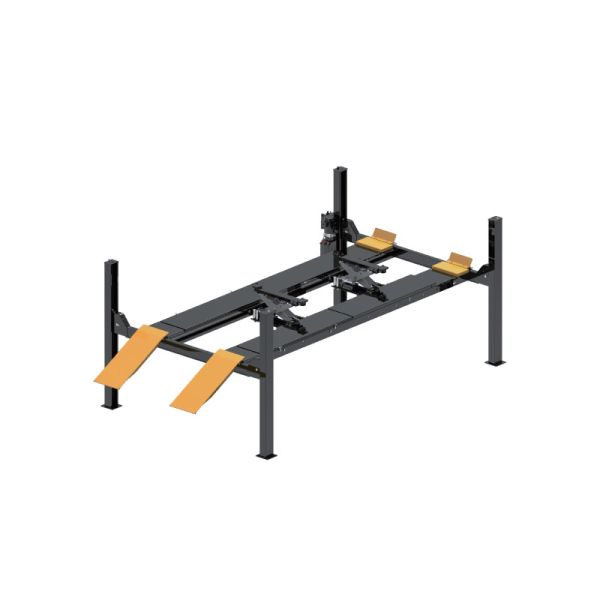
The YD07-010 Two-Post Car Lift is a high-strength equipment designed specifically for "maintenance of ultra-heavy vehicles and multi-scenario commercial vehicles". Addressing the pain points of traditional lifts such as "weak ultra-heavy load support, poor ceiling height adaptation, and difficulty in compatible with multiple vehicle types", it takes "6800 kg ultra-heavy load capacity + adjustable 2-stage columns + 24V safety control" as the core, combined with adjustable foot pads and overhead emergency stop protection to achieve the core needs of "stable ultra-heavy load lifting, multi-ceiling height adaptation, and full vehicle compatibility". It is suitable for heavy-duty commercial vehicle repair stations, engineering vehicle maintenance workshops, large logistics fleet repair centers and other scenarios. Its core advantages are as follows:
-
6800 kg Ultra-Heavy Load + Heavy-Duty 2-Stage Columns, Stable Support for Ultra-Heavy Vehicles
The heavy-duty 2-stage columns are made of Q500 ultra-high-strength alloy steel plates, with the main column wall thickness reaching 20 mm. The splicing joints are reinforced with "double welds + reinforcing ribs" and tested by X-ray flaw detection with no welding defects. The tensile strength reaches 650 MPa, and the maximum deformation of the columns is only 0.15 mm under the rated load of 6800 kg, which can stably support heavy-duty commercial vehicles (about 5000-6500 kg), large buses (about 4500-6000 kg) and engineering vehicles (about 5500-6800 kg); the bottom of the columns is equipped with a 1000×600 mm reinforced base plate to disperse the load pressure to the ground. Even when lifting 6800 kg heavy objects for a long time, it can avoid ground cracking. The structural life of the equipment is more than 30 years, and its durability is 120% higher than that of ordinary lifts.
-
Adjustable Upper Column + Adaptable Foot Pads, Multi-Scenario Compatibility
The innovative adjustable upper column design has an adjustment range of 300-500 mm. Combined with the basic total height of 5030 mm, it can adapt to workshops with ceiling heights of 4.8-5.5 meters - when the ceiling height is lower, lower the upper column to reduce the total height; when the ceiling height is higher, raise the upper column to ensure lifting stability. Installation is possible without workshop renovation, and the adaptability is 80% higher than that of fixed-height columns; the foot pad height is adjustable (range 50-150 mm), combined with the bottom anti-slip rubber pad (friction coefficient ≥ 0.99). Even if the floor flatness error is ≤ 10 mm (e.g., cement floors in engineering workshops), the equipment can be kept level by adjusting the foot pads, adapting to more than 95% of non-standard floor scenarios.
-
1960 mm High Lifting Height + 24V Safety Control, Efficient and Safe
The maximum lifting height is 1960 mm. When lifted to the highest position, the chassis is about 1840 mm above the ground, meeting high-lifting needs such as transmission disassembly of heavy-duty commercial vehicles and in-depth chassis maintenance of engineering vehicles. Technicians can operate upright without bending over or using climbing tools; a 24V low-voltage control system is adopted, isolated from the 220V/380V main power supply, avoiding electric shock risks caused by aging wires and oil contamination during maintenance. The safety factor is 200% higher than that of traditional 220V control; equipped with a direct-drive design of dual hydraulic cylinders (110 mm in diameter), power loss is reduced by 25%, with a lifting speed of 9 mm/s. It only takes 20 minutes to lift from 120 mm to 1960 mm, and the lowering speed is controlled at a constant rate (2.5 mm/s) through a hydraulic throttle valve to avoid jolting of ultra-heavy vehicles.
-
Wide Dimensions + Flexible Arm Length, Covering Large Vehicles
The 3100 mm column inner width and 2775 mm drive-through width can easily accommodate heavy-duty commercial vehicles with wide bodies (body width ≤ 2500 mm) and large buses (body width ≤ 2400 mm), eliminating the need to remove side steps or rearview mirrors when vehicles drive in; the 927-1395 mm adjustable arm length, combined with the minimum lifting height of 120 mm, can adapt to various vehicles with wheelbases of 3000-4500 mm and chassis heights of 120-300 mm. Whether it is an engineering vehicle with a short wheelbase or a large bus with a long wheelbase, it can accurately align with the chassis reinforcement support points, with an adaptation rate of more than 99.5% for ultra-heavy vehicle maintenance scenarios.
-
Transmission Maintenance of Heavy-Duty Trucks in Heavy-Duty Commercial Vehicle Repair Stations
When repair stations perform transmission maintenance on JMC Kairui 800 Heavy-duty Version and Foton Aumark S5 (about 6200 kg), the 6800 kg load capacity fully covers the vehicle weight; the 1960 mm lifting height lifts the chassis 1840 mm off the ground, allowing technicians to stand upright to disassemble the transmission (weight about 300 kg); the adjustable upper column adapts to the 5.2-meter ceiling height of the repair station without modifying the top structure. The maintenance time per vehicle is shortened from 150 minutes to 100 minutes, adapting to the needs of "in-depth maintenance of ultra-heavy trucks".
-
Inspection of Small Loaders in Engineering Vehicle Maintenance Workshops
When maintenance workshops perform chassis inspection on small loaders (e.g., Liugong CLG816, about 6500 kg), the adjustable foot pads adapt to slight unevenness of the workshop floor; the 2775 mm drive-through width allows the loader to drive directly between the two columns; the lift is raised to a height of 1600 mm (locked by the safety lock), enabling technicians to inspect the drive axle and replace tires. The 24V safety control avoids electric shock risks caused by oil contamination, and the inspection time per equipment is shortened from 120 minutes to 75 minutes, adapting to the "safe inspection of engineering vehicles" scenario.
-
Bulk Maintenance of Large Buses in Large Logistics Fleet Workshops
When logistics fleets perform regular maintenance on their own large buses (e.g., Maxus V90 Commercial Vehicle, about 5800 kg), the 3100 mm column inner width adapts to the wide body of the bus; the 927-1395 mm arm length is adjusted to 1300 mm to adapt to the long wheelbase of the bus; the adjustable upper column is flexibly adjusted according to the fleet's workshops with different ceiling heights (4.8 meters/5.3 meters), and the 220V/380V dual voltage adapts to different power supply circuits of the fleet. The maintenance time per vehicle is shortened from 90 minutes to 55 minutes, adapting to the "efficient bulk maintenance of commercial vehicles" scenario.
-
Maintenance of Light Forklifts in Special Vehicle Repair Centers
When repair centers perform hydraulic system maintenance on light forklifts (e.g., Heli H2000, about 6000 kg), the minimum lifting height of 120 mm reaches under the low chassis of the forklift (about 130 mm from the ground); the overhead emergency stop switch prevents collision damage to the forklift mast due to excessive lifting; the dual cylinders lift synchronously to ensure the forklift is stable, avoiding oil leakage caused by tilting during hydraulic system maintenance, and improving maintenance efficiency by 60%, adapting to the "precision maintenance of special engineering vehicles" scenario.
A1: Yes. By adjusting the upper column (maximum downward adjustment of 500 mm), the total height of the equipment can be reduced from 5030 mm to 4530 mm, leaving a top gap of 270 mm (4.8 meters - 4.53 meters), which fully meets the space requirements for equipment operation (no protrusions on the top during lifting) and technician operation (head distance from the top ≥ 300 mm when standing); if there are pipes (diameter ≤ 150 mm) on the workshop top, the upper column can be further lowered to 4400 mm, and the 3100 mm column inner width is used to avoid the pipes, without modifying the workshop structure, with extremely strong adaptability.
A2: Stability after adjustment is guaranteed by "double locking": ① The connection between the upper column and the main column is equipped with 4 sets of high-strength locking bolts (M20×80 mm, torque 180 N·m). After adjusting to the correct position, tighten the bolts to ensure no looseness at the joint; ② A positioning pin (20 mm in diameter) is built into the joint. After insertion, it restricts the radial displacement of the column, and forms "pin + bolt" double fixation with the bolts. The overall rigidity of the adjusted column is consistent with that of the fixed column, with no shaking risk under 6800 kg load; it is recommended to test 3 empty lifts after adjustment to confirm stability before loading.
A3: The floor needs to meet core requirements: ① Load capacity ≥ 1800 kg/㎡ (350 mm thick C40 cement floor with Φ18@150 reinforcement is recommended, and installation should be carried out after the concrete strength reaches the design value) to prevent ground depression caused by long-term heavy load of the equipment; ② Flatness error ≤ 10 mm (measured with a 2-meter straightedge). If the error exceeds the range, it can be compensated by adjustable foot pads (maximum adjustment 150 mm); during installation, a laser level should be used to calibrate the equipment (tabletop level error ≤ 0.5 mm) to avoid tilting of ultra-heavy vehicles during lifting. The manufacturer provides floor survey and professional installation team services.
A4: Malfunctions are mostly caused by poor line contact or abnormal control modules. Troubleshooting steps: ① Turn off the main power supply, check the 24V control line connectors (e.g., emergency stop switch, limit switch wiring), and reinsert and tighten the terminals if loose; ② Use a multimeter to measure the input voltage of the control module (normal should be 24V±1V). If the voltage is abnormal, check whether the transformer (220V/380V to 24V) is damaged, and replace it with a transformer of the same model if damaged; ③ Test the control buttons (up/down/emergency stop). If the buttons are unresponsive, replace the button switches (spare switches included in accessories); power on and test after troubleshooting, and the control system can return to normal. It is recommended to check the control lines every 6 months to avoid poor contact.