Product Overview
The 70-1000 kN marine hydraulic towing winch is project-engineered deck machinery for paying out, recovering, holding, and storing towing wire during tug, workboat, salvage, and ship-assistance operations. The hydraulic drive can be arranged with a single or double drum, one or two optional warping heads, customized drum capacity, and an optional level-wind device. Local and remote control can be combined with optional line-pull, rope-speed, and paid-out-length indication.
Selection must be based on the approved towing duty rather than rated pull alone. The buyer should confirm towline diameter, construction and MBL, required pull at the specified drum layer, line speed, drum capacity, brake and rendering requirements, duty cycle, hydraulic power-unit data, line-lead arrangement, deck foundation, and classification scope. The four configurations below are reference examples and do not define the complete 70-1000 kN product range. This towing winch is not presented as a lifting winch.
Quick Specifications
Main Technical Parameters
|
Selection & Inquiry Guide
Step 1: Define the vessel and duty: harbor towing, escort or ocean towing, salvage, ship assistance, expected bollard pull, towing mode, duty cycle, ambient conditions, and required classification society.
Step 2: Provide towline data: wire-rope or approved alternative, diameter, construction, MBL, unit mass, required storage length, end termination, minimum bending guidance, and preferred number of drum layers.
Step 3: Confirm performance values separately: rated pull and drum layer, rated speed, recovery speed at reduced load, brake holding load, rendering load and speed, free-spooling requirement, and emergency-release function if required by the vessel or class.
Step 4: Select the arrangement: single or double drum, one or two warping heads, level-wind or spooling device, drum grooving, clutch arrangement, brake type, guard arrangement, and maintenance access.
Step 5: Confirm the hydraulic and electrical interfaces: HPU pressure and flow, electric-motor power, 380 V/50 Hz, 415 V/50 Hz or 440 V/60 Hz three-phase supply, cooling medium, control voltage, IP rating, alarms, and local/remote station layout.
Step 6: Provide GA drawing, deck foundation and reinforcement information, line-lead geometry, quantity, material and coating requirement, certificate and witness scope, delivery destination, and required delivery time.
Structure
Welded steel bedframe | Single or double rope drum | Hydraulic motor and reduction drive | Project-specified brake and clutch arrangement | Optional one or two warping heads | Optional level-wind device | Local and remote control stations | Optional line-pull, speed, and length monitoring | Deck foundation interface
Towing, Hydraulic and Engineering Advantages
Custom Attributes
How It Works
Hydraulic power unit supplies pressurized oil → Hydraulic motor and reduction drive rotate the drum → Towline is paid out or recovered at controlled speed → Brake and clutch arrangement holds, stops, or releases the drum as specified → Optional level-wind distributes the rope → Optional sensors display line pull, speed, and paid-out length
Applications
Harbor tug towing | Ship-assistance operations | Salvage and emergency towing | Workboats and utility vessels | Multipurpose support vessels | Ocean-towing arrangements subject to approved design | Newbuilding and retrofit projects
Certifications & Advantages
Certificates and classification involvement can be arranged according to project requirement, approved drawings, material traceability, inspection scope, testing plan, and class approval procedure. The required society and certificate type should be confirmed before quotation.
Certification: CCS, NK, BV, ABS, DNV, LR, KR, IRS, RS, RINA, CRS, Makers Test Certificate.
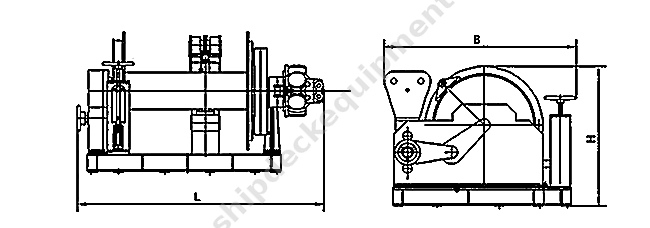
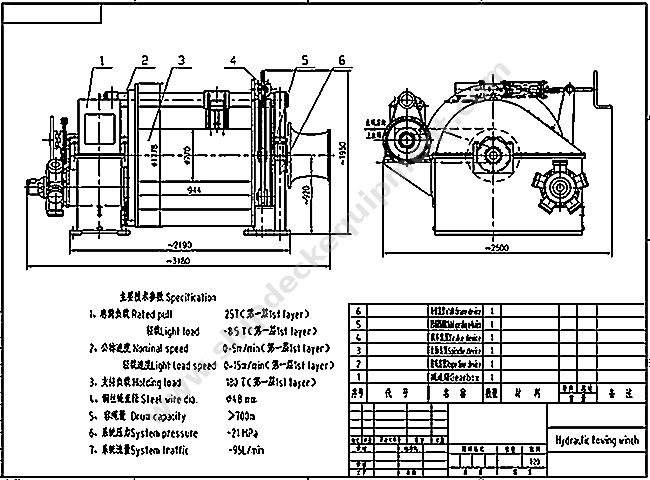
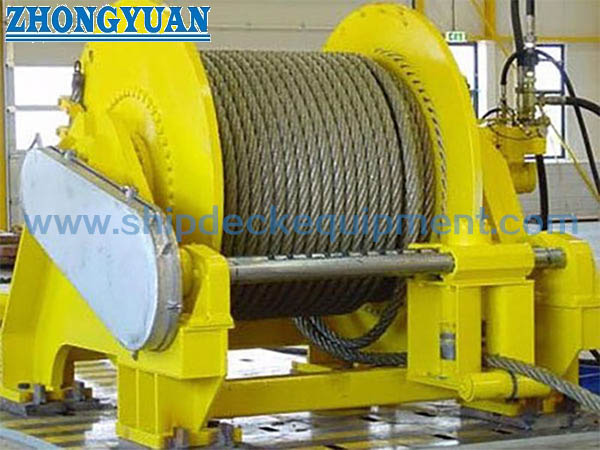
Drawing & Photos


FAQ
Q1: Is rated pull the same as brake holding load or towline MBL?
A1: No. Rated pull is the powered hauling force at a stated drum layer and speed. Brake holding load is a separate static holding value, while towline MBL is the rope breaking-strength value. These terms must not be interchanged.
Q2: What information is required to size the drum and hydraulic drive?
A2: Provide rope diameter, construction, MBL, storage length, preferred layers, drum grooving, rated pull layer, line speed, duty cycle, brake and rendering requirements, hydraulic supply, and available installation space. These values determine drum geometry, torque, motor, gearbox, HPU, and cooling.
Q3: What should be confirmed for class approval and shipyard installation?
A3: Confirm vessel towing duty, applicable class rules, load cases and line-lead angles, foundation reactions, deck reinforcement, brake and release philosophy, control and alarm functions, material traceability, welding/NDT, FAT or load test scope, marking, and final documentation.