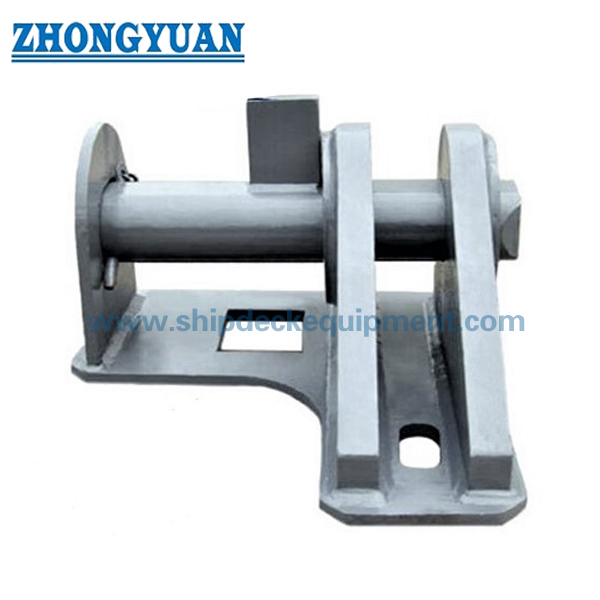
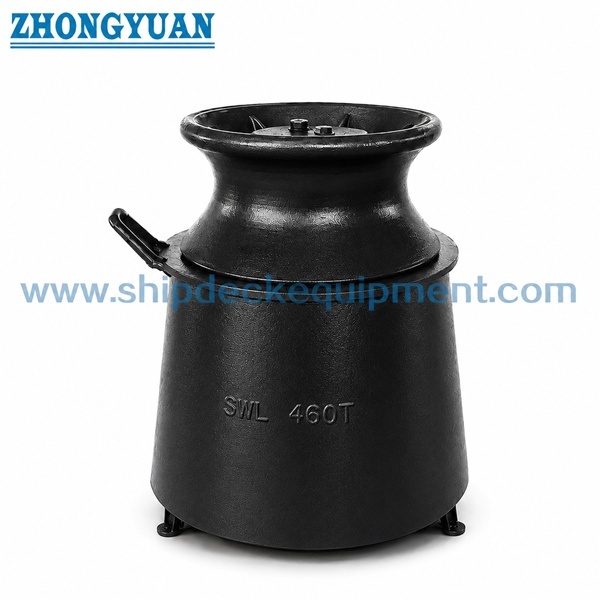
Bulwark-Mounted Cast Steel Panama Chock for Ship Mooring & Towing | DIN 81915:1998 Form A
Product Overview
The DIN 81915 Form A bulwark mounted mooring chock is a cast steel rope guide used on vessel bulwarks where mooring or towing lines need a defined closed passage and smooth rope-contact radius. It helps limit the rope position and reduce direct friction between the rope and the ship structure during berthing, shifting, harbour mooring, and towing-line arrangement where applicable.
This page is written for the Form A bulwark-mounted configuration based on the supplied DIN 81915 data. The page should not be treated as a lifting product page. Final material grade, weld interface, local bulwark reinforcement, surface treatment, and certificate scope should be confirmed according to the vessel drawing and project specification.
Quick Specifications
Main Technical Parameters
| Nominal size |
SWL KN |
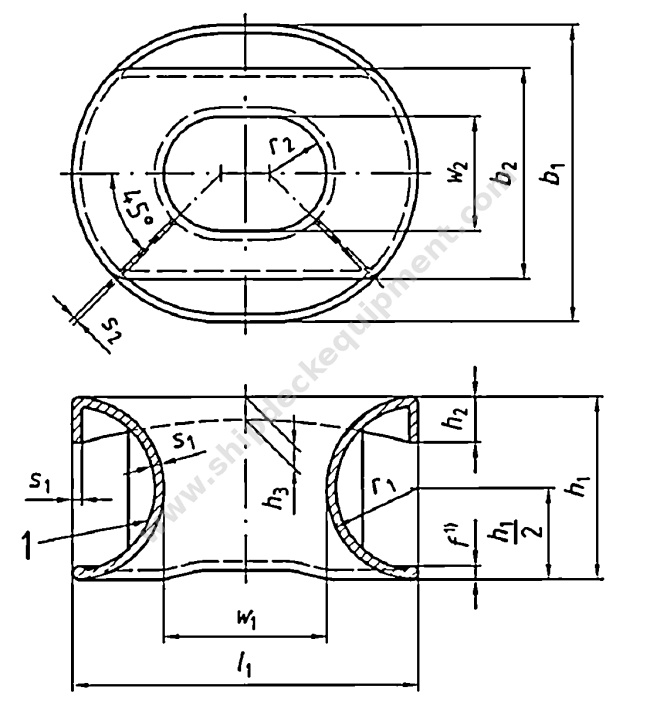
b1 | b2 | d | e | f | h1 | h2 | h3 | l1 | l2 | r1 | r2 | s1 | s2 | w1 | w2 | Weight (GGG) kg |
Weight (GS) kg |
| 1 | 10 | 250 | 175 | 30 | 125 | 15 | 160 | 65 | 20 | 285 | 115 | R80 | R45 | 10 | 5 | 125 | 90 | 16.5 | 18 |
| 2 | 20 | 315 | 225 | 35 | 157.5 | 18 | 200 | 70 | 25 | 360 | 125 | R100 | R57.5 | 12 | 6 | 160 | 115 | 24 | 26 |
| 3 | 30 | 390 | 275 | 40 | 195 | 21 | 250 | 75 | 32 | 450 | 140 | R125 | R70 | 14 | 7 | 200 | 140 | 39 | 42 |
| 5 | 50 | 480 | 340 | 45 | 240 | 24 | 300 | 80 | 38 | 550 | 160 | R150 | R90 | 16 | 8 | 250 | 180 | 69 | 74 |
| 8 | 80 | 585 | 415 | 50 | 292.5 | 27 | 360 | 90 | 45 | 680 | 180 | R180 | R112.5 | 18 | 9 | 320 | 225 | 112 | 120 |
| 12 | 120 | 710 | 500 | - | 355 | 30 | 440 | 110 | 55 | 840 | - | R220 | R135 | 20 | 10 | 400 | 270 | 175 | 185 |
| 20 | 200 | 840 | 595 | - | 420 | 33 | 520 | 130 | 65 | 1020 | - | R260 | R160 | 22 | 11 | 500 | 320 | 265 | 285 |
| 32 | 320 | 1100 | 800 | - | 550 | 700 | 150 | 80 | 1300 | - | R350 | R200 | 35 | 20 | 600 | 400 | 730 | 795 |
Selection & Inquiry Guide
Step 1: Confirm DIN 81915 Form A bulwark mounted mooring chock and nominal size 1 / 2 / 3 / 5 / 8 / 12 / 20 / 32 according to vessel drawing.
Step 2: Confirm required SWL, mooring or towing line direction, rope type, rope diameter, and whether the chock is for newbuilding or replacement.
Step 3: Confirm bulwark mounting position, opening alignment, weld interface, surrounding hull reinforcement, and available installation space.
Step 4: Confirm material requirement: cast steel, casting stainless steel, special steel for ice-class use, or other specified material.
Step 5: Confirm surface treatment: Sa 2.5 blasting with epoxy shop primer, final paint system, polished stainless steel surface, or customized coating.
Step 6: Confirm certificate scope before quotation: maker certificate, material certificate, class certificate, witness inspection, or project-specific approval.
Step 7: Provide quantity, delivery destination, required delivery time, installation drawing, and reference photos if available.
Structure
Cast chock body | Closed rope passage | Smooth rope-contact radius | Bulwark mounting interface | Rounded rope guide opening | Cast surface finishing | Shop primer or specified surface treatment
Casting, Installation & Engineering Advantages
Custom Attributes
How It Works
Mooring or towing line approaches the bulwark area → Rope passes through the closed chock opening → Smooth cast contact radius guides the rope path → Local contact force is transferred into the bulwark structure → Inspection and final coating are completed according to project requirement
Applications
Cargo vessels | Bulk carriers | Tankers | Container vessels | Tugboats | Workboats | Barges | Bulwark mooring stations | Towing-line guide positions | Newbuilding and replacement projects
Certifications & Advantages
Certificates can be arranged according to project requirement, inspection scope, material traceability, and class society approval procedure.
Certification: CCS, NK, BV, ABS, DNV, LR, KR, IRS, RS, RINA, CRS, Makers Test Certificate.
Drawing & Photos


FAQ
Q1: Is DIN 81915 Form A a lifting product?
A1: No. This product is a bulwark mounted mooring / towing line chock used to guide and limit the rope path. It should not be described as a lifting eye, lifting pad, pulling winch, or lifting accessory.
Q2: Can the SWL in the table be treated as rope breaking load?
A2: No. The SWL values in the supplied table are product selection loads. Rope MBL, rope breaking load, proof load, and test load are different concepts and should be confirmed separately according to the vessel mooring or towing arrangement.
Q3: What information is needed before quotation?
A3: Confirm DIN 81915 Form A, nominal size, SWL, material grade, surface treatment, quantity, installation drawing, certificate requirement, delivery destination, and required delivery time.