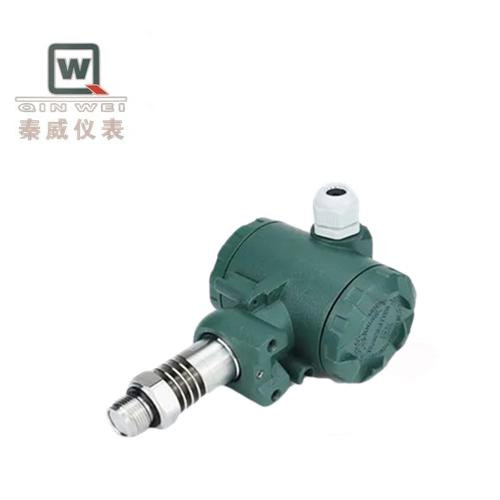
IP68 Protected 0-200 Meters Range DN25 Pressure Level Gauge For Liquid Level Measurement
Pressure-type liquid level gauges are a general term for a category of devices that measure liquid levels based on the principle of hydrostatic pressure. They directly or indirectly sense the pressure of the liquid through sensors and then convert the pressure signal into a liquid level height signal.
Structural Composition
- Sensor probe: Usually made of stainless steel or titanium alloy, with an internal pressure-sensitive element.
- Gas-conducting cable: Used for pressure transmission and signal transmission, featuring waterproof and corrosion-resistant properties.
- Transmitter/display: Processes signals and outputs standard signals, with some models supporting remote monitoring and alarm functions.
Core Classification and Structural Features
Pressure level gauges are mainly divided into three types based on installation methods and structural differences, each suitable for different scenarios:
-
Direct Mount Pressure Level Gauge
- The simplest structure, with the sensor directly installed at the bottom or side of the container via threads (such as G1/2, NPT1/2).
- Suitable for clean, non-corrosive liquids (such as water, lubricating oil) and containers with low pressure (typically ≤ 4MPa).
-
Flanged Pressure Level Gauge
- The sensor is connected to the container via a flange (such as DN25, DN50, with pressure ratings of 1.6-10MPa), and the diaphragm directly contacts the medium.
- Solves the corrosion resistance issue of the direct mount type. The diaphragm can be made of materials like 316L stainless steel or Hastelloy, suitable for acidic and alkaline solutions (such as sulfuric acid, sodium hydroxide).
-
Submersible Pressure Level Gauge
- The sensor is lowered into the liquid via a cable (with a vent tube), kept vertical by a counterweight, and the vent tube compensates for atmospheric pressure.
- Specifically designed for deep liquid level monitoring (such as deep wells, large storage tanks, with a range up to 0-200 meters), and can handle liquids with a small amount of suspended solids (such as sewage).
- Key components: The cable should be made of wear-resistant materials (such as polyurethane), and the protection level should reach IP68 to ensure no damage from long-term immersion.
Applicable scenarios
- Water treatment and environmental protection: liquid level monitoring in urban water supply, sewage treatment, sedimentation tanks, reservoirs, rivers, etc.
- Industrial fields: liquid level measurement in chemical storage tanks, reactors, industrial water tanks, oil tanks, etc.
- Food : liquid level control in aseptic tanks, condiments, beverages, etc.
- Resource extraction: geothermal wells, mines, groundwater monitoring.
- Agricultural irrigation: liquid level management in water towers, reservoirs.
Installation Points
- Still water environment: Directly immerse the probe at the bottom of the liquid, and fix the cable at the opening of the container.
- Flowing or agitated environment: Insert a steel pipe with an inner diameter of approximately Φ45mm (with several small holes) into the liquid, and place the probe inside the pipe to reduce the influence of fluctuations.
- Avoid interference: The installation location should be far away from the liquid inlet and outlet, agitators, and vibration sources.
- Cable protection: Avoid excessive bending. The bending radius should be greater than 10 centimeters. Use steel wire for shock absorption if necessary.
Common Faults and Solutions
Faults of pressure type liquid level gauge are mostly related to installation and medium characteristics. Common problems and handling steps are as follows:
-
Liquid level display is too high / too low
- Cause: Zero drift (environmental temperature change), medium density change (such as liquid temperature increase leading to density decrease).
- Solution: Recalibrate the zero point (use the hand controller to adjust to 4mA). If the density change is large, the density parameter in the system needs to be corrected.
-
Frequent signal fluctuations
- Cause: Sensor is close to the agitator (turbulent flow interference), poor cable contact (loose grounding).
- Solution: Adjust the sensor position (away from the interference source), check if the cable shield is grounded (single-ended grounding is required to avoid circulating current).
-
Sensor damage (no output)
- Cause: Membrane corrosion and perforation (wrong material selection), water ingress in the cable (insufficient protection level).
- Solution: Replace the membrane with the corresponding material (such as using Hastelloy for strong corrosion), if water has entered the cable, the sensor needs to be replaced as a whole (ensure IP68 protection).