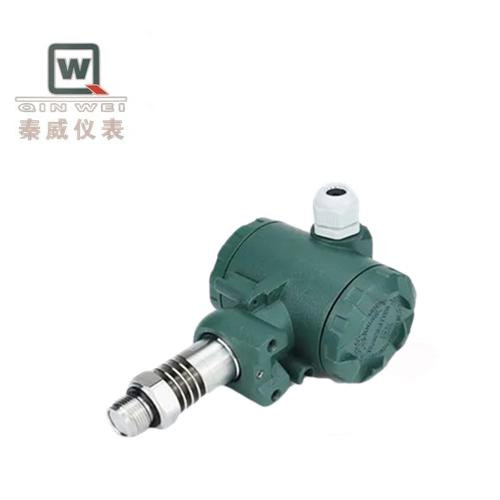
Differential Pressure Level Gauge HART Protocol Support Tantalum And PTFE
The differential pressure level gauge is a device that measures liquid level based on the principle of hydrostatic pressure difference. Its core function is to calculate the liquid level height by measuring the pressure difference between the liquid phase and the gas phase inside the container.
Structural composition
- High-pressure side: Connected to the bottom of the container, it measures the liquid pressure.
- Low-pressure side: Connected to the top of the container or the atmosphere, it measures the vapor pressure.
- Pressure transmission tube/capillary: Transmits pressure signals, some are filled with liquid (such as silicone oil).
- Differential pressure transmitter: Converts the pressure difference into a standard electrical signal (such as 4-20mA), and supports HART protocol, etc.
Applicable scenarios:
- Liquid level measurement in sealed containers: such as reaction vessels, storage tanks, boilers, etc.
- High-temperature, high-pressure, and highly corrosive media: such as in the chemical, petroleum, and pharmaceutical industries.
- Media prone to crystallization and scaling: such as DMAC, ammonia water, dilute sulfuric acid, etc.
- Applications requiring high-precision measurement: such as liquid level control, alarm systems, inventory management, etc.
Installation Points
- Installation Position: Connect the high-pressure side to the bottom of the container and the low-pressure side to the top of the container or the atmosphere to ensure accurate measurement.
- Pressure Conduit Layout: Keep it as short as possible, avoid high points (for liquids) or low points (for gases), and ensure a slope of no less than 1/12.
- Sealing and Protection: Ensure good sealing at the connection points to prevent leakage; in cold regions, provide heat tracing and insulation.
- Calibration and Debugging: Perform zero and full-scale calibration after installation; density compensation may be necessary.
Key technical parameters
1. Measurement accuracy and range migration
Accuracy: Conventional industrial grade ±0.2% FS, high-precision models can reach ±0.1% FS, suitable for scenarios with high requirements for liquid level control (such as pharmaceutical fermentation tanks, chemical reaction vessels).
Range migration: Differential pressure level gauges often require "migration" to correct installation position deviations, which are divided into:
- Positive migration: When the gas phase flange installation position is higher than the liquid phase flange, a fixed differential pressure (such as the pressure generated by the weight of the capillary) needs to be added;
- Negative migration: When the gas phase flange installation position is lower than the liquid phase flange, part of the pressure needs to be offset to ensure accurate zero point.
Modern intelligent transmitters (such as E+H PMP75) support one-click migration through HART handheld devices, eliminating the need for on-site mechanical adjustments.
2. Corrosion resistance (material of wetted parts)
The material of the wetted parts (diaphragm, flange, capillary) determines the compatibility with the medium. Common selections are as follows:
| Material |
Compatible medium |
Prohibited scenarios |
| 316L stainless steel |
Weakly corrosive liquids (brine, ethanol) |
Strong acids and bases (concentrated hydrochloric acid, aqua regia) |
| Hastelloy C-276 |
Strong acids and bases (sulfuric acid, caustic soda) |
Fluoride solutions (hydrofluoric acid) |
| Tantalum |
Strongly corrosive (nitric acid, hydrochloric acid) |
Strong bases (sodium hydroxide) |
| Polytetrafluoroethylene (PTFE) |
Strongly corrosive, high-temperature liquids (concentrated nitric acid) |
High-temperature environments > 200℃ |
3. Temperature and pressure compatibility range
- Temperature: Common models are suitable for -40℃ to 120℃, high-temperature models (with heat sinks or special filling fluids) can reach 300℃ ; for low-temperature environments, low-temperature resistant filling fluids (such as silicone oil, does not freeze at -60℃) should be selected.
- Pressure: Flange pressure ratings can be selected from Class 150 (2.5MPa) to Class 2500 (42MPa), and high-pressure models are suitable for high-pressure vessels (such as hydrogenation reactors).
4. Output and communication
- Basic output: 4-20mA analog signal (compatible with PLC, DCS systems);
- Intelligent models: Support HART, Profibus PA, Foundation Fieldbus protocols, allowing for remote calibration, parameter modification, and fault diagnosis (such as diaphragm blockage, capillary leakage), reducing on-site maintenance workload.
Routine Maintenance
- Regular Calibration: Calibrate once every 6 to 12 months. Use a standard pressure source to simulate liquid and gas phase pressures and check if the transmitter output is consistent with the theoretical value (the error should be ≤ ±0.2% FS).
- Pressure Conduit Maintenance (for ordinary differential pressure type): Blow clean once a month (using nitrogen or steam to avoid damaging the transmitter) to prevent medium residue from clogging. In winter, check if the heating system is functioning properly (to prevent freezing).
- Double Flange Inspection: Check the capillary for leakage every quarter (observe if there is silicone oil seeping from the transmitter) and inspect the diaphragm for deformation (if the liquid level display is abnormal, it may be due to diaphragm corrosion or blockage).