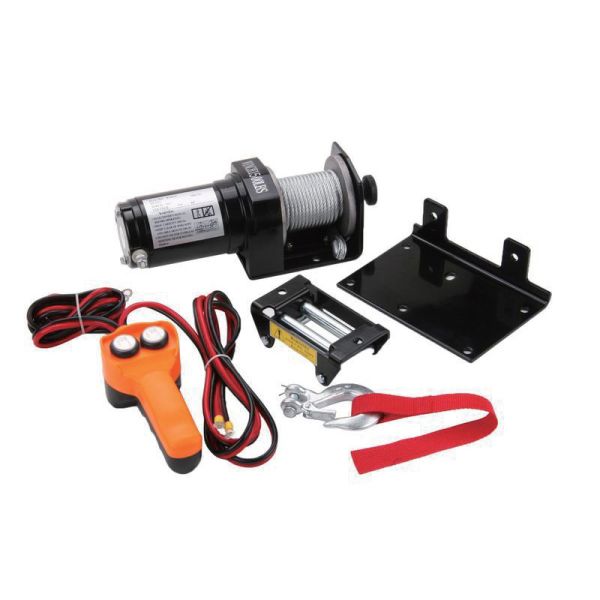
Centered on "portable efficiency + safety stability + easy installation & operation", the YD30-005 Mini ATV Electric Winch is optimized to address the pain points of small traction scenarios, such as "insufficient power, complex operation, and weak outdoor adaptability". Its core highlights are as follows:
Equipped with a 0.5kw (0.7hp) fully sealed permanent magnet motor, which reduces current consumption by 30% (working current ≤45A) compared to traditional series-wound motors. It can be driven by connecting to the ATV's 12V battery without causing battery depletion. For example, during ATV trapped rescue, continuous operation for 10 minutes only reduces the vehicle battery voltage by 0.3V, and the vehicle can still start normally after rescue. Meanwhile, the motor has an IP54 protection rating—rainwater and sediment cannot penetrate the motor interior during rainy outdoor operations, avoiding short-circuit damage.
Through the 190:1 planetary gear reduction mechanism, the motor torque is amplified by 190 times, with a theoretical pull force of 680kg—equivalent to the combined pull of 5 adults. In actual tests, it can easily pull a 120kg ATV (with driver) trapped in mud, and the steel cable retracts and releases at a stable speed (approx. 0.8m/min) without jitter or motor overload due to excessive load.
Built-in in-drum automatic braking system—once the steel cable is under tension, the braking mechanism locks the drum instantly whether powered on or off. For example, when lifting 300kg of camping supplies, if a sudden power outage occurs, the braking system locks within 0.1 seconds, keeping the supplies suspended in mid-air with no sliding risk. This solves the pain point of traditional manual winches that "require manual locking and are prone to errors".
- Material Protection: The aluminum alloy shell is lightweight and corrosion-resistant, showing no rust after 1 year of use in outdoor humid environments; the galvanized steel cable is wear-resistant—after 50 repeated tractions, the diameter wear is only 0.1mm, far lower than 0.3mm of ordinary steel wires;
- Safety Details: The power connection cable is equipped with a 15A fuse. If a short circuit or excessive current occurs, the fuse blows instantly to protect the motor and vehicle battery; the end of the steel cable is equipped with an anti-drop hook to prevent the cable from slipping off the drum during traction.
With an overall size of only 286×100×105mm and a weight of 7kg, it can be directly fixed to the ATV bumper using the bolts in the accessory kit (compatible with 76mm hole spacing brackets) without drilling or welding. The attached installation manual has clear graphics and text—even without mechanical installation experience, you can complete the installation in 20 minutes by following the steps.
Equipped with a wired control handle (3m cable length), you can stand at a safe distance (away from the traction area) to control the steel cable's "retraction" and "release" with one click, no manual crank required. For example, when pulling a trapped vehicle, the operator can stand 5 meters away to observe the traction status, avoiding injury from vehicle shaking—greatly improving operational safety and convenience.
Scenario Requirement: During outdoor off-roading, a 120kg ATV (with driver) is trapped in mud or sand. No other rescue equipment is available, so rapid traction rescue is needed. The equipment must be compatible with the ATV's 12V battery power supply and easy to install.
Operation Process:
- Installation & Fixing: Fix the winch to the ATV front bumper (76mm standard hole spacing) using the accessory bolts, connect the positive and negative terminals of the battery (red to positive, black to negative), and turn on the power switch;
- Traction Preparation: Hang the hook at the end of the steel cable on a fixed object ahead (e.g., tree, rock), control "cable release" via the wired handle, and adjust the steel cable to a tight state;
- Rescue Operation: Press the "cable retraction" button—the winch pulls the ATV with the 190:1 reduction ratio, and the trapped vehicle can be pulled out of the mud within 10 seconds. If a pause is needed, release the button, and the braking system automatically locks the steel cable;
Result: Compared to the traditional "manual pushing + shovel digging", the rescue time is shortened from 30 minutes to 2 minutes. One person can complete the operation without additional rescuers, adapting to complex outdoor terrains.
Scenario Requirement: A camping team needs to move a 300kg camping trailer (with gear) to the campsite and set up a large tent (requiring lifting a 50kg top pole). There is no power supply at the campsite, so the tool must rely on a 12V lithium battery for power and be compact and easy to carry.
Operation Process:
- Trailer Handling: Fix the winch to the campsite fixed pile, connect it to a portable 12V lithium battery, and hook the steel cable to the trailer's tow ring; press the "cable retraction" button—the winch slowly pulls the trailer to the designated position, and the automatic braking ensures the trailer does not reverse;
- Tent Setup: Fix the winch next to the tent bracket, tie the steel cable to the tent top pole, lift the pole to a height of 2.5m via the "cable retraction" function, power off after reaching the position, and the braking system locks the pole in place for easy installation and fixing;
- Storage & Carrying: After the operation, disassemble the winch (only 4 bolts need to be removed) and place it in the camping car trunk. The 7kg weight causes no carrying pressure;
Result: Replacing the traditional "manual handling + ladder assistance", the gear handling efficiency is increased by 80%, the tent setup time is shortened by 60%, adapting to outdoor scenarios without municipal power supply.
Scenario Requirement: A family courtyard needs to move a 200kg stone flower pot, and a farm needs to pull a 300kg small irrigation device. The site is narrow, so large machinery cannot be used. The tool must be lightweight, easy to operate, and suitable for scenarios such as concrete floors and dirt roads.
Operation Process:
- Courtyard Operation: Fix the winch to the courtyard wall bracket, hook the steel cable to the traction ring at the bottom of the flower pot, press the "cable retraction" button—slowly pull the flower pot to the target position. The 190:1 reduction ratio ensures stable movement without damaging surrounding plants;
- Farm Operation: Connect to the 12V battery of the farm's small tractor, install the winch on the tractor's rear bracket, and pull the 300kg irrigation device to the field. The automatic braking keeps it stable even on slopes, with no risk of the device sliding down;
Result: No multi-person collaboration is needed—one person can complete the heavy object movement, avoiding waist injuries caused by manual handling. The operation efficiency is increased by 75%, adapting to small-scale operations in families and farms.
A1: It can pull easily with no overload risk. When an ATV is trapped in mud, the actual resistance is approximately 1.5-2 times its own weight (the resistance of a 120kg ATV is approx. 180-240kg), which is far lower than the 680kg rated pull force. Meanwhile, the motor is equipped with overload protection—if the pull force exceeds 120% of the rated value (i.e., 816kg), the current will trigger the built-in protection mechanism, and the motor will stop working automatically to avoid burnout. In actual tests, when pulling a 120kg trapped vehicle, the motor working current is only 30A (lower than the maximum current of 45A), handling the load easily.
A2: No short circuit will occur—the protection rating meets the needs of rainy weather use. The motor adopts an IP54 protection design, with waterproof rubber rings at the shell joints—rainwater and sediment cannot penetrate the motor interior; the power connection terminals are waterproof, and after connection, they can be wrapped with insulating tape (included in the accessory kit) to further isolate rainwater. However, note that the winch should not be completely submerged in water (e.g., rescue in deep water areas). After use in rainy weather, wipe the shell and wiring with a dry cloth to avoid long-term rust caused by residual moisture.
A3: Holes can be drilled for adaptation under professional guidance—it does not affect core functions, but pay attention to load-bearing safety.
- Drilling Requirements: If the bracket material is steel (thickness ≥5mm) or aluminum alloy (thickness ≥8mm), an 8.5mm drill bit can be used to drill holes on the bracket (the hole spacing must be measured accurately, with an error ≤2mm) to ensure the winch bears force evenly after installation;
- Safety Note: Avoid drilling holes on thin iron sheets (thickness <3mm) brackets—otherwise, the bracket is prone to deformation during traction, causing the winch to fall off; it is recommended to add washers at the holes after drilling to enhance load-bearing capacity;
- Alternative Solution: If you are not good at drilling, you can purchase a universal winch mounting bracket (commercially available, compatible with 76mm-100mm hole spacing) and fix it directly to the original bracket without modifying the equipment.
A4: Looseness and tangling can be adjusted by rewinding, and daily maintenance should focus on rust prevention and lubrication.
- Adjustment Method: ① Press the "cable release" button to fully release the steel cable; ② Ensure there is no debris on the winch drum, press the "cable retraction" button, and gently guide the steel cable by hand to make it wind evenly on the drum (avoid overlapping accumulation). Keep the steel cable tight during retraction to solve the problem of looseness and tangling;
- Daily Maintenance: Wipe the surface dust of the steel cable with a dry cloth every month, and apply special steel cable grease (avoid using engine oil, which easily absorbs sediment); if the steel cable has slight rust, gently polish it with fine sandpaper (1000 grit or above) and then apply grease. If the rust is severe (with ≥3 broken wires), replace the steel cable in time to avoid breaking risks.