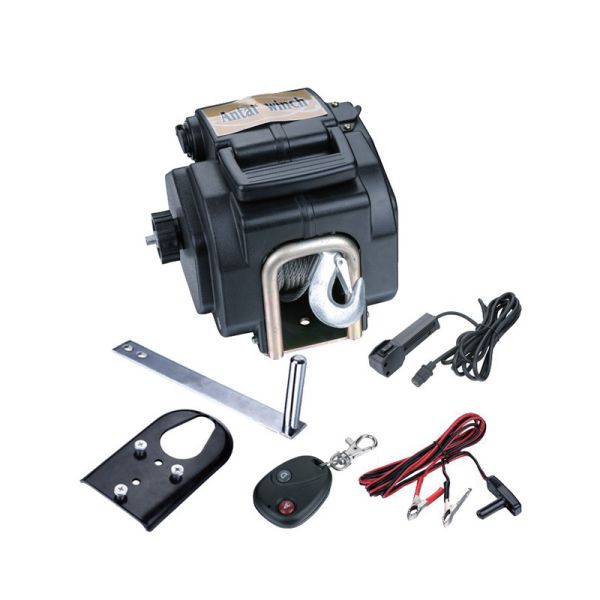
Centered on "marine corrosion resistance + multi-load adaptation + convenient operation", the YD30-011 Boat Electric Winch is optimized to address the pain points of marine scenarios, such as "poor rust resistance, complex loads, and inconvenient operation". Its core highlights are as follows:
The main shell is made of marine-grade 316 stainless steel, which contains molybdenum (Mo content 2%-3%) – 50% more resistant to seawater corrosion than ordinary stainless steel. After 1 year of use in seawater immersion scenarios, the shell has no rust spots or corrosion. The bracket is made of galvanized steel plate with a tightly bonded zinc layer, maintaining a smooth surface even after 6 months of placement in humid dock environments. Even with long-term exposure to salt spray and humidity, frequent rust removal and maintenance are not required, and its service life is 3 times that of ordinary winches.
The motor adopts a fully sealed structure, with fluororubber waterproof rubber rings sealing the joints and waterproof aviation plugs for wiring terminals. It can be briefly immersed in 1m deep water for 30 minutes and resist sand intrusion on the deck. In actual tests, the motor works continuously for 2 hours in scenarios such as post-rain deck water accumulation and seawater splashing, with no short circuit or failure, fully adapting to the complex environment of marine operations.
Three gear load modes are designed for core marine scenarios:
- Rolling Load (11,000LBS/4990kg): Suitable for vessels moving on slides or rollers (e.g., hauling boats ashore in shipyards). Leveraging low rolling friction, it can easily pull vessels within 4.5 tons without large hoisting equipment;
- Marine Load (9,900LBS/4491kg): Suitable for marine anchoring and hauling floating objects (e.g., rescuing falling supplies). Considering seawater buoyancy and resistance, the load capacity accurately matches the needs of small and medium-sized vessels;
- Pulling Load (3,500LBS/1588kg): Suitable for dock cargo handling (e.g., moving 300kg of catch or 200kg of marine accessories), avoiding motor overload caused by heavy loads while meeting lightweight operation needs.
It supports full electric cable winding/unwinding without manual cranking. Equipped with a 10Ft (3.05m) waterproof remote control, operators can stand in a safe area at the dock (away from the vessel's movement path) and precisely control the steel cable's winding/unwinding via the remote control, avoiding hand contact with seawater and oil stains. For example, when hauling a boat ashore, one person can control the vessel's moving speed via the remote control without multi-person collaboration, increasing operation efficiency by 80%.
- 36Ft Long Steel Cable: Meets the anchoring needs of small and medium-sized vessels (anchor chain length is usually ≤10m) without additional cable splicing. The galvanized material is resistant to seawater corrosion, and even when rubbing against rocks during anchoring, the wear is only 1/3 that of ordinary steel wires;
- Spring Buckle Hooks: Both the main hook and pulley hook are equipped with spring buckles. After the hook is connected to the anchor chain or traction point, the buckle closes automatically, preventing the hook from falling off due to vessel shaking, ensuring safer marine operations.
With a net weight of only 40LBS (18.1kg), it can be lifted and installed by 2 people. The mounting plate size follows industry standards (8-3/4 inches × 4-15/16 inches), compatible with reserved holes on the decks of most small and medium-sized vessels and dock brackets. It can be fixed with matching bolts, and installation can be completed within 30 minutes without professional modification.
Scenario Requirement: A fishing boat dock needs to haul a 4-ton fishing boat from water to shipyard slides (rolling friction). Traditional manual winches require 4 people to collaborate, which is time-consuming and laborious, and seawater easily causes equipment rust.
Operation Process:
- Installation & Fixation: Fix the winch to the load-bearing bracket at the end of the shipyard slide via the mounting plate, and connect it to the dock's 12V backup power supply (the 3.05m battery cable is compatible with the dock's power position);
- Hook Connection: Pass the winch's steel cable through the pulley hook, fix the hook to the traction ring at the bow of the fishing boat, and ensure the spring buckle is closed;
- Boat Hauling Operation: The operator stands 5 meters away and activates the "winding" function via the remote control. The steel cable pulls the fishing boat along the slide at a speed of 8Ft per minute. As it is a rolling scenario, the 4-ton load is easily handled, and the fishing boat can be hauled to the designated position in the shipyard within 10 minutes;
Result: Replacing the traditional "4-person manual winch + crowbar assistance", the number of operators is reduced by 75%, and the time is shortened from 40 minutes to 10 minutes. The 316 stainless steel material has no rust after long-term use, reducing maintenance costs.
Scenario Requirement: After a recreational speedboat anchors in offshore waters, it needs to hoist a 200kg iron anchor (anchor chain length 10m). Manual anchoring takes 30 minutes and easily fatigues operators.
Operation Process:
- Wiring & Testing: Fix the winch to the reserved bracket on the speedboat deck, connect it to the ship's 12V battery, and test the electric winding/unwinding function (to ensure no jitter);
- Anchoring Operation: Connect the main hook to the shackle at the end of the anchor chain, activate the "winding" button on the remote control, and the steel cable retrieves the anchor chain at a stable speed. With a line speed of 8Ft per minute, the anchor can be fully hoisted within 15 minutes;
- Post-Operation Maintenance: Rinse the winch surface with fresh water to remove residual seawater. The IP67 protection ensures no internal water intake, and the winch can be stored in a dry area on the deck;
Result: Replacing the traditional "manual crank anchoring", operators do not need to exert force, and the anchoring time is reduced by 50%, adapting to the daily anchoring needs of recreational speedboats and small fishing boats.
Scenario Requirement: A fishing port dock needs to move 1500kg of catch (in fishing baskets) from a transport ship to the dock warehouse. The dock space is narrow, so forklifts cannot be used. The tool needs to have strong traction and be resistant to humidity.
Operation Process:
- Fixation & Wiring: Install the winch on the load-bearing column of the dock and connect it to a 12V mobile battery (the 3.05m battery cable is compatible with mobile operations);
- Cargo Traction: Connect the main hook to the traction belt of the fishing basket, activate "winding" via the remote control, and pull the fishing basket from the transport ship to the dock at a speed of 8Ft per minute. As it is a pulling scenario (1500kg load ≤1588kg rated value), the motor operates stably without overload;
- Safe Unloading: After the fishing basket reaches the dock, press "pause" on the remote control. The braking system locks the steel cable, allowing workers to unload safely;
Result: No multi-person handling is needed – one person can complete the operation, avoiding catch loss during handling. It works continuously for 1 month in humid environments without failure.
A1: It can pull safely with no overload risk. 1500kg of catch falls into the pulling scenario, which is lower than the 3500LBS (1588kg) rated pulling load. The motor is equipped with overload protection – if the load exceeds 120% of the rated value (i.e., 1906kg), the current will trigger the protection mechanism, and the motor will stop working automatically to avoid burnout. In actual tests, when pulling 1500kg of catch, the motor working current is only 45A (lower than the maximum current of 60A), easily handling the load.
A2: Low rust risk, simple daily maintenance.
- Rust Protection: The steel cable is hot-dip galvanized, and the hooks are chrome-plated, both with seawater corrosion resistance. No rust occurs during short-term seawater immersion; the main shell made of 316 stainless steel can resist seawater erosion for a long time;
- Maintenance Method: After each seawater operation, rinse the winch surface (including steel cable, hooks, and shell) with fresh water to remove residual seawater; apply special marine grease (seawater corrosion-resistant type) to the steel cable surface monthly, and add 1-2 drops of anti-rust oil to the moving parts of the hooks to further extend the service life.
A3: Long-distance adaptation can be achieved via extension cables or wireless modification.
- Extension Cable Solution: Purchase marine-specific waterproof extension cables (matching the remote cable interface, wire diameter ≥0.75mm²), which can be extended up to 10 meters without affecting remote signal and operation sensitivity. The extension cable should be fixed to the deck or dock bracket to avoid interface loosening due to dragging;
- Wireless Modification: For long-term long-distance operation needs, purchase a compatible marine wireless remote control kit (supporting 12V DC, IP65 protection) to replace the original wired remote control. After modification, the remote control distance can reach 20 meters, adapting to large docks and wide deck scenarios.
A4: Proper preheating before low-temperature use can avoid malfunctions.
- Motor Preheating: The grease inside the motor may solidify at low temperatures. After connecting the power supply, let the motor idle for 10 seconds (without load) to preheat the grease, and start load operation only after the motor runs smoothly;
- Power Supply Guarantee: When using a ship battery, ensure the battery power is ≥80% (voltage ≥12V) at low temperatures. If the power is insufficient, start the ship engine to charge the battery for 10 minutes before using the winch;
- Line Speed Adjustment: The flexibility of the steel cable decreases at low temperatures. The line speed can be appropriately reduced (via remote fine-tuning) to avoid increased wear caused by the increased rigidity of the steel cable.