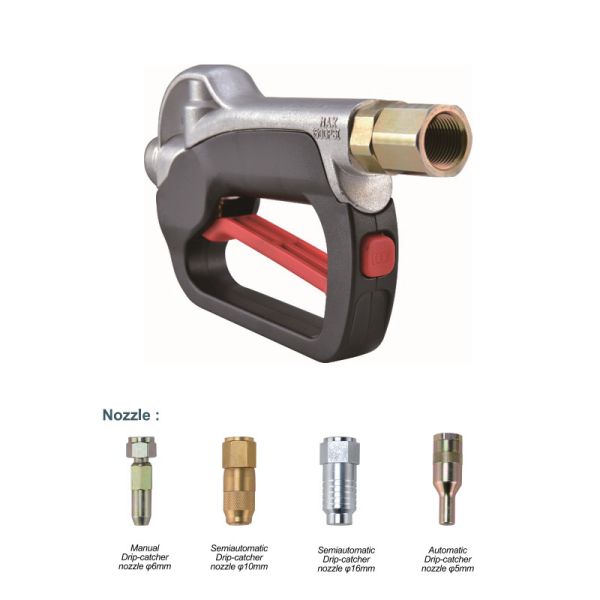
This Aluminum Alloy Grip Drip-Catcher Nozzle Series solves common fluid dispensing pain points: "dripping waste, limited flow control, and uncomfortable handling". With "4 nozzle types + aluminum alloy ergonomic grip + F1/2" swivel joint" as core strengths, it caters to diverse precision and flow needs:
- Built-In Drip-Catcher Mechanism: All nozzles feature a drip-catcher that traps residual fluid after dispensing, preventing drips on floors, machinery, or vehicles. This reduces fluid waste by 15% compared to standard nozzles and keeps workspaces clean—critical for automotive workshops and industrial facilities.
- Size-Specific Precision: The φ5mm automatic nozzle (low-flow) and φ6mm manual nozzle (precision) are ideal for small-volume, accurate dispensing (e.g., topping up engine oil), while the φ10mm/16mm semiautomatic nozzles handle medium-to-high flow tasks (e.g., diesel refueling).
- Lightweight & Corrosion-Resistant: Aluminum alloy grip weighs 30% less than steel alternatives, reducing hand fatigue during long sessions (e.g., refueling a fleet of trucks). It resists corrosion from fluids like diesel and antifreeze, ensuring a 5+ year service life.
- Ergonomic Design & Lever Lock: The non-slip grip fits most hand sizes, and the integrated lever locking button secures the trigger in place for continuous dispensing—no need to hold the trigger manually, improving efficiency for high-volume tasks.
- 360° Rotation: The F1/2" swivel inlet joint allows the nozzle to rotate freely, preventing hose kinking and making it easy to reach tight spaces (e.g., vehicle fuel tanks in narrow engine bays).
- Universal Compatibility: Fits most standard fluid hoses and pumps (common in automotive, industrial, and agricultural settings), eliminating the need for custom adapters.
Scenario Requirement: A car repair shop tops up engine oil (500ml-2L per vehicle) for 20 cars daily. Precision is critical to avoid overfilling, and drips must be prevented to keep vehicles clean.
Operation Process:
- Setup: Connect the φ5mm automatic nozzle to the oil pump via the F1/2" swivel joint; lock the lever if continuous flow is needed;
2. Dispensing: Insert the nozzle into the engine oil fill port; trigger to dispense (auto-shutoff prevents overfilling); the drip-catcher traps residual oil after removal;
3. Efficiency: 20 cars serviced in ~30 minutes; no oil drips on vehicle exteriors or workshop floors;
4. Comfort: Aluminum alloy grip reduces hand fatigue during repeated use.
Effect: Precision auto-shutoff avoids overfilling; drip-catcher maintains cleanliness.
Scenario Requirement: A logistics center refuels 15 delivery trucks (each needing 60L diesel) weekly. High flow and continuous dispensing are needed to save time, and drips must be avoided to prevent slips.
Operation Process:
- Setup: Attach the φ16mm semiautomatic nozzle to the diesel tank pump; use the lever locking button for continuous flow;
2. Refueling: Insert the nozzle into the truck’s fuel tank—high-flow φ16mm diameter fills 60L in ~5 minutes per truck;
3. Safety: Drip-catcher prevents diesel drips on the ground (reducing slip risks); swivel joint avoids hose kinking when moving around trucks;
4. Efficiency: 15 trucks refueled in ~75 minutes; ergonomic grip reduces worker fatigue.
Effect: High flow meets fleet needs; drip-catcher enhances workplace safety.
Scenario Requirement: A manufacturing plant fills antifreeze (10-15L per machine) for 8 industrial machines monthly. The plant needs a nozzle that works with cold temperatures (-10℃) and avoids antifreeze waste.
Operation Process:
- Setup: Connect the φ10mm semiautomatic nozzle to the antifreeze pump; the aluminum alloy grip remains comfortable to hold in cold conditions;
2. Filling: Use the lever lock for steady flow—φ10mm diameter fills 15L in ~3 minutes per machine;
3. Cleanliness: Drip-catcher traps residual antifreeze, preventing damage to machine components; swivel joint reaches tight fill ports;
4. Durability: Nozzle withstands -10℃ temperatures without material brittleness.
Effect: Cold-resistant design suits plant conditions; medium flow balances speed and precision.
A1: Auto-shutoff failure is usually due to a clogged sensor or misalignment. Solutions: 1) Clean the Sensor: The automatic nozzle has a small flow sensor near the tip—wipe it with a clean cloth to remove fluid residue (clogs block sensor detection); 2) Check Nozzle Alignment: Ensure the nozzle tip is fully inserted into the tank (partial insertion disrupts sensor function); 3) Adjust Trigger Pressure: Lightly squeeze the trigger (over-squeezing may override the auto-shutoff). These steps restore auto-shutoff functionality.
A2: No. Gasoline is highly flammable, and the nozzle’s materials (including seals and grip components) are not designed to resist gasoline degradation. Additionally, gasoline vapors pose a fire risk with standard nozzles (no explosion-proof features). Use only for diesel, oil, antifreeze, or other non-flammable, non-corrosive fluids—gasoline use will void the warranty and cause safety hazards.
A3: Stiff swivel joints are caused by dirt or lack of lubrication. Fixes: 1) Clean the Joint: Disconnect the nozzle from the hose; wipe the F1/2" swivel joint with a cloth to remove dirt or fluid buildup; 2) Lubricate: Apply a small amount of oil-resistant lubricant (e.g., silicone-based lubricant) to the joint’s rotating parts; 3) Test Rotation: Reconnect the hose and rotate the nozzle to ensure smooth movement. Repeat every 3 months for maintenance.
A4: Choose based on flow needs and automation preference: 1) Low-Flow Precision (50ml-5L): φ5mm automatic nozzle (auto-shutoff) or φ6mm manual nozzle (manual control)—ideal for engine oil topping-up; 2) Medium-Flow (5L-30L): φ10mm semiautomatic nozzle—suits antifreeze filling or small-vehicle diesel refueling; 3) High-Flow (30L+): φ16mm semiautomatic nozzle—best for truck fleet diesel refueling or large machinery lubricant filling.