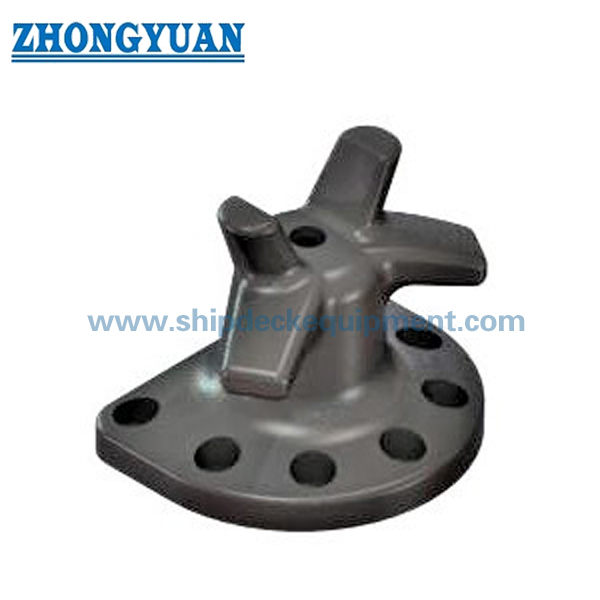
Deck Welded Double Cross Bitt Bollard for Ship Mooring | GB/T 554 Type DH DN200–300
Product Overview
The GB/T 554 Type DH deck welded double cross bitt bollard is a welded steel-pipe mooring bollard with a high welded base for ship deck installation. According to the corrected size clarification, Type DH is the DN200–DN300 deck-welded configuration, mainly used for larger vessel mooring stations where direct welding to the deck structure and stronger load transfer into deck reinforcement are required.
Compared with the Type DL bolted-base version for below-DN200 sizes, Type DH focuses on welded deck installation, bevel-prepared fabrication joints, and a high base interface. The horizontal cross pipe is continuous through the double-bitt structure, which supports strength continuity and load transfer. Pipe-to-base joints and base-to-deck welding should follow the project drawing and WPS; rope-contact welds should be ground smooth to reduce damage to mooring ropes.
Quick Specifications
Main Technical Parameters
Main webpage dimensions for GB/T 554 Type DH deck welded double cross bitt bollard, limited to DN200–DN300. Dimensions are in mm unless otherwise stated.
| Nominal Diameter | SWL (kN) | A(mm) | B(mm) | D / D1(mm) | H(mm) | L(mm) | Approx. Weight (kg) |
| DN200 | 72 | 600 | 360 | 203 / 225 | 795 | 960 | 181 |
| DN250 | 105 | 750 | 450 | 245 / 280 | 855 | 1200 | 310 |
| DN300 | 185 | 900 | 540 | 299 / 330 | 1160 | 1440 | 576 |
Note: Deck weld groove, weld size, WPS, NDT scope, and deck reinforcement are project-specific and should be confirmed before production.
Selection & Inquiry Guide
Step 1: Confirm GB/T 554 Type DH and nominal diameter DN200–DN300 according to SWL and vessel mooring layout.
Step 2: Confirm deck welded installation, base height, available deck space, rope lead direction, and surrounding reinforcement.
Step 3: Confirm welding requirement: groove preparation, deep-penetration weld detail, WPS, weld inspection, and class witnessing if required.
Step 4: Confirm material requirement: mild steel, C-Mn steel, stainless steel, or special steel for ice-class projects if specified.
Step 5: Confirm surface treatment: shop primer, final paint system, galvanizing, mirror / satin polished stainless finish, or other specified finish.
Step 6: Confirm certificate scope before order: maker certificate, material certificate, class certificate, witness inspection, or project-specific approval.
Step 7: Provide quantity, destination, required delivery time, installation drawing, deck foundation drawing, and reference photos if available.
Structure
High welded base | Deck weld interface | Two vertical pipe bitts | Continuous horizontal cross pipe | Bevel-prepared welded joints | Smooth ground rope-contact areas | Shop primer or specified finish
Deck Welding, Fabrication & Load-Transfer Advantages
Custom Attributes
How It Works
Mooring rope is led to the bollard → Rope is turned around the double-cross bitt structure → Continuous cross pipe and smooth contact surfaces support rope load transfer → Welded high base transfers local force into the reinforced deck structure → Final inspection and coating are completed according to project requirement
Applications
Cargo ships | Tankers | Bulk carriers | Container vessels | Larger workboats | Deck mooring stations | Newbuilding welded deck projects | Replacement of DN200–DN300 welded-base bollards
Certifications & Advantages
Certificates can be arranged according to project requirement, inspection scope, material traceability, and class society approval procedure.
Certification: CCS, NK, BV, ABS, DNV, LR, KR, IRS, RS, RINA, CRS, Makers Test Certificate.
Drawing & Photos


FAQ
Q1: Why should Type DH have a separate webpage from Type DL?
A1: Type DH is the deck welded high-base version covering DN200–DN300 according to the corrected clarification. Type DL is the bolted flat-base version for nominal diameters below DN200. The installation method, size range, photo requirements, and SEO intent are different.
Q2: What welding information should be confirmed for Type DH?
A2: Confirm groove preparation, weld size, WPS, weld inspection method, deck reinforcement, and whether class witness inspection is required. These items should follow the project drawing rather than being assumed from the standard table alone.
Q3: How should the correct DH nominal diameter be selected?
A3: Select DN200, DN250, or DN300 by required SWL, vessel mooring arrangement, rope lead direction, deck space, deck reinforcement, and class requirement. For replacement projects, provide the existing bollard drawing or photos to avoid selecting the wrong base type.