Wide Base Double Bitt Mooring Bollard | GB/T 554-2008 Type A for Ship Deck Mooring
Product Overview
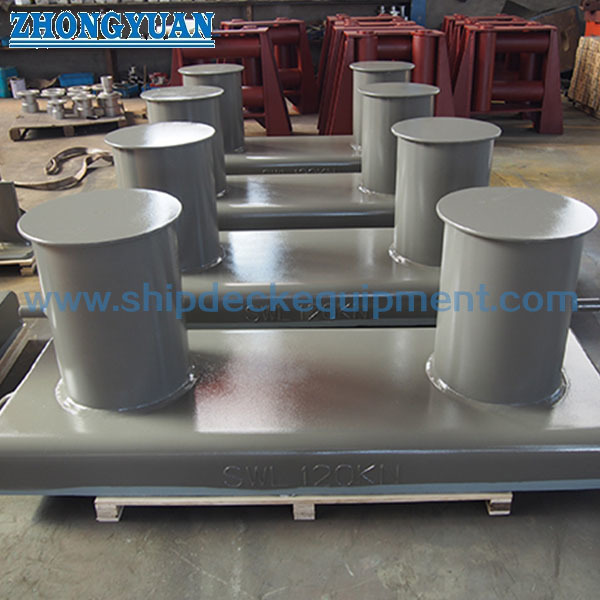
The GB/T 554-2008 Type A wide base double bitt mooring bollard is a deck-welded ship mooring fitting used for securing mooring lines on vessel decks. This Type A configuration uses two vertical bitts on a broad base, allowing the mooring line to be turned around the bollard while the base transfers the mooring reaction into the welded deck structure.
For fabricated steel construction, the bitts can be made from steel pipe or from steel plate rolled into pipe and then welded. The pipe-to-base joint and deck welding interface should be prepared with bevel grooves and deep-penetration welding according to the project drawing. Weld seams and rope-contact areas should be ground and dressed smooth to reduce the risk of damaging mooring ropes during operation.
Quick Specifications
• Product type: Wide base double bitt mooring bollard → deck-welded mooring point for ship deck mooring arrangements.
• Standard and type: GB/T 554-2008 Type A → reference for Type A wide base bollard dimensions, SWL range, and standard designation.
• Nominal diameter range: 100 to 800 mm → covers small deck fittings up to large ship mooring positions.
• Standard SWL range: 29 to 981 kN → select by vessel mooring calculation, rope arrangement, and project drawing; do not mix with rope breaking load.
• Construction: fabricated steel pipe or rolled steel plate pipe → pipe seam and rope-contact areas should be dressed smooth after welding.
• Base form: wide welded base → deck reinforcement, weld detail, and line lead angle should be confirmed before production and installation.
• Surface treatment: Sa 2.5 blasting + one layer epoxy shop primer as reference → final coating, galvanizing, polished stainless steel, or other finish follows project requirement.
• Approximate weight range: 19 to 3,071 kg → useful for handling, shipyard installation planning, packing, and freight estimation.
Main Technical Parameters
Main webpage parameters for GB/T 554-2008 Type A wide base double bitt mooring bollard. Dimensions are in mm unless otherwise stated. The table is simplified for website selection; detailed fabrication dimensions and welding details should be checked against the official standard drawing and project-approved installation drawing.
|
Nominal Dia. (mm) |
Standard SWL (kN) |
Bitt D / D1 (mm) |
Height H / H1 (mm) |
Wide Base A × B × L (mm) |
Approx. Weight (kg) |
|---|---|---|---|---|---|
| 100 | 29 | 114 / 145 | 196 / 150 | 250 × 165 × 415 | 19 |
| 125 | 39 | 140 / 180 | 246 / 190 | 315 × 195 × 540 | 29 |
| 160 | 49 | 168 / 210 | 316 / 250 | 400 × 225 × 670 | 45 |
| 200 | 78 | 219 / 270 | 378 / 300 | 500 × 290 × 860 | 80 |
| 250 | 118 | 273 / 335 | 470 / 380 | 630 × 360 × 1,065 | 141 |
| 315 | 196 | 325 / 390 | 597 / 480 | 800 × 430 × 1,300 | 264 |
| 355 | 255 | 351 / 420 | 663 / 530 | 890 × 480 × 1,475 | 358 |
| 400 | 314 | 402 / 480 | 749 / 600 | 1,000 × 550 × 1,630 | 499 |
| 450 | 382 | 450 / 545 | 841 / 680 | 1,130 × 620 × 1,840 | 680 |
| 500 | 451 | 508 / 610 | 928 / 750 | 1,250 × 690 × 2,040 | 911 |
| 560 | 549 | 560 / 670 | 1,025 / 830 | 1,380 × 750 × 2,240 | 1208 |
| 630 | 686 | 610 / 730 | 1,152 / 940 | 1,570 × 820 × 2,510 | 1601 |
| 710 | 804 | 712 / 840 | 1,291 / 1,050 | 1,750 × 960 × 2,840 | 2252 |
| 800 | 981 | 813 / 940 | 1,480 / 1,200 | 2,000 × 1,100 × 3,240 | 3071 |
Selection & Inquiry Guide
Step 1: Confirm GB/T 554-2008 Type A wide base double bitt mooring bollard and nominal diameter from 100 to 800 mm.
Step 2: Confirm required standard SWL, mooring line direction, rope size, line lead angle, and wrapping arrangement around the bitts.
Step 3: Confirm installation position, deck reinforcement, bevel groove requirement, pipe-to-base weld detail, and shipyard welding responsibility.
Step 4: Confirm material requirement: C-Mn steel, stainless steel, or special steel for low-temperature / ice-class application if specified.
Step 5: Confirm surface treatment: shop primer, complete marine coating system, galvanized finish, polished stainless steel, or customer-specified finish.
Step 6: Confirm certificate scope before quotation: maker certificate, material certificate, class certificate, welding inspection, or witness inspection according to project requirement.
Step 7: Provide quantity, application vessel type, delivery destination, required delivery time, GA drawing, deck installation drawing, or reference photos if available.
Structure
Two vertical steel pipe bitts | Wide welded base plate | Bitt cap / cover plate | Stiffeners according to size | Bevelled pipe-to-base welded joint | Deck welding interface | Ground smooth rope-contact surface | Shop primer or specified final coating
Fabrication, Welding & Engineering Advantages
• The Type A wide base design provides a larger deck contact area than inserted or simple bollard arrangements, helping the shipyard transfer mooring force into the reinforced deck structure.
• Fabricated steel pipe or rolled steel plate pipe construction is suitable for controlled welding, dimensional adjustment, and project-specific material selection.
• Pipe-to-base joints can be prepared with bevel grooves and deep-penetration welds according to the project drawing, supporting stronger welded continuity at the main load-transfer area.
• Longitudinal pipe seams, cap edges, and external rope-contact areas should be ground and dressed smooth after fabrication to reduce sharp local contact with mooring ropes.
• The standard size range from 100 to 800 mm allows shipyards to match bollard size with vessel mooring layout, SWL requirement, deck space, and handling weight.
• The GB/T 554-2008 standard information also supports material confirmation, fabrication checking, appearance inspection, marking, and corrosion protection planning during procurement.
• For classed newbuilding or replacement projects, material traceability, welding procedure, inspection scope, and deck reinforcement should be confirmed before production instead of assumed.
Custom Attributes
• Standard: GB/T 554-2008 → used when the shipyard or owner specification requires Chinese standard marine mooring bollards.
• Type: Type A wide base double bitt → suitable for deck-welded mooring stations requiring a broad base footprint.
• Nominal Diameter: 100 / 125 / 160 / 200 / 250 / 315 / 355 / 400 / 450 / 500 / 560 / 630 / 710 / 800 mm → select by SWL, vessel drawing, and installation space.
• Standard SWL: 29 to 981 kN → should be treated as bollard safe working load from the supplied standard table, not as rope breaking load.
• Construction: Steel pipe or rolled steel plate pipe welded assembly → final pipe source and seam treatment should be confirmed before production.
• Welding Requirement: Bevel preparation and deep-penetration welding as specified → pipe-to-base weld and deck weld details should follow project drawing and WPS.
• Rope Protection: Ground smooth weld seam and contact surface → helps reduce rope abrasion at the bollard body and cap areas.
• Surface Treatment: Sa 2.5 blasting + epoxy shop primer as reference → final coating or galvanizing follows the vessel painting specification.
• Certificate Requirement: Available according to order scope → class approval, witness inspection, and material certificate should be confirmed before quotation.
How It Works
Mooring line approaches the deck bollard → Rope is turned around the two bitts according to the mooring arrangement → Load is transferred from the bitts to the wide welded base → Deck welds and reinforced deck structure carry the mooring reaction → Inspection and final coating are completed according to project requirement
Applications
Cargo ships | Tankers | Bulk carriers | Container vessels | Tugboats | Barges | Workboats | Ship deck mooring stations | Newbuilding projects | Replacement and repair projects
Certifications & Advantages
Certificates can be arranged according to project requirement, inspection scope, material traceability, welding requirement, and class society approval procedure.
Certification: CCS, NK, BV, ABS, DNV, LR, KR, IRS, RS, RINA, CRS, Makers Test Certificate.
Drawing & Photos


FAQ
Q1: How should the correct GB/T 554 Type A bollard size be selected?
A1: Select the nominal diameter according to the required bollard SWL, vessel mooring arrangement, rope size, line lead angle, deck space, and shipyard installation drawing. Deck reinforcement and welding details should be checked by the vessel designer or shipyard.
Q2: Can this Type A bollard be fabricated from rolled steel plate pipe instead of standard steel pipe?
A2: Yes, this can be discussed when permitted by the project specification. The pipe may be made from steel pipe or steel plate rolled into pipe and welded, but the longitudinal seam and rope-contact area should be dressed smooth, and material / welding approval should be confirmed before production.
Q3: Is the SWL in the table the same as rope breaking load?
A3: No. The table SWL is the bollard safe working load used for mooring selection. Rope MBL, mooring line design load, test load, and deck structural design should not be mixed with bollard SWL unless the project specification clearly defines the relationship.