Marine Two Roller Chock | How to Select Roller Chock for Ship Mooring
Product Overview
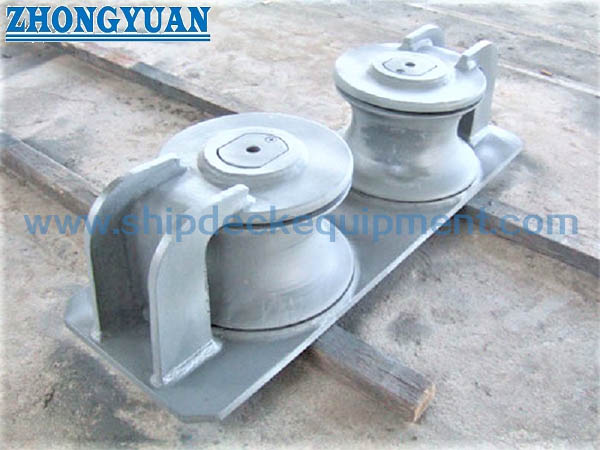
Marine two roller chock is designed to guide mooring ropes through a fixed opening while reducing friction and controlling rope direction.
This page provides both product information and a practical selection guide to help engineers and buyers choose the correct model based on rope size, load and installation conditions.
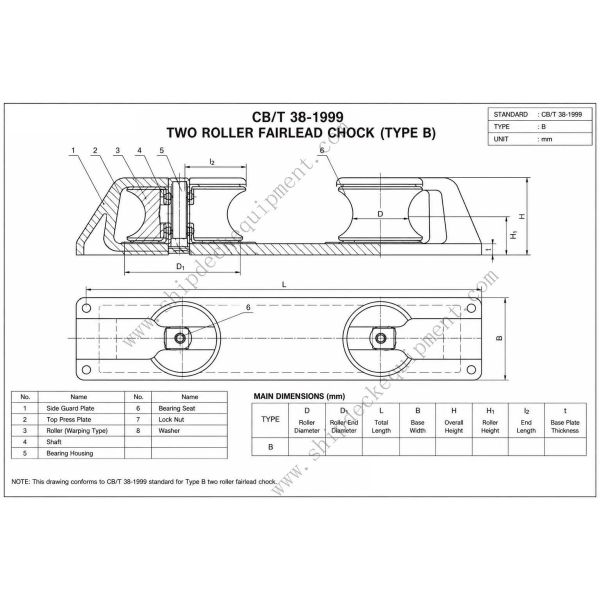
The product follows updated standards such as CB/T 38-1999, while maintaining compatibility with CB39-66 for replacement projects.
Quick Specifications
How to Select a Two Roller Chock
Step 1 – Confirm Rope Diameter → Select based on mooring rope size
Step 2 – Confirm Rope Breaking Load (MBL) → Match chock capacity
Step 3 – Determine Installation Type → Welded for newbuild / Bolt-on for replacement
Step 4 – Check Rope Direction → Straight or angle guidance
Step 5 – Confirm Certification → CCS, ABS, DNV, etc.
Quick Selection Example
If rope diameter is 24 mm → Select nominal size 200
If rope MBL is around 246 kN → Match with table values
New vessel → Choose welded base
Replacement → Choose bolt-on type
Main Technical Parameters (CB/T 38-1999 Double Roller Chock)
Nominal | Rope MBL (kN) | Wire Rope Dia | PP Rope Dia | L | B | H | D | Weight (kg) |
| 75 | 23.3 | 7.4 | 12 | 400 | 150 | 116 | 75 | 18 |
| 100 | 52.5 | 11 | 18 | 530 | 200 | 147 | 100 | 41 |
| 125 | 93.4 | 15 | 24 | 650 | 250 | 173 | 125 | 76 |
| 150 | 145.8 | 18.5 | 30 | 780 | 300 | 201 | 150 | 132 |
| 200 | 246.6 | 24 | 40 | 1100 | 370 | 251 | 200 | 264 |
| 250 | 373.6 | 30 | 48 | 1240 | 470 | 300 | 250 | 498 |
| 300 | 472.7 | 33.5 | 56 | 1480 | 550 | 353 | 300 | 798 |
| 350 | 583.5 | 37.5 | 64 | 1690 | 640 | 386 | 350 | 1134 |
Load & Selection Basis
The Break Load shown in the table refers to the maximum breaking load (MBL) of the applicable mooring rope, not the direct SWL of the chock.
For engineering reference, the safe working load (SWL) can be estimated as:
SWL ≈ Rope MBL ÷ Design Safety Factor
Typical safety factor ranges from 1.5 to 2.0 depending on standards and operating conditions.
The chock is designed to withstand loads equal to or higher than the rope breaking strength, ensuring structural integrity under extreme conditions.
Mounting Method (Standard Evolution)
CB39-66: Bolt-on installation → suitable for retrofit projects.
CB/T 38-1999: Welded base → improved load transfer and structural strength.
Engineering Advantage
Welded base design provides continuous load transfer and reduces stress concentration.
Frame structure allows easier maintenance and ensures smooth roller rotation.
Selection Guide
Step 1 – Select rope diameter
Step 2 – Confirm rope breaking load (MBL)
Step 3 – Match nominal size
Step 4 – Confirm installation method
Structure
Two rollers | Frame support | Welded base | Free rotation system
Custom Attributes
Inquiry Guide
Provide rope diameter, breaking load, installation location and certification requirements.
How It Works
Rope passes through chock → rollers rotate → friction reduced → smooth guidance → extended rope life.
Applications
Ship bow | Ship stern | Bulwark | Deck edge mooring
Certifications & Advantages
Certification: CCS, NK, BV, ABS, DNV, LR, KR, IRS, RS, RINA, CRS, Makers Test Certificate
Drawing & Photos
General arrangement drawing and product photos

Ordering
Specify: size, material, mounting method, coating, certification
FAQ
Q1: Is Break Load the SWL?
A: No, Break Load is the rope MBL. SWL is derived using safety factor.
Q2: Can you supply CB39-66 type?
A: Yes, for replacement projects.
Q3: Do rollers rotate?
A: Yes, freely rotating to reduce friction and wear.