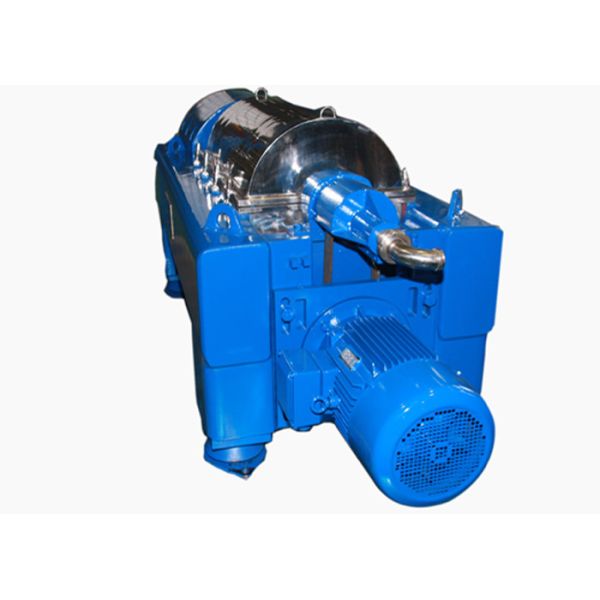
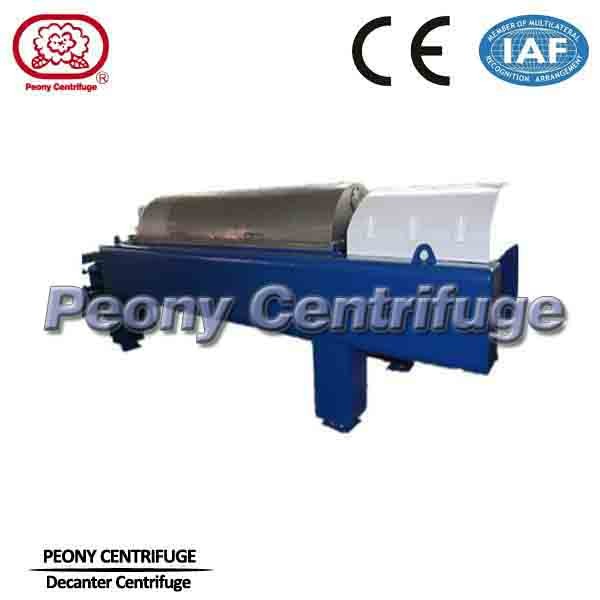
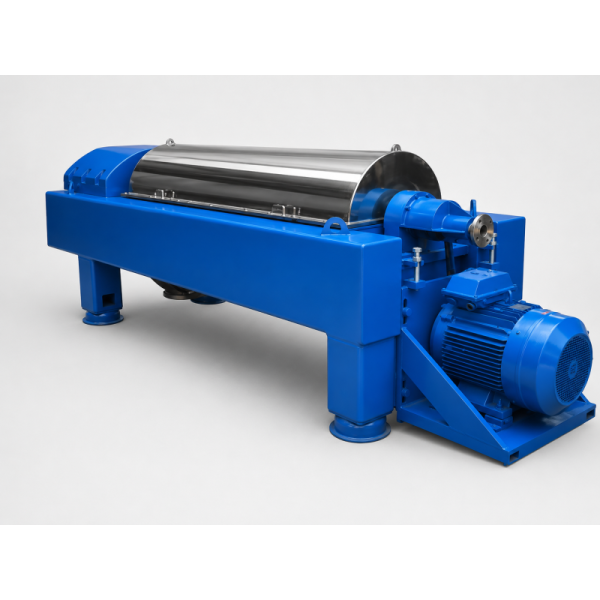
The Three Phase Decanter Centrifuge for Pyrolysis Oil Sludge Separation continuously separates recoverable pyrolysis oil, water, and carbon-rich solids from conditioned sludge.
It is suitable for suitable waste-plastic, tyre, and mixed-waste pyrolysis streams containing oil, free water, char, recovered carbon black, ash, rust, and catalyst fines. Pyrolysis-oil properties can vary significantly in viscosity, water content, stability, and contaminant loading, so feed testing is required before final selection.
Fine char, carbon black, ash, and catalyst particles may remain suspended in the oil.
High centrifugal force and stable feeding help recover these solids. Polishing filtration may still be required when very low solids content is needed.
Heavy hydrocarbons, waxes, and tar-like components may reduce pumpability and separation efficiency.
Controlled heating can reduce viscosity and improve feeding, but the temperature must remain within the process and safety limits.
Fine solids and process chemicals may stabilize the oil-water interface.
Heating, settling, dilution, or demulsifier dosing may be needed before centrifugation.
Carbon particles, ash, sand, and metal fines can cause wear, while tar may create deposits.
Carbide tiles, ceramic liners, replaceable discharge inserts, and automatic flushing can be provided.
Pyrolysis oil quality changes with feedstock, reactor conditions, condensation temperature, and storage time. Adjustable bowl speed, differential speed, feed rate, and phase interface help accommodate changing conditions.
Peony provides three-phase separation for oil recovery, water removal, and carbon-solids concentration.
Pyrolysis Oil Sludge
→ Screening
→ Heated Feed Tank
→ Three Phase Decanter
→ Oil + Water + Solids
Recovered Oil → Filtration / Upgrading
Separated Water → Further Treatment
Solids → Carbon Recovery / Disposal
Screened and heated pyrolysis oil sludge enters the rotating bowl through a controlled feed pipe.
Agitation maintains a uniform feed and prevents carbon solids from settling inside the tank.
Centrifugal force moves char, carbon black, ash, rust, and other dense particles toward the bowl wall.
The solids form a concentrated outer layer.
The lighter pyrolysis-oil phase remains closer to the bowl center.
The heavier free-water phase forms a separate liquid layer.
The screw conveyor transports settled carbon solids toward the conical discharge end.
Concentrated solids discharge continuously through wear-protected outlets.
Recovered oil and separated water leave through independent outlets.
Carbon-rich solids discharge continuously for recovery, drying, further treatment, or disposal. A three-phase decanter is suitable when the feed contains two immiscible liquids of different densities and a heavier solid phase.

| Model | Diameter (mm) | Length (mm) | Length-to-diameter rate | G force | Max solid discharge (m³/h) | Weight (kg) | Dimension (L*W*H) (mm) |
|---|---|---|---|---|---|---|---|
| PDC-10 | 250 | 1000 | 4 | 4080 | 0.4 | 1000 | 2410*800*1080 |
| PDC-12 | 4200 | 1350 | 4 | 3500 | 0.6 | 1200 | 2610*800*1080 |
| PDC-12 | 4200 | 1350 | 4.5 | 3180 | 1.2 | 1800 | 3495*840*1180 |
| PDC-18 | 4000 | 1600 | 4.5 | 3180 | 1.2 | 3200 | 3497*1020*1385 |
| PDC-18 | 450 | 2150 | 4 | 2500 | 2 | 3800 | 4447*1080*1385 |
| PDC-20 | 400 | 2250 | 4.5 | 2500 | 3.5 | 4000 | 4580*1140*1470 |
| PDC-21 | 530 | 2280 | 4.3 | 2500 | 5 | 5000 | 4924*1170*1540 |
| PDC-26 | 655 | 2800 | 4.3 | 2270 | 8 | 7000 | 4300*1900*1350 |
Recovers hydrocarbon-rich liquid from sludge before solids disposal or downstream purification.
Separates char, carbon black, ash, and other suspended particles that may foul filters and downstream equipment.
Removes free and separable water before oil filtration, distillation, or upgrading.
Protected feed, scroll, cone, and solids-outlet areas support abrasive carbon-rich sludge.
The phase interface and operating speeds can be adjusted for changing oil, water, and solids ratios.
Please provide:
Yes. It can remove suspended carbon-rich particles after oversized solids are screened out. Final oil clarity depends on particle size and may require polishing filtration.
Heating is often helpful for heavy, tar-rich, or high-viscosity sludge. The suitable temperature depends on oil properties, flash point, and plant safety requirements.
Not always without pretreatment. Heating, settling, demulsifier dosing, or controlled dilution may be required when the emulsion is stable.
Only after testing. Biomass bio-oil may contain water within a chemically complex, sometimes single liquid phase rather than as separable free water. A three-phase decanter works only when distinct oil and water phases can form.
Usually not without analysis or further treatment. Solids, water, acidity, viscosity, contaminants, and fuel specifications should be checked before filtration, blending, upgrading, or use.
Peony welcomes cooperation with plastic and tyre pyrolysis plants, recovered-carbon-black producers, waste-to-fuel companies, oil recyclers, environmental contractors, and pyrolysis-system integrators.
Send us your feedstock, oil-water-solids ratio, viscosity, temperature, required capacity, recovery target, and downstream process. Our engineering team will recommend a suitable three-phase decanter centrifuge solution.