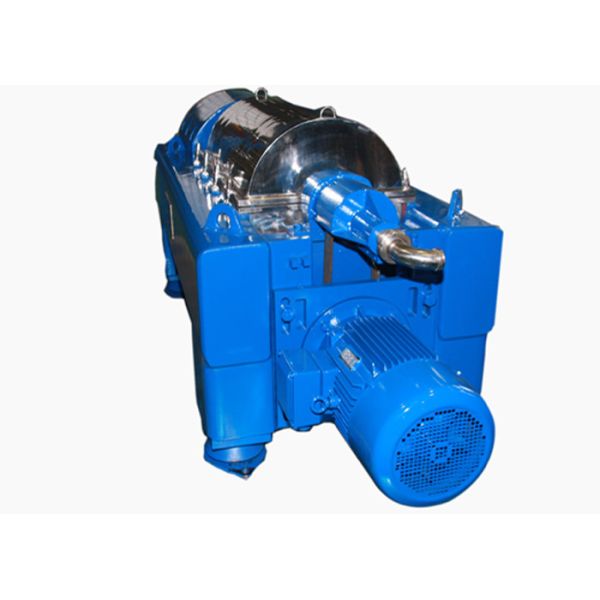
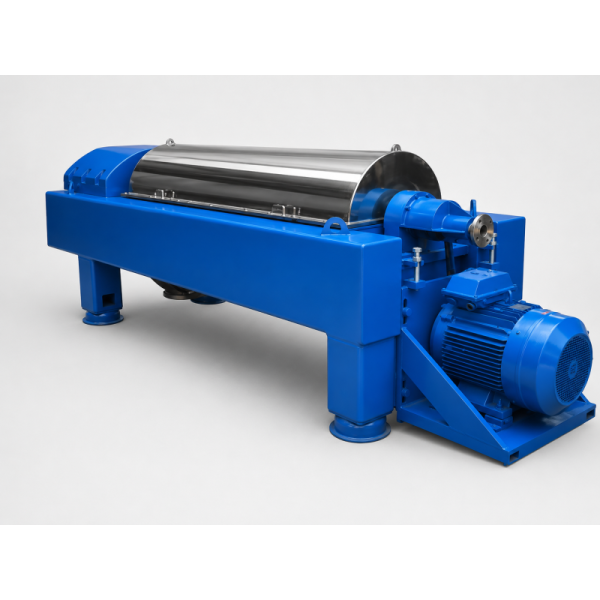
The Three Phase Decanter Centrifuge for Soybean Oil Sludge Treatment continuously separates recoverable soybean oil, aqueous liquid, and concentrated solids from conditioned oil sludge.
It is suitable for crude soybean oil settling residues, degumming sludge, refinery tank bottoms, wash-water sludge, meal fines, gums, and filter residues. The recovered oil can be sent to polishing filtration or further refining.
Soybean oil sludge may contain hydrated or non-hydrated phospholipids that form viscous, sticky gums.
Stable temperature, mixing, and controlled feed conditions help maintain continuous separation.
Proteins, gums, soap, and fine solids may stabilize the oil-water interface.
pH adjustment, heating, or suitable conditioning may be required before centrifugation.
Meal fines, husk particles, rust, and filter aid can increase solids loading.
Screening and an agitated buffer tank help prevent blockages and feed fluctuations.
Neutralization residues may contain soap, free fatty acids, oil, water, and suspended solids.
The actual composition should be tested because stable soap emulsions may require additional treatment.
Product-contact materials, seals, surface finish, and cleaning design should meet edible-oil processing requirements.
Peony provides three-phase separation for oil recovery, water removal, and sludge reduction.
Soybean Oil Sludge
→ Screening
→ Heated Feed Tank
→ Optional Conditioning
→ Three Phase Decanter
→ Oil + Water + Solids
Recovered Oil → Filtration / Refining
Aqueous Phase → Further Treatment
Solids → Recovery / Disposal
Screened and conditioned soybean oil sludge enters the rotating bowl.
Agitation maintains uniform temperature and keeps gums and solids suspended.
Centrifugal force moves meal fines, filter aid, gums, and dense impurities toward the bowl wall.
A concentrated outer solids layer forms.
The lighter soybean oil remains closer to the bowl center.
The heavier aqueous phase forms a separate outer liquid layer.
The screw conveyor transports settled solids toward the conical discharge end.
Concentrated sludge is discharged continuously.
Recovered oil and aqueous liquid leave through separate outlets.
The concentrated solids discharge continuously for further treatment or disposal.

| Model | Diameter (mm) | Length (mm) | Length-to-diameter rate | G force | Max solid discharge (m³/h) | Weight (kg) | Dimension (L*W*H) (mm) |
|---|---|---|---|---|---|---|---|
| PDC-10 | 250 | 1000 | 4 | 4080 | 0.4 | 1000 | 2410*800*1080 |
| PDC-12 | 4200 | 1350 | 4 | 3500 | 0.6 | 1200 | 2610*800*1080 |
| PDC-12 | 4200 | 1350 | 4.5 | 3180 | 1.2 | 1800 | 3495*840*1180 |
| PDC-18 | 4000 | 1600 | 4.5 | 3180 | 1.2 | 3200 | 3497*1020*1385 |
| PDC-18 | 450 | 2150 | 4 | 2500 | 2 | 3800 | 4447*1080*1385 |
| PDC-20 | 400 | 2250 | 4.5 | 2500 | 3.5 | 4000 | 4580*1140*1470 |
| PDC-21 | 530 | 2280 | 4.3 | 2500 | 5 | 5000 | 4924*1170*1540 |
| PDC-26 | 655 | 2800 | 4.3 | 2270 | 8 | 7000 | 4300*1900*1350 |
Reduces oil loss from degumming sludge, tank residues, and refinery waste.
Removes phospholipid gums, meal fines, filter aid, and suspended impurities.
Produces separate oil, aqueous liquid, and concentrated solids streams.
Lowers the load on filtration, wastewater treatment, and final disposal.
Sanitary materials, polished surfaces, and CIP options support edible-oil processing.
Please provide:
Yes. Performance depends on gum concentration, water ratio, viscosity, temperature, and emulsion stability.
Possibly. Moisture, phosphorus, soap, solids, and free fatty acids should be tested before further refining.
Yes, after feed evaluation. Soap-rich emulsions may require heating, acidulation, or other conditioning.
It is often helpful for viscous or gum-rich sludge. The temperature should remain within the oil-quality requirements.
Dense particles settle against the bowl wall and are continuously conveyed to the solids outlet.
Peony welcomes cooperation with soybean crushing plants, solvent-extraction facilities, edible-oil refineries, engineering contractors, and food-processing equipment distributors.
Send us your sludge composition, temperature, capacity, recovery target, and downstream process. Our engineering team will recommend a suitable three-phase decanter centrifuge solution.