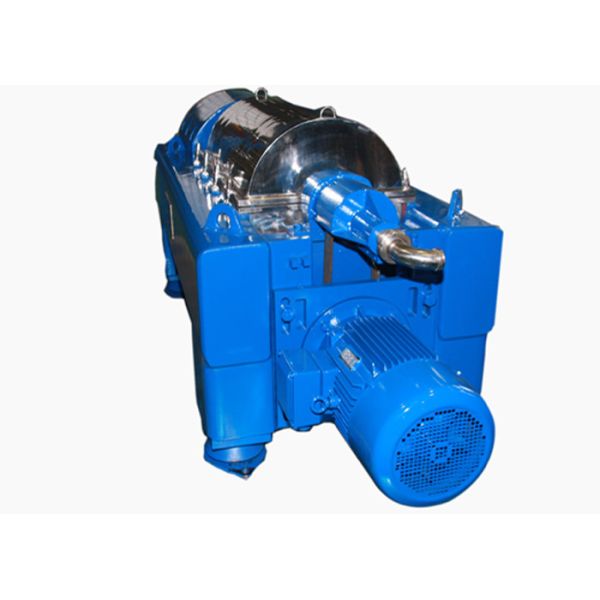
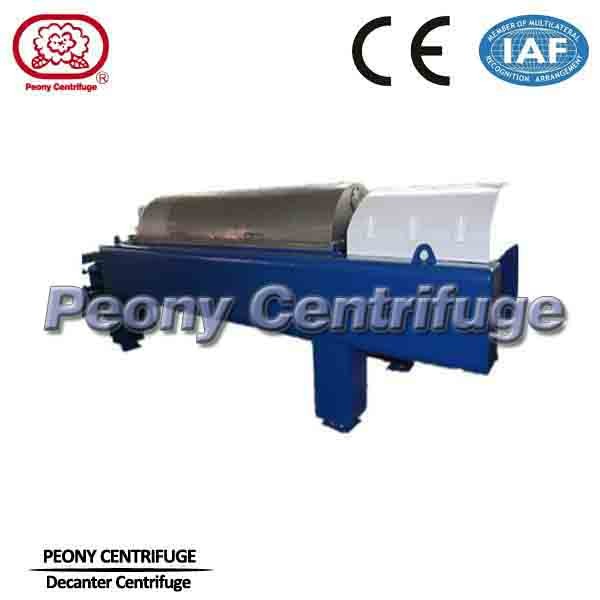
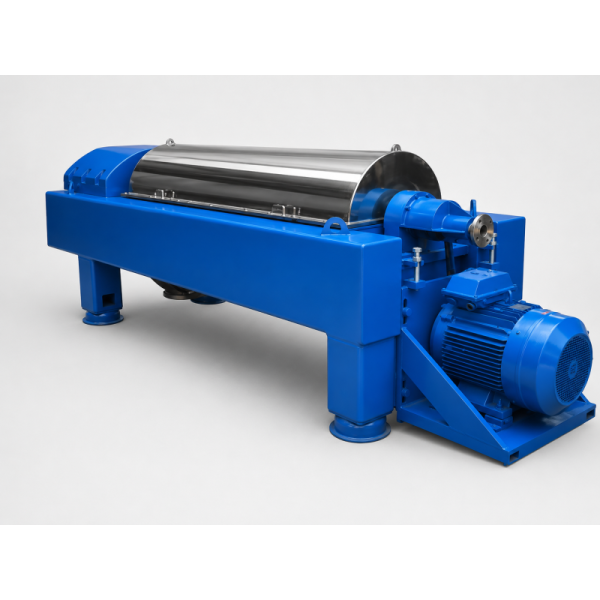
The Three Phase Decanter Centrifuge for Rice Bran Oil Sludge Separation continuously separates recoverable rice bran oil, aqueous liquid, and concentrated solids from conditioned oil sludge.
It is suitable for crude rice bran oil tank bottoms, extraction residues, degumming sludge, wax-containing sediment, bran fines, filter residues, and oily wastewater generated during refining.
Rice bran oil naturally contains waxes that may crystallize at lower temperatures and increase sludge viscosity.
Controlled heating helps maintain fluidity and stable feeding.
Bran fines, husk particles, filter aid, and suspended impurities can remain in the oil.
Screening and stable feed preparation improve solids discharge.
Phospholipids, proteins, soap, and fine particles may stabilize the oil-water interface.
Heating, pH adjustment, or suitable conditioning may be required before separation.
Oil, water, wax, gums, and solids content may vary between extraction, storage, and refining stages.
Adjustable bowl speed, differential speed, and phase interface help maintain stable separation.
Excessive temperature or long holding time may affect oil color and oxidation stability.
The feed temperature and residence time should match the refining process.
Peony provides three-phase separation for oil recovery, water removal, and sludge reduction.
Rice Bran Oil Sludge
→ Screening
→ Heated Feed Tank
→ Three Phase Decanter
→ Oil + Water + Solids
Recovered Oil → Filtration / Refining
Water Phase → Further Treatment
Solids → Recovery / Disposal
Screened and heated rice bran oil sludge enters the rotating bowl through a controlled feed pipe.
Agitation keeps wax, gums, and solids uniformly suspended.
Centrifugal force moves bran fines, filter aid, wax solids, and dense impurities toward the bowl wall.
A concentrated solids layer forms.
The lighter rice bran oil remains closer to the bowl center.
The heavier aqueous phase forms a separate outer liquid layer.
The screw conveyor transports settled solids toward the conical discharge end.
Concentrated sludge is discharged continuously.
Recovered oil and aqueous liquid leave through separate outlets.
The concentrated solids discharge continuously for further treatment or disposal.

| Model | Diameter (mm) | Length (mm) | Length-to-diameter rate | G force | Max solid discharge (m³/h) | Weight (kg) | Dimension (L*W*H) (mm) |
|---|---|---|---|---|---|---|---|
| PDC-10 | 250 | 1000 | 4 | 4080 | 0.4 | 1000 | 2410*800*1080 |
| PDC-12 | 4200 | 1350 | 4 | 3500 | 0.6 | 1200 | 2610*800*1080 |
| PDC-12 | 4200 | 1350 | 4.5 | 3180 | 1.2 | 1800 | 3495*840*1180 |
| PDC-18 | 4000 | 1600 | 4.5 | 3180 | 1.2 | 3200 | 3497*1020*1385 |
| PDC-18 | 450 | 2150 | 4 | 2500 | 2 | 3800 | 4447*1080*1385 |
| PDC-20 | 400 | 2250 | 4.5 | 2500 | 3.5 | 4000 | 4580*1140*1470 |
| PDC-21 | 530 | 2280 | 4.3 | 2500 | 5 | 5000 | 4924*1170*1540 |
| PDC-26 | 655 | 2800 | 4.3 | 2270 | 8 | 7000 | 4300*1900*1350 |
Reduces oil loss in tank sludge, degumming residues, and refining waste.
Separates wax particles, bran fines, filter aid, and suspended sediment.
Produces separate oil, aqueous liquid, and concentrated solids streams.
Lowers the volume sent to filtration, drying, or disposal.
The phase interface and rotational speeds can be adjusted for changing sludge conditions.
Please provide:
It can remove suspended or crystallized wax solids. Dissolved wax may require controlled cooling or winterization before separation.
It is often recommended when the sludge contains wax or has high viscosity. The temperature should remain within the oil-quality requirements.
Yes, after evaluating the gum content, emulsion stability, water ratio, and oil-recovery target.
Possibly. Moisture, gums, wax, solids, free fatty acids, and color should be tested before further refining.
Dense particles settle against the bowl wall and are continuously conveyed to the solids outlet.
Peony welcomes cooperation with rice bran oil mills, solvent-extraction plants, edible-oil refineries, engineering contractors, and food-processing equipment distributors.
Send us your sludge composition, temperature, capacity, recovery target, and downstream process. Our engineering team will recommend a suitable three-phase decanter centrifuge solution.