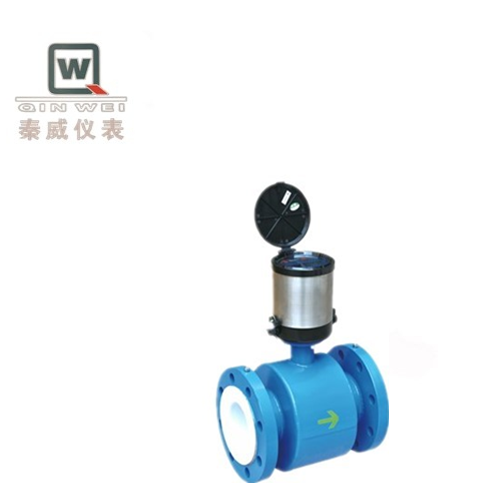
Sewage-Type Electromagnetic Flowmeter With 316L Stainless Steel Electrode And IP65/IP68 Protection
The sewage-type electromagnetic flowmeter is a flow measurement instrument specifically designed for complex liquids such as municipal sewage, industrial wastewater, and agricultural wastewater, which contain solid particles, suspended matter, and corrosive components.
The sewage-type electromagnetic flowmeter is based on Faraday's law of electromagnetic induction. When a conductive liquid flows through a magnetic field, an induced electromotive force is generated, and its magnitude is proportional to the flow velocity.
Functional Features
- No flow-blocking components: There are no moving parts inside the measuring tube, resulting in no pressure loss and a lower requirement for straight pipe sections (upstream ≥ 5DN, downstream ≥ 3DN).
- Strong resistance to impurities: Suitable for wastewater containing solid particles and suspended matter, and is less prone to clogging.
- High protection grade: With IP65/IP68 protection grade, it is suitable for underground and submerged working environments.
Typical Product Parameters
| Parameter Type |
Common Options |
| Lining Material |
Polyurethane, Neoprene, PTFE, F46 |
| Electrode Material |
316L Stainless Steel, Hastelloy B/C, Titanium, Tantalum |
| Protection Grade |
IP65 (Conventional), IP68 (Submersible) |
| Output Signal |
4-20mA, Pulse, RS485, HART |
| Accuracy |
±0.3% to ±0.5% |
| Medium Temperature |
-20℃ to +180℃ (Depending on Lining Material) |
Installation Requirements
- Straight pipe sections: Upstream ≥ 5DN, downstream ≥ 3DN (DN is the pipe diameter).
- Position: Avoid the highest point of the pipe (to prevent air bubbles), and the pump inlet (to prevent negative pressure). Vertical installation is preferred (flow direction from bottom to top).
- Grounding: Must be reliably grounded. For non-metallic pipes, a grounding ring should be installed.
Maintenance Points
- Regularly clean the electrodes and liners to prevent scaling or corrosion.
- Check the sealing of the cable joints to avoid signal interference from damp environments.
Application scenarios
- Sewage treatment plants: Measure the flow of influent, effluent, and sludge return, etc., to provide data support for process optimization.
- Industrial wastewater monitoring: Monitor the wastewater discharge of industries such as chemical engineering, metallurgy, and papermaking to ensure compliance.
- Agricultural irrigation: Measure the water flow in the irrigation system to achieve water conservation and emission reduction.
- Environmental monitoring: Connect with environmental protection departments, upload data in real time, and achieve remote monitoring and alarm.