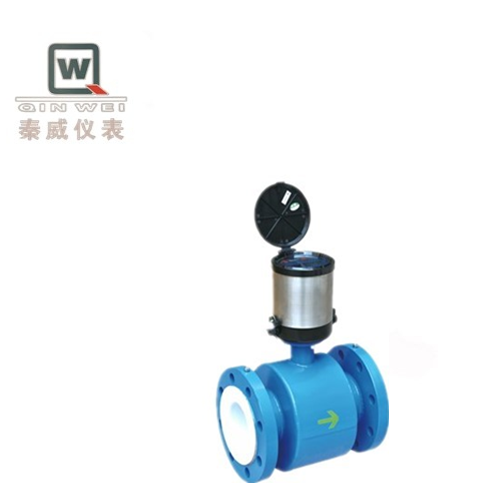
Sewage Flowmeter, Large-Diameter Pipeline Electromagnetic Flowmeter
The pipe-type electromagnetic flowmeter is a flowmeter made based on Faraday's law of electromagnetic induction, with the measuring tube and the main body formed in one piece. It is directly installed in series in the pipeline through connection methods such as flange, clamp or thread, and is used to measure the volume flow of conductive liquids.
Key Features
- No Obstructive Components: No moving parts inside the pipe, no pressure loss, suitable for measuring fluids containing suspended particles or high-viscosity fluids.
- High Measurement Accuracy: Usually up to ±0.5%, with good long-term stability.
- Strong Adaptability: Insensitive to changes in fluid temperature, pressure, density, and viscosity; corrosion-resistant lining materials are suitable for corrosive media such as acids and alkalis.
- Limitations: Only applicable to conductive liquids with an electrical conductivity greater than 5 μS/cm; cannot measure non-conductive media such as gases, vapors, and petroleum products.
Installation Requirements
- Straight pipe section: At least 5DN upstream and 3DN downstream (DN is the inner diameter of the pipe).
- Installation direction: Can be installed horizontally, vertically or at an angle, but must ensure full pipe to avoid air bubbles and sediment affecting the electrodes.
- Grounding and anti-interference: Good grounding, keep away from strong magnetic fields and vibration sources.
- Location selection: Avoid the highest point of the pipe, pump outlet or near valves to prevent negative pressure from damaging the lining.
Typical application fields
- Industrial fields: Chemical, petroleum, metallurgy, power and other industries, used for measuring acid, alkali, slurry, cooling water, etc.
- Water treatment: Urban water supply, sewage treatment, raw water metering, etc., suitable for liquids containing suspended particles.
- Food and medicine: Beverage, dairy products, other hygienic requirements high occasions (sanitary type should be selected)
Due to its high precision, high reliability and wide applicability, the pipe-type electromagnetic flowmeter has become the main force in the field of flow measurement of conductive liquids. Correct selection and standardized installation are the two key pillars to ensure its long-term stable and accurate operation. When making a choice, it is essential to provide detailed and accurate working condition information to experienced engineers or suppliers.