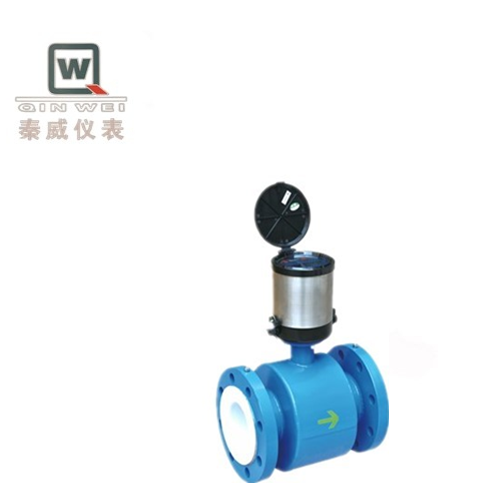
Split-Type Electromagnetic Flowmeter, Pipeline Sensor, Sewage Stainless Steel Flowmeter
Split-type electromagnetic flowmeters are electromagnetic flowmeters where the sensor (also known as the primary instrument) and the converter (also known as the secondary instrument) are installed separately.
- Sensor: Directly installed on the pipeline, in contact with the measured fluid, it is responsible for detecting the original induced signal (a weak voltage signal) generated by the flow.
- Converter: Usually installed in a control room, cabinet or a convenient location away from the measurement point, it is responsible for providing excitation current to the sensor, receiving the weak signal transmitted by the sensor, amplifying, processing and calculating it, and ultimately converting it into a standard flow signal (such as 4-20mA) and digital communication signal for output.
The sensor and the converter are connected by a dedicated shielded cable.
In contrast, there is the "integral electromagnetic flowmeter", where the sensor and the converter are integrated in one housing and directly installed on the pipeline.
Advantages:
- Flexible installation and adaptability to harsh environments: This is the most significant advantage of the split type. The sensor can be installed in high-temperature, humid, vibrating, corrosive or hard-to-reach locations (such as underground or at heights), while the converter can be installed in a better-conditioned control room, facilitating observation and operation by personnel.
- Easy maintenance and debugging: The converter is far from the site, so maintenance, parameter setting, calibration and fault diagnosis do not require personnel to go to the harsh measurement point, ensuring high safety and convenience of operation.
- User-friendly display and operation interface: The converter usually has a large LCD screen and buttons, making it much easier to view data and configure settings compared to the integrated type.
- Suitable for high or low temperature media: For extremely high or low temperature fluids, the electronic components of the integrated type may not be able to withstand the conditions, while the split type can separate the converter to avoid the influence of temperature.
- Space-saving: In dense piping systems, the integrated type may be too large to install, while the sensor part of the split type is usually more compact.
Split-type electromagnetic flowmeters are widely used in the following situations:
- Harsh environments on site: such as chemical, metallurgical, and pharmaceutical factories with high temperatures, high humidity, much dust, and corrosive gases.
- Locations with limited installation space or difficult observation: such as deep wells, underground pipe galleries, and high-altitude pipelines.
- Measurement of high-temperature fluids: such as high-temperature steam condensate water and heat transfer oil.
- Situations requiring centralized monitoring: signals from multiple flowmeters need to be transmitted remotely to the central control room DCS or PLC system.
- Large-diameter pipelines: for large-diameter pipelines, the integral type is too bulky, while the split type is more convenient for installation and maintenance.
Split-type Electromagnetic Flowmeter vs. Integrated Electromagnetic Flowmeter
| Characteristics |
Split-type Electromagnetic Flowmeter |
Integrated Electromagnetic Flowmeter |
| Structure |
Sensor and converter are separated |
Sensor and converter are integrated |
| Installation |
More complex, wiring is required |
Simpler, overall installation |
| Cost |
Instrument itself + cable, higher total cost |
Lower total cost |
| Environmental Adaptability |
Strong, suitable for harsh sites |
General |
| Maintenance and Operation |
Convenient, converter is in an easily accessible location |
Requires on-site operation |
| Applicable Scenarios |
High temperature, harsh environments, remote monitoring |
Well-conditioned environments, easily observable locations |
In conclusion, the split-type electromagnetic flowmeter, with its outstanding environmental adaptability and convenient operation and maintenance, plays an irreplaceable role in complex industrial measurement fields.