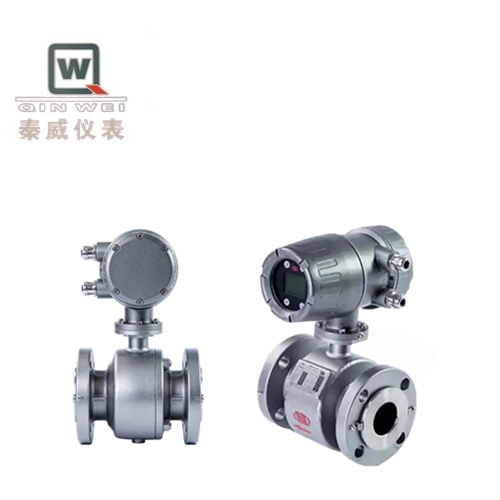
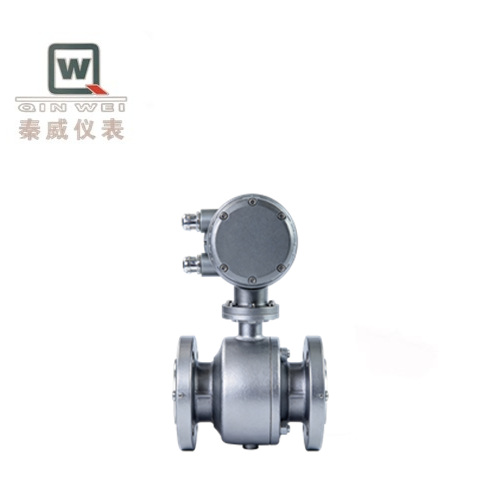
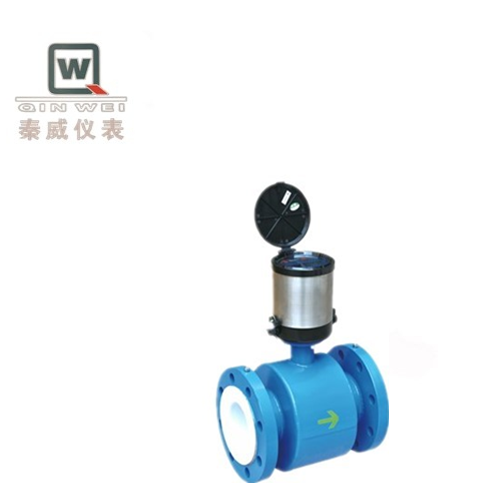
Low-Power, High-Integration Two-Wire Electromagnetic Flowmeter
A two-wire electromagnetic flowmeter refers to an electromagnetic flowmeter that simultaneously accomplishes power supply and signal transmission using only two wires.
Core Advantages
- Extremely low wiring cost and easy installation: Save a large amount of cable and construction costs. The traditional four-wire system requires two power lines and two signal lines, while the two-wire system only needs a pair of twisted wires, making it especially suitable for long-distance and multi-point distribution scenarios.
- Inherent safety and explosion-proof advantage: As the entire circuit's energy is limited to 4-20mA and the voltage is usually at a low level of ≤24V DC, it is very easy to achieve Intrinsic Safety (Ex ia) certification, making it an ideal choice for hazardous areas such as chemical and petroleum industries.
- Strong anti-interference ability: Current signal transmission is not sensitive to changes in line resistance and is less affected by electromagnetic interference, making it suitable for long-distance transmission.
- "Live zero point" for easy diagnosis: The "live zero point" at 4mA can clearly distinguish between "instrument failure/power off (0mA)" and "true zero flow (4mA)", facilitating remote diagnosis.
- Easy system integration: Seamless compatibility with current mainstream DCS/PLC control systems (whose analog input cards generally support two-wire 4-20mA power supply), without the need for additional power distribution.
Comparison with Four-wire Electromagnetic Flowmeters
| Characteristics |
Two-wire Electromagnetic Flowmeters |
Four-wire Electromagnetic Flowmeters |
| Wiring |
Two wires (power + signal) |
Four wires (two power wires + two signal wires) |
| Power Supply |
Loop-powered, DC 24V (commonly used) |
Independent power supply, AC 220V or DC 24V |
| Power Consumption |
Extremely low (must be ≤ 3.6mA @ 24V, i.e., ≤ 86.4mW) |
High, unrestricted, can drive stronger excitation. |
| Maximum Distance |
Limited by loop voltage drop, usually at the kilometer level. |
Unrestricted power supply distance, signal transmission distance the same as two-wire. |
| Intrinsic Safety |
Easy to achieve, preferred in hazardous areas. |
More complex to achieve, usually flameproof (Ex d). |
| Cost |
Low wiring cost, the meter itself may be slightly more expensive. |
High wiring cost, the meter may be cheaper. |
| Applicable Scenarios |
High explosion-proof requirements, scattered points, long distances, new digital factories. |
Non-explosion-proof areas, on-site power supply available, occasions with extremely high requirements for response speed/functions. |
Typical application scenarios
- Hazardous areas in oil, chemical, natural gas, etc.: tank farm metering, process pipelines, flammable and explosive media.
- Water treatment and municipal water networks: distributed water supply/drainage monitoring points, remote transmission water meters.
- Energy management and building automation: central air conditioning cold/hot water metering, district heating metering.
- Equipment matching and OEM: integrated into complete sets of equipment (such as water treatment units, chemical equipment).
- Newly built digital factories: all plant instrument signals uniformly adopt two-wire 4-20mA standard.
Two-wire electromagnetic flowmeters are a successful example of the development of electromagnetic flowmeter technology towards "low power consumption, high integration, and intrinsic safety". It is not merely a change in wiring method, but also an innovation in system design concept.