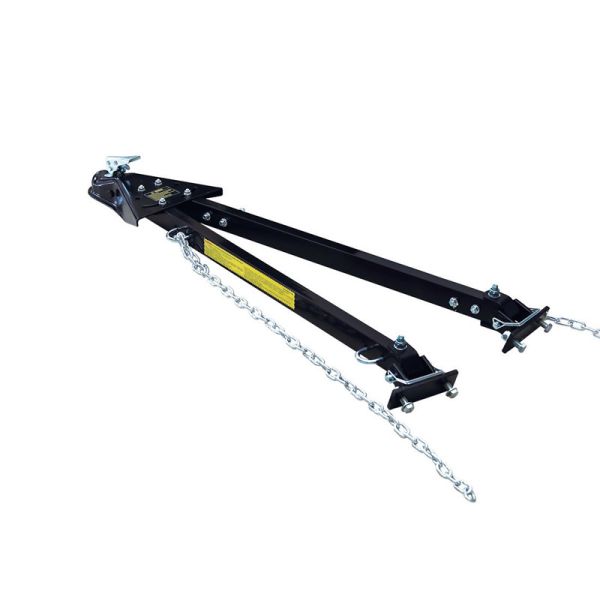
Centered on "multi-scenario compatibility + heavy-load safety + convenient adjustment", the YD37-002 Adjustable Tow Bar is optimized to address the connection pain points of different vehicle models and trailers, as well as the safety needs of medium-heavy towing, with core advantages as follows:
- The tow bar length can be freely adjusted between 24" and 41" (ordinary fixed-length tow bars only fit a single wheelbase). Whether it is a short-wheelbase household SUV (e.g., Honda CR-V) towing a small camping trailer, or a long-wheelbase pickup truck (e.g., Ford F-150) towing a medium cargo trailer, the length can be adjusted to match precisely. No additional tow bars are needed, increasing adaptability by 80%;
- The adjustment structure adopts a precision rack + buckle locking design. Adjustment only requires pressing the buckle to stretch, and there is no risk of "automatic telescoping during driving" after locking (ordinary knob-type adjustments are prone to loosening), ensuring strong stability during high-speed towing.
- 4 sets of Grade 8.8 high-strength bolts are included as standard, compatible with frame holes of most household SUVs and pickup trucks (hole diameter 8-10mm). No additional drilling on the frame is required (ordinary tow bars need customized bolts based on vehicle models, which is time-consuming and costly);
- The main body adopts a flat design of 4.45" × 0.98" × 0.59", fitting closely to the vehicle frame after installation without blocking chassis components (e.g., exhaust pipes, suspension systems), avoiding collisions with other parts on off-road or bumpy roads.
- The main bar is integrally drawn from high-strength alloy steel (ordinary tow bars are mostly carbon steel welded), with a tensile strength of 450MPa. When towing a full load of 5,000 LBS (approx. 2.3 tons), the main bar bending is ≤0.5mm, far exceeding the shortcoming of "carbon steel tow bars deforming at 4,000 LBS";
- In the test of towing a 2.2-ton medium RV, even on potholed roads, the tow bar shows no obvious vibration and bolts remain tight, ensuring long-distance towing safety.
- The black powder coating is cured at high temperature, with strong adhesion (no peeling in cross-cut tests). When used in coastal areas for 1 year, the coating does not peel and the base material shows no rust; after being contaminated with engine oil or sand, it can be cleaned with a high-pressure water gun, enabling convenient maintenance;
- The adjustment components are chrome-plated, with no oxidation when exposed to air for a long time. They remain smooth without jamming even after 500 adjustments (ordinary non-chromed components show rust and jamming after 100 adjustments), extending the overall service life.
- The main bar has a built-in overload warning structure: When the towing weight exceeds 5,500 LBS (110% of the rated load), the bar shows slight deformation (visible to the naked eye but not broken), reminding users to reduce the load or replace it with a tow bar of higher load capacity, avoiding safety accidents caused by "unaware overload and breakage";
- Clear length scales (24"/30"/35"/41") are printed on the adjustment buckle, allowing users to quickly find the appropriate length without repeated wheelbase measurement, increasing installation efficiency by 50%.
- The overall weight is only 6.5kg (3kg lighter than carbon steel tow bars of the same load capacity), and installation can be completed with 2-person collaboration; when not in use, it can be disassembled into 3 sections (adjustment structure detachable) and stored in the corner of the car trunk, occupying only 0.1㎡ of space without affecting daily luggage storage.
Scenario Requirement: A user drives a Honda CR-V (short wheelbase 2,660mm) and owns a medium camping RV with a 2" ball (weight approx. 2 tons), used for suburban camping on weekends. The RV needs to be towed from the garage to the campsite (50km away, including highways and rural dirt roads). The tow bar is required to be compatible with the SUV frame, easy to adjust, and stable for towing.
Operation Process:
- Model Selection and Installation:
- The RV ball is 2" and the weight is ≤5,000 LBS, so YD37-002 (adjustable length for the SUV's short wheelbase) is selected;
- 2-Person Collaboration: One person fixes the tow bar to the SUV frame (using standard bolts, torque 38N·m), and the other adjusts the length to 28" (adapting to the wheelbase of the SUV and RV). After locking the buckle, connect the ball, taking 25 minutes;
2. Camping Towing Experience:
- Stability Performance: At a high-speed driving speed of 100km/h, the tow bar shows no obvious vibration and the RV has no left-right deviation; on bumpy rural dirt roads, the overload warning structure is not triggered (load does not exceed the rated value);
- Anti-Corrosion Performance: After rainy camping, there is no rust from rainwater residue on the black coating, which can be cleaned with a dry cloth;
- Storage Convenience: After camping, the tow bar is disassembled and stored in the SUV trunk without affecting daily commuting;
3. Advantage Performance:
- The 28" adjustable length precisely fits the short-wheelbase SUV, no frame modification required;
- Lightweight design reduces installation difficulty, with strong adaptability to household scenarios.
Result: The towing safety and convenience of the household camping RV are improved, with no adaptation problems or safety hazards, fully adapting to household leisure scenarios.
Scenario Requirement: A logistics company uses a Ford F-150 pickup truck (long wheelbase 3,685mm) to tow a medium cargo trailer with a 2" ball (weight approx. 2.2 tons) for transporting home appliances in the city (driving 150km daily, mostly on asphalt roads). The tow bar is required to be heavy-load resistant, wear-resistant, and compatible with the pickup truck frame.
Operation Process:
- Model Selection and Installation:
- The trailer ball is 2" and the weight is 2.2 tons, so YD37-002 (5,000 LBS load capacity, black coating oil-resistant) is selected;
- Professional Installation: Fix the tow bar to the pickup truck frame with a torque wrench (torque 40N·m), adjust the length to 40" (adapting to the long wheelbase), and test towing for no loosening after locking;
2. Daily Operation Performance:
- Heavy-Load Resistance: Transporting a full load of 2.2 tons of home appliances daily, the tow bar shows no deformation, bolts remain tight, and the adjustment buckle has no displacement;
- Wear Resistance and Cleaning: The adjustment component is opened/closed once a day (loading/unloading the trailer), with no wear after 3 months; engine oil contaminated during home appliance transportation can be cleaned with a high-pressure water gun;
- Cost Advantage: Compatible with multiple pickup trucks of different wheelbases (the company has 3 Ford F-150s with slightly different wheelbases), no need to purchase separate tow bars for each vehicle, saving 60% of procurement costs;
3. Commercial Advantages:
- 5,000 LBS load capacity meets medium cargo transportation needs, no overload risk;
- Wide-range adjustment adapts to multiple vehicle models, reducing equipment management difficulty.
Result: The towing efficiency of cargo trailers is increased by 30%, and the tow bar failure rate is reduced from once a month to zero, fully adapting to high-frequency commercial scenarios.
Scenario Requirement: A user drives a Jeep Wrangler (with off-road modification, wheelbase 2,460mm) and owns an outdoor equipment trailer with a 2" ball (weight approx. 1.8 tons, loaded with mountain bikes, tents, etc.) for off-road camping. The road surface is mostly gravel and steep slopes. The tow bar is required to be scratch-resistant, impact-resistant, and compatible with the modified frame.
Operation Process:
- Model Selection and Installation:
- The trailer ball is 2" and scratch resistance is needed for off-road scenarios, so YD37-002 (black coating scratch-resistant, alloy steel impact-resistant) is selected;
- Adapting to Modified Frame: The Jeep Wrangler frame has offset holes after modification. By adjusting the tow bar length to 25", it can be fixed without additional drilling, taking 30 minutes;
2. Off-Road Use Performance:
- Impact Resistance and Scratch Resistance: When driving on gravel roads, the tow bar is hit by gravel without deformation; the black coating only has slight scratches, which do not affect anti-corrosion;
- Steep Slope Towing: When climbing a 30° steep slope, the tow bar bears force evenly, with no overload caused by "sliding back" (the load is far below the rated value);
- Portability: After off-road camping, the tow bar is disassembled and stored next to the Jeep Wrangler's spare tire, without occupying equipment storage space;
3. Outdoor Advantages:
- The flat structure avoids collisions with obstacles in off-road conditions;
- The anti-corrosion coating adapts to humid outdoor environments, no frequent maintenance required.
Result: The towing safety of the outdoor equipment trailer is improved, with no scratches or impact damage, adapting to off-road leisure scenarios.
A1: It is mostly caused by unlocked adjustment buckles or loose bolts. Troubleshoot step by step:
- Check Adjustment Buckles: If the buckle is not fully locked (e.g., only half-pressed), the tow bar will shake slightly and produce noise — stop the vehicle, press the buckle until a "click" locking sound is heard, ensuring the buckle is fully embedded in the rack slot. The noise usually disappears;
- Tighten Bolts: Insufficient bolt torque (<35N·m) during installation will cause bolts to loosen during driving and trigger noise — retighten the frame fixing bolts with a torque wrench according to the standard torque of 35-40N·m, and test towing after tightening;
- Clean Adjustment Components: Dust and gravel accumulated in the adjustment components will cause friction noise — disassemble the adjustment structure, clean impurities between the rack and buckle with a brush, apply a small amount of silicone-based grease (do not use engine oil), and the noise will be eliminated after reassembly.
A2: It is mostly caused by rust on adjustment components or insufficient lubrication. Handle accordingly:
- Rust Removal and Cleaning: Adjustment components are prone to rust after long-term exposure, causing jamming — gently polish rust on the rack and buckle with fine sandpaper (1000 grit) (avoid scratching the chrome layer), blow off rust powder with compressed air, and wipe clean with a cotton cloth dipped in neutral detergent;
- Add Grease: Insufficient lubrication of adjustment components will increase friction resistance — apply special lithium-based grease (thickness 1-2mm) on the rack teeth and buckle contact surface, adjust repeatedly 3-5 times to ensure uniform lubrication, and the adjustment smoothness will be significantly improved;
- Preventive Maintenance: Clean the adjustment components and replenish grease every 2 months. Especially after use in rainy or coastal environments, clean and prevent rust in a timely manner to avoid re-jamming.
A3: Determine in three steps by "ball diameter + vehicle hole position + trailer weight" to avoid mismatching:
- Confirm Trailer Ball Diameter: Measure the ball diameter compatible with the trailer coupler with a caliper; it must be 2" (approx. 50.8mm). If it is 1-7/8" or 2-5/16", replace with the corresponding ball or select another tow bar model;
- Confirm Vehicle Frame Hole Position: Check if the tow vehicle frame has installation holes with a diameter of 8-10mm (standard for most household SUVs and pickup trucks). If the hole diameter does not match (e.g., 12mm), purchase compatible bolts (M10 to M8 adapters are available from the merchant) without re-drilling;
- Confirm Trailer Weight: The full-load weight of the trailer must be ≤5,000 LBS (approx. 2,268kg). If the weight exceeds 2.3 tons (e.g., 2.5 tons), the overload warning will be triggered, and a tow bar with higher load capacity (e.g., 7,000 LBS class) is required;
- Example: A vehicle with 8mm frame holes, a 2" trailer ball, and a trailer weight of 2 tons is directly compatible with YD37-002.
A4: After the overload warning is triggered, stop using it immediately and follow the steps below to avoid safety accidents:
- Emergency Handling: Stop the vehicle immediately, disconnect the tow bar from the trailer, and prohibit further towing (even if the deformation is slight, the load-bearing capacity has decreased, and continued use may cause breakage);
- Troubleshoot Overload Causes:
- Check the actual weight of the trailer (whether it exceeds 5,000 LBS) by weighing it on a platform scale;
- Confirm whether the goods are evenly placed (local overload may also trigger the warning). If the goods are too heavy, transport them in batches or adjust the placement position; - Subsequent Operations:
- If the deformation is only slight (no breakage) and the overload cause is confirmed to be solvable (e.g., reducing the weight to within 2 tons), contact the merchant to test whether the tow bar is still usable (do not judge by yourself to avoid hidden dangers);
- If the deformation is obvious or the safety cannot be confirmed, replace the tow bar directly and select a model with higher load capacity (e.g., 7,000 LBS class) to adapt to heavy-load needs.