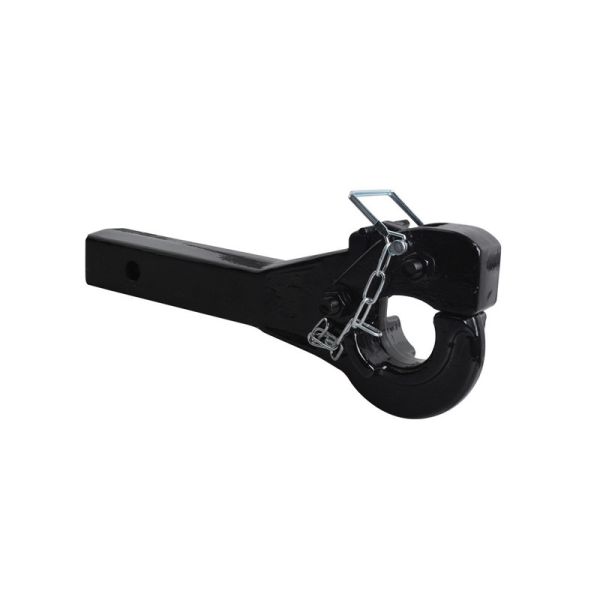
Centered on "safe heavy-load + durable adaptation + convenient installation", the YD39-008 Heavy-Duty Pintle Hook Mount is optimized to address the pain points of "connection stability, environmental adaptability, and operational convenience" in light to medium-duty trailer towing, with core advantages as follows:
- The shank is forged from solid alloy steel (ordinary hook mounts mostly have hollow shanks), with a shear strength of 420MPa. When towing a full load of 1,000 LBS, there is no risk of shear deformation of the shank. Even when bumping on potholed roads, it can still stably transmit traction;
- The body is integrally welded from high-strength carbon steel, with a tensile strength of ≥400MPa at the welds, no false welding or missing welding. In the test of towing a 900 LBS small engineering equipment trailer, the body bending is ≤0.3mm, far exceeding the shortcoming of "ordinary carbon steel hook mounts deforming at 700 LBS", adapting to daily light to medium-duty heavy-load scenarios.
- Standard high-strength steel anti-theft chain: 35cm in length, which can be flexibly fixed to the trailer or tow vehicle. Even if the ball is accidentally loosened during towing, the chain can prevent the hook mount from falling off, avoiding safety accidents (ordinary hook mounts mostly lack this accessory and require additional purchase);
- Chrome-plated engagement part: 15μm in thickness, which not only improves corrosion resistance (no rust for 1 year of use in coastal humid environments) but also reduces friction loss between the ball and the hook mount, extending the service life and avoiding the problem of "jamming after frequent engagement of ordinary non-chrome-plated parts".
- The surface black powder coating is cured at high temperature, with strong adhesion (no peeling in cross-cut tests), no corrosion in 48-hour salt spray tests. After rainy use, it can be cleaned with a dry cloth without rust residue;
- The coating is oil-resistant and easy to clean: Diesel and engine oil contaminated in cargo transportation scenarios can be cleaned by rinsing with a high-pressure water gun or wiping with a rag dipped in neutral detergent, restoring cleanliness and maintaining a good appearance for long-term use.
- Pre-drilled universal mounting holes (center distance 3-3/8" × 1-7/8") are compatible with the frame mounting plates of most light trucks and heavy SUVs, no additional drilling required (ordinary hook mounts need customized holes based on vehicle models, which is time-consuming and costly);
- With a net weight of only 7.05kg (1.5kg lighter than solid-shank hook mounts of the same load capacity), it can be installed by two people in 30 minutes without professional tools, suitable for household or small commercial scenarios.
- It can flexibly select 1-7/8" or 2" standard balls according to the trailer coupler size, without replacing the hook mount body (ordinary hook mounts mostly only adapt to a single ball size, with poor adaptability);
- The engagement gap between the ball and the hook mount can be fine-tuned (0.1-0.2mm), ensuring stable connection of balls of different sizes and avoiding the problem of "wobbling due to mismatched ball size".
- The hook mount surface is printed with clear load-bearing markings (1,000 LBS) and compatible ball sizes (1-7/8"/2"), allowing users to quickly identify the adaptation range and avoid safety hazards caused by improper use;
- When not in use, it can be disassembled into the hook mount body and anti-theft chain, and stored in the trunk of a car or the corner of a garage, occupying only 0.05㎡ of space without affecting daily storage.
Scenario Requirement: A user drives a Toyota Tundra heavy SUV (compatible with 2" balls) and owns a medium-sized camping RV with a 2" coupler (weight approx. 800 LBS), used for inter-provincial camping on weekends (500km round trip, including highways and mountain roads). The hook mount is required to be easy to install, stable for towing, and slightly salt spray resistant.
Operation Process:
- Model Selection and Installation:
- The RV weighs 800 LBS with a 2" ball, so YD39-008 (1,000 LBS load capacity, safer with anti-theft chain) is selected;
- Installation: Two people work together: one fixes the hook mount to the SUV frame mounting plate (using Grade 8.8 M12 bolts, torque 62N·m), and the other installs the 2" ball (adjusting the gap to 0.15mm) and hangs the anti-theft chain, taking 25 minutes;
2. Camping Towing Experience:
- Stability Performance: At a high-speed driving speed of 100km/h, the hook mount shows no obvious vibration and the RV has no left-right deviation; there is no "metal collision noise" on bumpy mountain roads, and the engagement part is smooth without jamming;
- Salt Spray Resistance and Cleaning: When passing through coastal highways, the hook mount is rinsed with a high-pressure water gun after camping, with no salt spray residue on the coating and no rust;
- Safety Guarantee: The ball was slightly loosened during one trip, and the anti-theft chain held the hook mount in time without falling off, significantly improving safety;
3. Advantage Performance:
- Universal holes directly adapt to the Toyota Tundra frame, no modification required;
- Lightweight design reduces installation difficulty, with strong adaptability to household scenarios.
Result: The towing safety and comfort of the household camping RV are improved, with no adaptation problems or corrosion issues, fully adapting to household leisure scenarios.
Scenario Requirement: A small engineering company uses a Great Wall Poer light truck (compatible with 1-7/8" balls) to tow a small engineering equipment trailer with a 1-7/8" coupler (transporting a 500 LBS small generator) for short-distance transportation between construction sites (driving 80km daily, mostly on gravel roads and construction site dirt roads). The hook mount is required to be bump-resistant, dust-resistant, and firmly installed.
Operation Process:
- Model Selection and Installation:
- The equipment weighs 500 LBS with a 1-7/8" ball, so YD39-008 (sufficient 1,000 LBS load capacity margin, dust-resistant coating suitable for construction site scenarios) is selected;
- Installation: Tighten the hook mount with Grade 10.9 M12 bolts to 65N·m torque, install the 1-7/8" ball, and hang the anti-theft chain, taking 30 minutes;
2. Construction Site Transportation Performance:
- Bump Resistance and Dust Resistance: When bumping on gravel roads, the hook mount and trailer connection remain stable without loosening; when dust accumulates on the construction site, it can be cleaned with compressed air, and no dust penetrates the coating;
- Durability: Used twice a day, no body deformation after 3 months, no obvious wear on the engagement part, and no rust on the anti-theft chain;
- Efficiency Advantage: Compared with old hook mounts, installation time is reduced by 40%, reducing 1-2 construction site equipment scheduling delays caused by installation each month;
3. Engineering Advantages:
- 1,000 LBS load capacity meets small equipment transportation needs, with sufficient safety margin;
- No frequent maintenance required, reducing construction site operating costs.
Result: The transportation efficiency of small engineering equipment is increased by 30%, and the hook mount failure rate is reduced from once a month to zero, fully adapting to short-distance construction site transportation scenarios.
Scenario Requirement: A user uses a Ford F-150 pickup truck (compatible with 2" balls) to tow a medium-sized cargo trailer with a 2" coupler (transporting household furniture and home appliances, weight approx. 900 LBS) for short-distance transportation in the city and surrounding areas (driving 150km daily, mostly on asphalt roads and residential roads). The hook mount is required to be easy to clean, easy to install, and oil-resistant.
Operation Process:
- Model Selection and Installation:
- The trailer weighs 900 LBS with a 2" ball, so YD39-008 (suitable load capacity, black coating oil-resistant and easy to clean) is selected;
- Installation: Completed by one person with assistance in 1 hour, no professional team required;
2. Urban Transportation Performance:
- Easy Cleaning: Furniture packaging oil contaminated during transportation can be wiped clean with a rag dipped in dish soap, with no residue on the coating;
- Flexibility: Residential roads are narrow, and the hook mount has no protruding parts, which does not affect vehicle turning and meeting;
- Stability: At a high-speed driving speed of 90km/h, there is no abnormal noise and no trailer deviation, ensuring the safety of cargo transportation;
3. Household Advantages:
- Lightweight design facilitates storage, and it can be stored in the corner of the garage when not in use;
- Strong universal adaptability, and it can still be used when replacing the tow vehicle later.
Result: The transportation convenience and safety of the household cargo trailer are improved, with no cleaning problems or adaptation issues, adapting to short-distance urban household transportation scenarios.
A1: It is mostly caused by improper engagement gap or insufficient lubrication. Troubleshoot step by step:
- Adjust Engagement Gap: If the gap is <0.1mm (too tight), it will cause friction noise — loosen the hook mount bolts with a torque wrench, gently push the hook mount to adjust the gap to 0.1-0.2mm, retighten the bolts to the standard torque of 60-65N·m, and the friction noise will be significantly reduced;
- Add Grease: Lubricating grease is lost from the engagement part after long-term use, which will increase friction noise — clean the engagement surfaces of the ball and hook mount with a rag, apply a small amount of silicone-based grease (do not use engine oil, which is prone to dust adhesion) after drying, and ensure uniform lubrication to reduce friction;
- Check Ball Wear: Obvious scratches or dents on the ball surface can also cause friction noise — observe the ball surface. If the wear is severe (scratch depth >0.2mm), replace it with a standard ball of the same size to avoid further damage to the hook mount's engagement part.
A2: Remove rust and enhance protection to prevent rust spread:
- Minor Rust Treatment: Gently polish the rust with fine sandpaper (1000 grit) (avoid scratching the black coating) until the metal color is exposed. Then evenly apply touch-up paint for heavy-duty equipment of the same color (matching model available from the merchant), control the thickness to approximately 30μm, and air-dry for 24 hours;
- Enhance Anti-Corrosion Measures: After the touch-up paint dries, apply a layer of industrial anti-rust wax (salt spray-resistant type) to the hook mount surface and engagement part, and reapply every 2 months to enhance salt spray resistance in coastal areas;
- Daily Maintenance: Rinse the salt on the hook mount surface with fresh water after each use, and dry it with a dry cloth to avoid coating peeling and base material rust caused by salt residue.
A3: Determine in three steps by "trailer weight + ball size + tow vehicle mounting plate" to avoid mismatching:
- Confirm Trailer Weight: The full-load weight of the trailer must be ≤1,000 LBS (approx. 453.6kg). If the weight exceeds 1,000 LBS (e.g., 1,200 LBS), it will cause overload of the hook mount and possible body deformation. A hook mount with higher load capacity (e.g., YD39-004) is required;
- Confirm Ball Size: The ball size compatible with the tow vehicle must be 1-7/8" or 2". If it is a 2-5/16" large-size ball, YD39-008 cannot be adapted, and the corresponding ball needs to be replaced or another hook mount model selected;
- Confirm Tow Vehicle Mounting Plate: The tow vehicle frame must have a standard mounting plate (hole center distance 3-3/8" × 1-7/8", hole diameter 1/2"). If the mounting plate holes do not match, a compatible bracket needs to be customized (customization service available from the merchant), and forced drilling is not allowed;
- Example: A trailer with weight 800 LBS, 2" ball, and a tow vehicle with a standard mounting plate is directly compatible with YD39-008.
A4: Solve the problem by adjusting the installation method and checking the chain status to ensure effective protection:
- Adjust Fixing Position: Looseness of the anti-theft chain is mostly due to improper selection of fixing points — fix one end of the chain to the preset hanging point of the hook mount, and the other end to the rigid part of the trailer or tow vehicle (e.g., frame crossbeam, avoid fixing to plastic or rubber parts). Ensure there is no slack when the chain hangs naturally (retain 5-10cm of movable allowance to avoid pulling the hook mount too tightly);
- Check Chain Length and Status: If the chain is too long (slack >15cm), its length can be shortened with a chain adjustment buckle (if there is no adjustment buckle, it can be wrapped 1-2 times before fixing); if the chain shows signs of rust or breakage, it must be replaced with a high-strength chain of the same specification (tensile strength ≥1,000N) immediately, and damaged chains are prohibited from use;
- Post-Installation Test: After fixing the chain, pull the hook mount manually to check if the chain can bear force effectively (no obvious looseness). Check again after 5km of no-load towing to ensure no chain displacement or loosening and qualified protection performance.