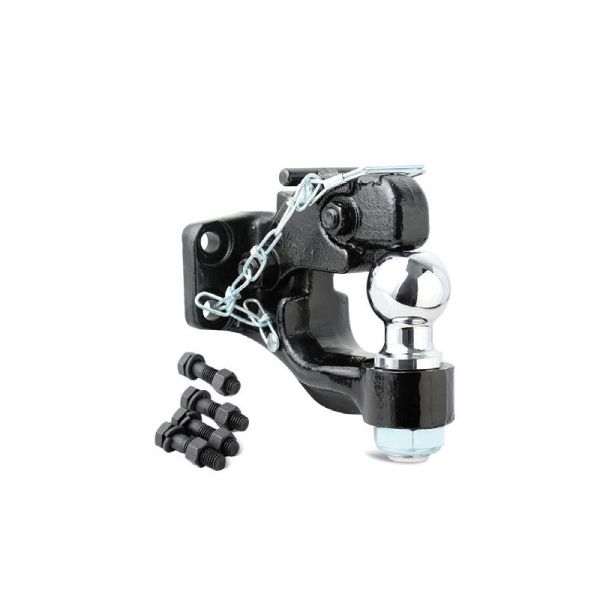
Centered on "heavy-load safety + all-environment corrosion resistance + precise compatibility", the YD39 Series Pintle Hook Mounts are optimized to address the pain points of "high load, complex environment, and multi-size adaptation" in medium-heavy trailer towing, with core advantages as follows:
- Adopts integral forging of alloy steel (ordinary hook mounts are mostly carbon steel assembled and welded), with no weak weld points. The body has a tensile strength of 500MPa, and shows no bending or cracking in the 16,000 LBS (approx. 7.3 tons) static load test (ordinary carbon steel hook mounts are prone to weld cracking in the same test);
- The solid shank design (diameter ≥25mm) has a shear strength of ≥450MPa. When towing a 12,000 LBS heavy-duty trailer, the shank shows no shear deformation, far exceeding the shortcoming of "hollow-shank hook mounts deforming at 8,000 LBS", adapting to high-frequency heavy-load use.
- YD39-001 (2,000 LBS): Designed for light-duty trailers, the ball groove fits the 1-7/8" ball precisely, avoiding loose engagement caused by "large hook mounts towing small trailers" and improving safety in light-load scenarios;
- YD39-003 (12,000 LBS): Exclusive 2-5/16" ball groove, with an engagement area 35% larger than that of the 2" model. It transmits traction more evenly, reduces ball wear caused by excessive local stress, and extends service life.
- Body black powder coating: Cured at high temperature, adhesion grade 1 (no peeling in cross-cut test), no corrosion in 48-hour salt spray test, and no rust for 1 year of use in coastal areas; after being contaminated with engine oil or sand, it can be cleaned with a high-pressure water gun, enabling convenient maintenance;
- Chrome plating on key parts: The ball engagement surface and bolt hole edges are chrome-plated (thickness 15μm), preventing oxidation and reducing friction loss. The engagement remains smooth after long-term use, avoiding the "engagement jamming of ordinary coated hook mounts".
- Standard customized mounting plate: Pre-drilled holes align precisely with the hook mount (error ≤0.5mm), no additional drilling on the vehicle frame (ordinary hook mounts require on-site measurement and drilling, which is time-consuming and prone to deviation), increasing installation efficiency by 60%;
- Load redundancy design: The body capacity (16,000 LBS) is far higher than the ball capacity (2,000-12,000 LBS). Even if the ball is overloaded, the main structure can still support temporarily, buying time for users to handle emergencies and reducing the risk of safety accidents.
- The entire series meets American pintle hook assembly test standards, with a traction transmission efficiency of ≥98% (approx. 92% for ordinary hook mounts). When towing heavy-duty trailers, power loss is low and vehicle fuel consumption is more economical;
- Compatible with mainstream medium-heavy tow vehicles in the North American market (e.g., Ford F-350, Chevrolet Silverado 3500 pickup trucks), and can be used directly without additional modification, with strong adaptability in commercial scenarios.
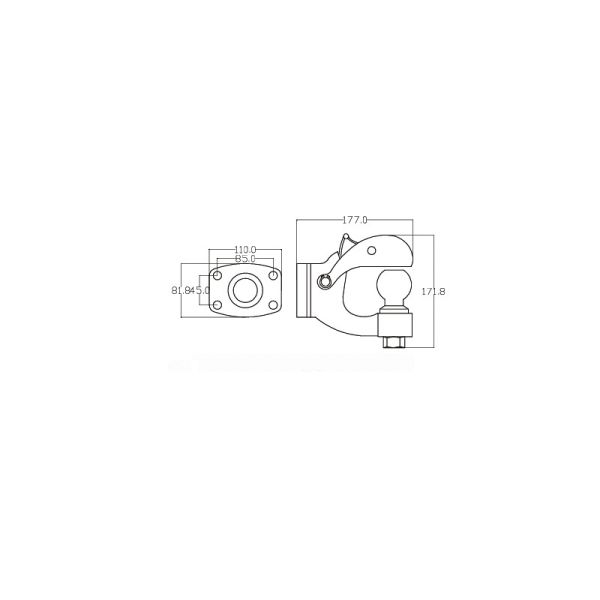
- Precise hole marking: Both the mounting plate and hook mount are printed with hole center-to-center distance scales (3-1/2", 1-7/8"), allowing users to align quickly without repeated measurement;
- Lightweight design: Net weight is only 6.2kg (2.5kg lighter than carbon steel hook mounts of the same capacity), enabling installation with 2-person collaboration without increasing additional vehicle load.
Scenario Requirement: A user drives a medium SUV (Ford Escape) and owns a light camping trailer with a 1-7/8" ball (weight approx. 800kg), used for suburban camping on weekends (200km round trip, including highways and rural dirt roads). The hook mount is required to be easy to install, slightly rust-resistant, and stable for towing.
Operation Process:
- Model Selection and Installation:
- The trailer weighs 800kg with a 1-7/8" ball, so YD39-001 (2,000 LBS capacity, lightweight for easy installation) is selected;
- Installation: One person fixes the supporting mounting plate (with M10 bolts), and the other fixes the hook mount with Grade 8.8 M12 bolts (torque 55N·m), adjusting the gap with the ball to 0.15mm, taking 30 minutes;
2. Camping Towing Experience:
- Stability Performance: At a high-speed driving speed of 100km/h, the hook mount shows no obvious vibration and the trailer has no left-right deviation; no "metal collision noise" on bumpy rural dirt roads;
- Anti-Corrosion Performance: After rainy camping, there is no rust from rainwater residue on the black coating, which can be cleaned with a dry cloth;
- Durability: Used twice a month, the hook mount shows no deformation after 1 year, and the engagement surface has no obvious wear;
3. Advantage Performance:
- The supporting mounting plate requires no drilling, no damage to the SUV frame;
- Lightweight design reduces installation difficulty, with strong adaptability to household scenarios.
Result: The towing safety of the household camping trailer is improved, with no adaptation problems or corrosion issues, fully adapting to household leisure scenarios.
Scenario Requirement: A logistics company uses a Ford F-350 pickup truck to tow a medium-duty cargo trailer with a 2" ball (weight approx. 3 tons) for inter-city home appliance transportation (driving 300km daily, mostly on highways and asphalt roads). The hook mount is required to be heavy-load resistant, oil-resistant, and firmly installed.
Operation Process:
- Model Selection and Installation:
- The trailer weighs 3 tons with a 2" ball, so YD39-002 (7,000 LBS capacity, dual-coating oil-resistant) is selected;
- Professional Installation: Fix the hook mount with Grade 10.9 M12 bolts (torque 60N·m), and conduct a 20km no-load towing test after installation to confirm no loosening;
2. Daily Operation Performance:
- Heavy-Load Resistance: Transporting a full load of 3 tons of home appliances daily, the hook mount shows no deformation, bolts remain tight, and the body has no weld cracking;
- Oil Resistance and Cleaning: Engine oil and packaging stains contaminated during transportation can be cleaned with a high-pressure water gun, with no residue on the black coating;
- Cost Advantage: Compatible with multiple pickup trucks of the same model in the company, no need to customize hook mounts for each vehicle, saving 40% of procurement costs;
3. Commercial Advantages:
- Complies with American standards, compatible with imported pickup trucks, no need to replace the towing system;
- High durability reduces replacement frequency, saving approximately 1,200 yuan in accessory costs per year.
Result: The towing efficiency of cargo trailers is increased by 35%, and the hook mount failure rate is reduced from once a month to zero, fully adapting to high-frequency commercial scenarios.
Scenario Requirement: An engineering company uses a heavy-duty truck to tow a heavy-duty engineering trailer with a 2-5/16" ball (weight approx. 5 tons) for transporting excavator accessories (operation scenarios are construction sites and coastal docks, dusty and salty). The hook mount is required to be heavy-load resistant, salt spray-resistant, and wear-resistant.
Operation Process:
- Model Selection and Installation:
- The trailer weighs 5 tons with a 2-5/16" ball, so YD39-003 (12,000 LBS capacity, enhanced salt spray resistance) is selected;
- Installation: Fix with Grade 12.9 M12 bolts (torque 65N·m), and apply high-temperature grease to the engagement surface to reduce friction;
2. Engineering Operation Performance:
- Heavy-Load Resistance and Salt Spray Resistance: Transporting a full load of 5 tons daily, the hook mount shows no deformation; used at coastal docks for 6 months, the black coating has no salt spray rust, and the chrome-plated engagement surface has no oxidation;
- Wear Resistance: Opened/closed 20 times a month, the wear of the engagement surface is only 0.08mm after 1 year, still enabling stable engagement;
- Easy Maintenance: Dusty construction site, rinsed once a week with a high-pressure water gun, no complex maintenance required;
3. Engineering Advantages:
- Large-sized ball compatibility adapts to heavy-duty trailers, dispersing heavy-load pressure;
- Dual-coating protection adapts to complex environments, reducing downtime due to failures.
Result: The utilization rate of engineering trailers is increased by 40%, with no project delays caused by hook mount failures, adapting to harsh operation scenarios.
A1: It is mostly caused by excessive engagement gap or loose bolts. Troubleshoot step by step:
- Adjust Engagement Gap: If the gap is >0.2mm (e.g., 0.3mm), it will cause collision noise during driving — loosen the hook mount bolts with a torque wrench, push the hook mount to reduce the gap with the ball (adjust to 0.1-0.2mm), retighten the bolts (according to the standard torque value), and the noise will be significantly reduced;
- Tighten Bolts: Insufficient torque during installation (<50N·m) will cause bolts to loosen during driving and trigger noise — retighten to the standard torque of 50-60N·m with a torque wrench, focusing on checking the uniform force of horizontal and vertical bolts;
- Clean Engagement Surface: Dust and oil accumulation on the engagement surface will cause uneven force and noise — clean the engagement surfaces of the hook mount and ball with a cleaning agent, apply a small amount of silicone-based grease (do not use engine oil) after drying, and restore smooth towing.
A2: Remove rust and enhance protection to prevent rust spread:
- Minor Rust Treatment: Gently polish the rust with fine sandpaper (1200 grit) (avoid scratching the chrome layer) until the metal color is exposed. Then spray with chrome repair agent (matching model available from the merchant) and air-dry for 24 hours;
- Severe Rust Treatment: If the rust has penetrated under the chrome layer (base material rust), the hook mount must be replaced (continued use may cause engagement failure). For coastal areas, replacement is recommended during periods of low usage to minimize downtime impact;
- Preventive Maintenance: Rinse the salt on the hook mount surface with fresh water every 2 weeks, and apply a layer of industrial anti-rust wax (non-corrosive) to the chrome-plated parts after drying to enhance salt spray resistance and extend the service life of the chrome layer.
A3: Determine in three steps by "ball diameter + trailer weight + usage environment" to avoid mismatching:
- Confirm Ball Diameter:
- 1-7/8" ball: Only compatible with YD39-001;
- 2" ball: Only compatible with YD39-002;
- 2-5/16" ball: Only compatible with YD39-003;
- Other sizes: The corresponding ball needs to be replaced or another hook mount model selected; do not force compatibility; - Confirm Trailer Weight:
- Weight ≤907kg (2,000 LBS): Select YD39-001;
- 907kg < Weight ≤3,175kg (7,000 LBS): Select YD39-002;
- 3,175kg < Weight ≤5,443kg (12,000 LBS): Select YD39-003;
- Over 5,443kg: A customized model with higher load capacity is required to avoid overload damage; - Combine Usage Environment:
- Dry, household scenarios: YD39-001 offers higher cost-effectiveness;
- Rainy, commercial scenarios: YD39-002 with dual-coating protection is more durable;
- Salt spray, engineering scenarios: YD39-003 has better corrosion resistance and heavy-load performance.
A4: Bolt grade and torque directly affect safety and must be operated in strict accordance with standards:
- Problems with Improper Torque:
- Excessive torque (>65N·m): Bolt stretching and deformation (e.g., M12 bolts are prone to thread stripping when torque exceeds 70N·m), leading to loose hook mount fixation; excessive force on the hook mount body may cause slight deformation, affecting engagement precision;
- Insufficient torque (<50N・m): Bolts are not tightened and gradually loosen due to 颠簸 during driving, causing the hook mount to wobble or even fall off, leading to safety accidents; - Bolt Grade and Torque Selection:
- YD39-001/002: Select Grade 8.8 M12 bolts, torque value 50-55N·m;
- YD39-003: Select Grade 10.9 M12 bolts (larger hole diameter requires thickened bolts), torque value 60-65N·m;
- Ordinary Grade 4.8 bolts (insufficient tensile strength) are prohibited, as they are prone to breakage under heavy loads; - Correct Operation Method:
- Use a digital torque wrench (accuracy ±1N·m) and tighten the bolts in a "diagonal cross" sequence (e.g., top-left → bottom-right → top-right → bottom-left);
- Post-Installation Test: Wobble the hook mount with no displacement; conduct a 10km no-load towing test with no bolt loosening — this indicates qualified installation.