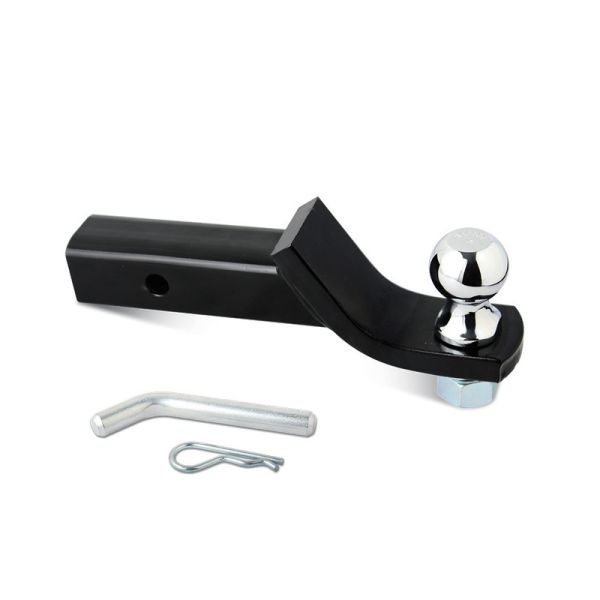
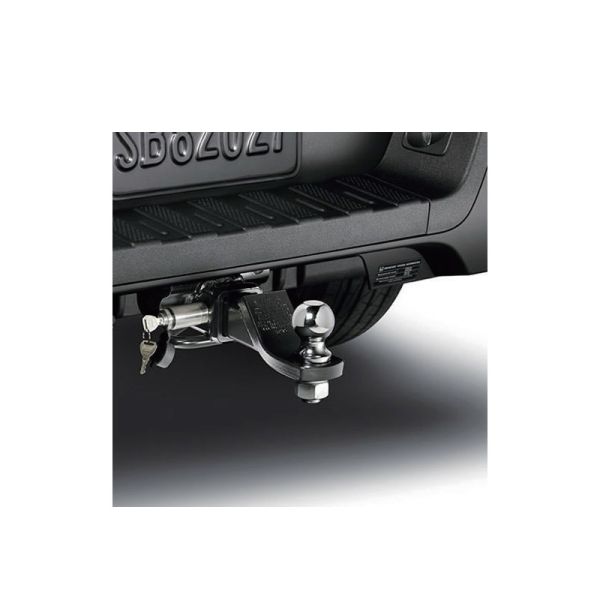
Centered on "high load-bearing + strong adaptability + corrosion resistance", the YD034 Integrated Standard Ball Mount Kit is optimized for safety and practicality in trailer towing scenarios, with core advantages as follows:
- The mount body adopts one-piece welded high-strength steel (ordinary ball mounts are mostly assembled structures). The tensile strength of welds is ≥450MPa, with no cold welding or missing welding. It can stably bear 6,000 LBS (approx. 2.7 tons) (e.g., towing a medium trailer fully loaded with goods);
- In the 2.7-ton full-load towing test, the mount shows no obvious deformation (bending ≤1mm), far exceeding the shortcoming of ordinary mounts that "deform under 3,000 LBS load", making it suitable for medium-to-heavy towing scenarios such as cargo transportation and RV travel.
- The mount tube precisely matches the 2"×2" standard trailer receiver (gap ≤0.5mm), with no wobbling after insertion. Combined with the 5/8" hitch pin for locking, there is no abnormal noise during driving (ordinary mounts tend to produce "metal collision noise" due to large gaps);
- The trailer ball size (2"×1"×2") is compatible with most standard trailer couplers worldwide (e.g., common trailer types in North America and Europe), eliminating the need for additional adapter replacement and increasing versatility by 80%.
- Black powder coating on the ball mount surface: Cured at high temperature with strong adhesion (no peeling in cross-cut test). When used in rainy, muddy, or salt spray environments (e.g., coastal areas), it shows no rust for 6 months (ordinary painted mounts start to rust in 3 months);
- Trailer ball options (chrome-plated, zinc-coated, stainless steel): Chrome-plated version is fingerprint-resistant and easy to clean; Zinc-coated version is cost-effective with basic corrosion resistance; Stainless steel version is suitable for long-term outdoor and high-humidity scenarios (e.g., coastal camping trailer towing), meeting diverse user needs.
- The standard chrome-plated hitch pin is zinc-coated, with smooth insertion and removal (switch life ≥1,000 times) and no "rust jamming" (ordinary iron hitch pins rust and become hard to pull out in 6 months);
- Aluminum alloy trailer ball: 30% lighter than steel (approx. 0.8kg), reducing the towing burden on vehicles. Meanwhile, its surface hardness reaches HB85, resistant to collision and wear (no obvious marks from slight scratches).
- YD034-001 (2" drop): For low-body vehicles such as sedans and compact SUVs. When towing small camping trailers, it keeps the trailer chassis parallel to the ground (avoiding cargo tilting caused by "high front and low rear");
- YD034-002 (3" drop): For high-body vehicles such as mid-to-large SUVs and pickup trucks. When towing RVs and medium trailers, it prevents the trailer chassis from scraping the ground (no "bottom scraping" risk when passing speed bumps or potholes).
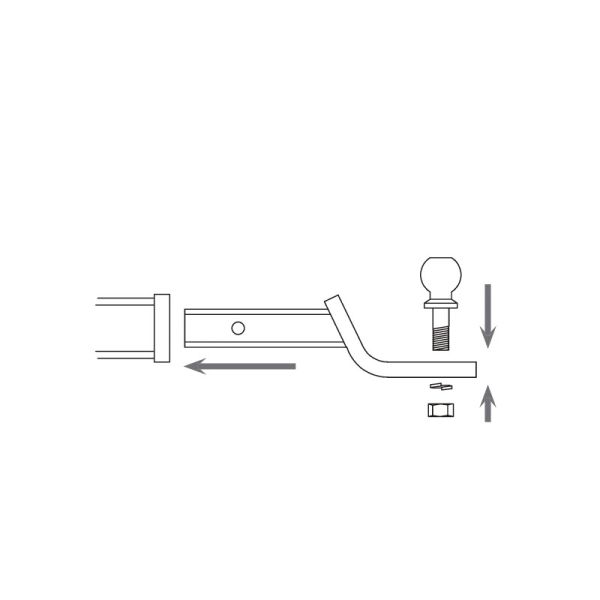
- Simplified installation steps: Just insert the mount tube into the trailer receiver, lock with a hitch pin (or add a trailer lock for anti-theft), then install the trailer ball according to the diagram. The whole process takes less than 5 minutes (ordinary mounts require adjusting gaskets and aligning holes, taking over 15 minutes);
- Convenient unlocking and replacement: To switch trailer types, simply pull out the hitch pin and remove the trailer ball for quick replacement (e.g., switching from towing a camping trailer to a cargo trailer), adapting to flexible scenario changes.
Scenario Requirement: A user drives a compact SUV (body height 1.6m) and needs to tow a 2.5m-long camping trailer (full-load weight approx. 1.8 tons). The mount is required to match the vehicle height, be corrosion-resistant (for outdoor rainy use), and easy to install (single-person operation).
Operation Process:
- Model Selection:
- Due to the moderate body height of the SUV, YD034-001 (2" drop) is selected to keep the camping trailer chassis parallel to the ground (avoiding cargo tilting);
- Accessory Selection: A stainless steel trailer ball is chosen (frequent rainy weather outdoors requires high corrosion resistance), paired with a chrome-plated hitch pin;
2. Installation and Use:
- Installation: Insert the mount tube into the SUV's 2"×2" trailer receiver, lock with the 5/8" hitch pin, then install the trailer ball according to the diagram, taking 4 minutes;
- Towing Experience: A 300km round trip for weekend camping (including highways and rural dirt roads) with no mount wobbling or abnormal noise, and no rust after rainy use;
3. Advantage Performance:
- Single-person installation is achievable without assistance;
- The stainless steel trailer ball is easy to clean, and can be rinsed with water after use on muddy roads.
Result: Towing safety of the camping trailer is improved, with no "cargo tilting" or "mount abnormal noise". Accessories are durable with no damage after 6 camping trips, adapting to family outdoor leisure needs.
Scenario Requirement: A logistics company uses a pickup truck (body height 1.8m) to tow a 3-ton cargo trailer (full-load weight approx. 2.5 tons). The mount is required to have strong load-bearing (≥2.5 tons), wear resistance (frequent cargo loading/unloading), and compatibility with trailer couplers.
Operation Process:
- Model and Accessory Selection:
- Due to the high body height of the pickup truck, YD034-002 (3" drop) is selected to prevent the trailer chassis from scraping the ground;
- A chrome-plated trailer ball is chosen (easy to wipe off oil stains in cargo scenarios), and a zinc-coated hitch pin (cost-effective and meeting basic corrosion resistance needs);
2. Daily Use:
- Installation: After loading/unloading cargo daily, the hitch pin is inserted/removed and trailers are replaced (e.g., switching from a construction material trailer to an appliance trailer) with smooth operation and no jamming;
- Load-Bearing Performance: Stable towing with 2.5-ton full load, no mount deformation, and steady trailer movement (no "left-right swaying") during driving;
3. Durability:
- The black powder-coated mount shows no rust after 3 months of use in the muddy environment of the cargo yard;
- The chrome-plated trailer ball is wear-resistant, with no obvious scratches after frequent contact with the trailer coupler.
Result: Cargo transportation efficiency is increased by 30% (shorter installation time reduces waiting), with no mount or accessory damage, lowering maintenance and replacement costs and adapting to high-frequency cargo transportation scenarios.
Scenario Requirement: A user drives a mid-to-large SUV (body height 1.7m) to tow a 6m-long RV (weight approx. 2.2 tons) for an inter-provincial long-distance trip (2,000km). The mount is required to be stable (no wobbling at high speed), salt spray-resistant (driving on coastal highways), and easy to maintain.
Operation Process:
- Model and Accessory Selection:
- YD034-001 (2" drop) is selected to match the height difference between the SUV and the RV, ensuring stable RV towing;
- A stainless steel trailer ball is chosen (strong salt spray resistance for coastal highways), and a trailer lock is added (to prevent mount theft);
2. Long-Distance Use:
- High-Speed Driving (100km/h): No mount wobbling, good RV followability (no "delayed swaying");
- Maintenance: Wipe the mount and trailer ball with a dry cloth after parking every night, with no salt spray rust after 7 days of travel;
3. Emergency Adaptation:
- During the trip, it is necessary to temporarily tow a friend's small camping trailer (weight 1 ton). The RV coupler is removed and the camping trailer is installed without replacing the mount, enabling flexible adaptation to different trailer types.
Result: High safety in long-distance towing, no "high-speed wobbling" or "salt spray rust", convenient maintenance, and adaptation to cross-scenario and long-distance towing needs.
A1: It is mostly caused by excessive gaps or unfastened hitch pins. Troubleshoot step by step:
- Check Mount-Receiver Gap: If the gap between the mount tube and the 2"×2" trailer receiver is >1mm (normal allowable gap ≤0.5mm), it may be due to wear on the receiver inner wall or deviation in the mount tube size — stick a layer of thin rubber strips (0.5mm thick) on the outer side of the mount tube to fill the gap and eliminate the noise;
- Confirm Hitch Pin Lock Status: The hitch pin is not fully inserted into the hole (e.g., only half-inserted) or mismatched with the hole (non-5/8" size), causing loosening and collision during driving — reinsert the hitch pin (ensure full locking) or replace it with the standard 5/8" hitch pin, and test if the noise disappears;
- Check Trailer Ball Installation: The trailer ball is not tightened (e.g., threads not fully screwed in), causing collision with the mount during driving — reinstall the trailer ball according to the diagram, tighten with a wrench (torque ≥30N·m), and ensure no loosening.
A2: Repair the coating and enhance protection to extend service life:
- Minor Rust Treatment: Gently polish the rusted area with fine sandpaper (800 grit) (avoid scratching the intact coating around), until the metal color is exposed. Then spray with a black powder coating touch-up pen (matching model available from the merchant) and air-dry for 24 hours;
- Large-Area Coating Peeling: If the peeling area exceeds 10%, it is recommended to contact the merchant to replace the mount body (or perform professional spray repair) to prevent further rusting of the base material;
- Preventive Maintenance: Wipe the mount surface with a neutral detergent (e.g., dish soap) every quarter, and apply a thin layer of industrial anti-rust wax (non-corrosive) after drying to enhance corrosion resistance, especially for users in coastal and rainy areas.
A3: Select based on the match between the tow vehicle's body height and the trailer's chassis height. The core principle is "keep the trailer chassis level during towing":
- Measure Key Dimensions:
- Step 1: Measure the height from the "trailer receiver center point" of the tow vehicle to the ground (recorded as H1);
- Step 2: Measure the height from the "trailer coupler center point" to the ground (recorded as H2); - Calculate and Select:
- If H1 - H2 ≈ 2" (50.8mm): Choose YD034-001 (2" drop) to keep the trailer chassis level;
- If H1 - H2 ≈ 3" (76.2mm): Choose YD034-002 (3" drop) to prevent the trailer chassis from being too high or too low;
- Example: For a compact SUV with H1=14" and a camping trailer with H2=12", H1-H2=2", so YD034-001 is selected; For a pickup truck with H1=15" and an RV with H2=12", H1-H2=3", so YD034-002 is selected.
A4: Select based on usage environment, budget, and maintenance needs. Specific adaptations are as follows:
- Chrome-Plated Version:
- Advantages: Bright surface, fingerprint-resistant, easy to clean (oil stains can be wiped off);
- Applicable Scenarios: Short-distance towing in cities (e.g., shopping trailers), users who value appearance cleanliness (e.g., family camping trailers); - Zinc-Coated Version:
- Advantages: Low cost, basic corrosion resistance (no obvious rust in rainy days);
- Applicable Scenarios: Arid areas (e.g., northern inland regions), low-frequency use (e.g., 1-2 times a month), users with limited budgets; - Stainless Steel Version:
- Advantages: Strongest corrosion resistance (no rust in salt spray and high-humidity environments), longest service life (3-5 years without damage);
- Applicable Scenarios: Coastal areas (high salt spray), long-term outdoor use (e.g., RV long-distance travel), high-frequency towing (e.g., logistics companies);
- Summary: Prioritize selection based on "corrosion degree of the usage environment" — stainless steel for high corrosion, chrome-plated/zinc-coated for medium-low corrosion