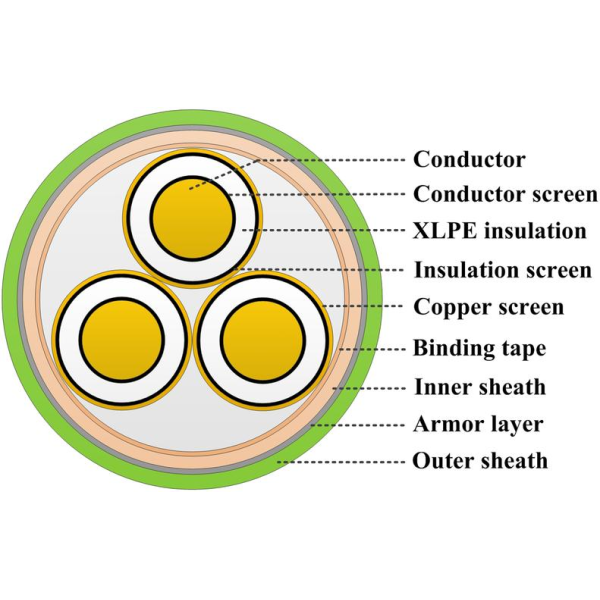
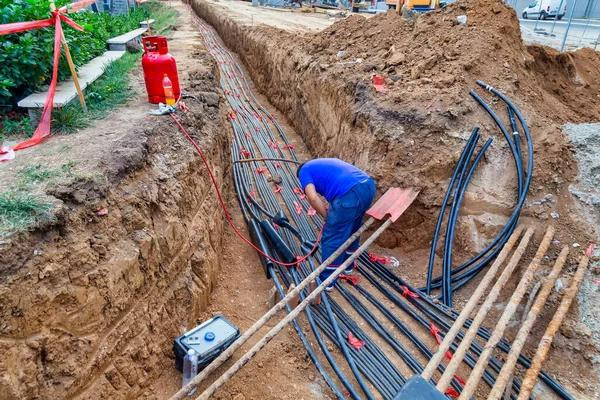
The High Voltage XLPE Insulated Armored Power Cable is designed for reliable energy transmission in medium and high-voltage electrical networks. According to the cable structures shown, the product adopts a multi-layer construction including copper conductor, XLPE insulation, metallic shielding layer, steel tape or steel wire armor, and protective outer sheath, providing excellent electrical performance and strong mechanical protection.
This type of power cable is widely applied in underground power distribution, industrial facilities, substations, renewable energy projects, and urban electrical infrastructure where safety, durability, and stable power delivery are required.
With excellent insulation performance, high current-carrying capacity, and resistance against mechanical impact, the cable provides a long-term solution for fixed power transmission applications.

Based on the cable cross-section structure, the main layers include:
The cable uses high-conductivity copper conductors to ensure efficient current transmission with low electrical resistance. The stranded conductor structure improves flexibility and installation convenience.
Cross-linked polyethylene (XLPE) insulation provides:
It is suitable for long-term operation under medium and high-voltage conditions.
The shielding layer helps control the electric field distribution around the insulation and improves cable safety during operation.
Depending on project requirements, the cable can be equipped with:
The armor layer enhances resistance against mechanical damage, external pressure, and underground installation stress.
The outer sheath protects the internal cable structure from moisture, corrosion, abrasion, and environmental influences.
| Product Technical Parameters | |
| Item | Specification |
| Product Name | High Voltage XLPE Insulated Armored Power Cable |
| Cable Type | Medium / High Voltage Power Cable |
| Conductor Material | Copper |
| Conductor Type | Stranded Copper Conductor |
| Insulation Material | XLPE (Cross-linked Polyethylene) |
| Shielding Layer | Copper Tape / Copper Wire Screen |
| Armor Type | Steel Tape Armor / Steel Wire Armor |
| Outer Sheath | PVC / PE / LSZH Customized |
| Rated Voltage | 6kV / 10kV / 15kV / 20kV / 26kV / 35kV |
| Voltage Class | Medium Voltage & High Voltage |
| Core Number | 1 Core / 3 Core / 4 Core / Customized |
| Cross Section Area | Customized According to Project Requirements |
| Installation Method | Underground / Duct / Direct Burial |

Used for urban electrical grids, residential communities, commercial buildings, and municipal power distribution systems where overhead lines are unsuitable.
Applied in factories, mining facilities, chemical plants, and manufacturing sites requiring stable and continuous electricity supply.
Suitable for solar farms, wind power stations, and energy storage facilities to transmit generated electricity to substations or distribution networks.
Used for connecting transformers, switchgear, and power distribution equipment in medium and high-voltage substations.
Commonly installed in:
where reliable power transmission is essential.
A: It is a power transmission cable that uses XLPE as the insulation material and adds a metallic armor layer for mechanical protection. It is mainly used in medium and high-voltage electrical systems.
A: The armor layer protects the cable from external mechanical damage, pressure, impact, and underground installation risks, allowing safer direct burial applications.
A: XLPE provides excellent insulation strength, low dielectric loss, high temperature resistance, and stable electrical performance, making it suitable for high voltage power transmission.
A: Yes. Armored versions are commonly designed for underground installation. The exact installation method depends on cable type, local regulations, and project requirements.
A: Common voltage ratings include 6kV, 10kV, 15kV, 20kV, 26kV, and 35kV. Customized voltage levels can also be produced according to customer specifications.
A: Steel tape armor provides strong protection against compression and is commonly used for underground applications. Steel wire armor offers higher tensile strength and is suitable for installations requiring greater mechanical pulling resistance.