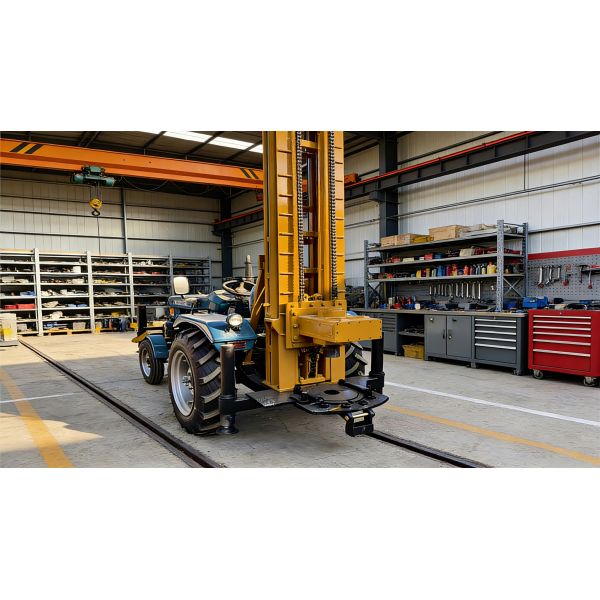
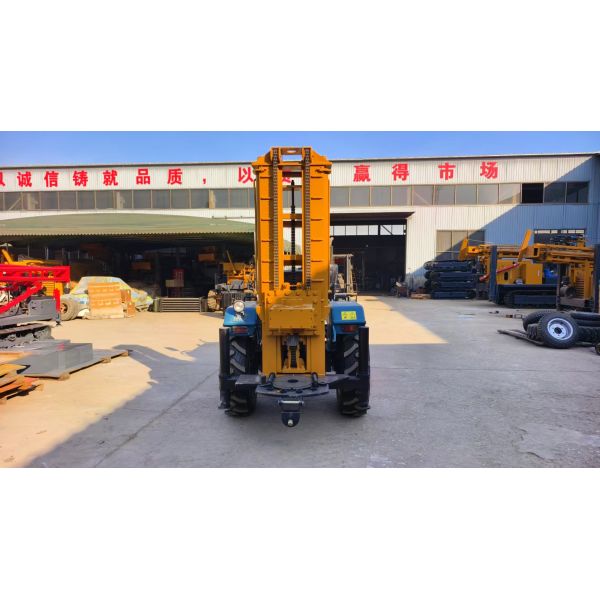
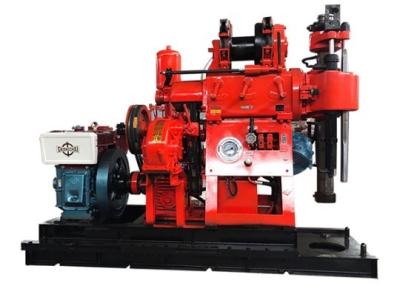
Working principle of traction water well drilling rig
1, Principles of Power Drive and Transmission
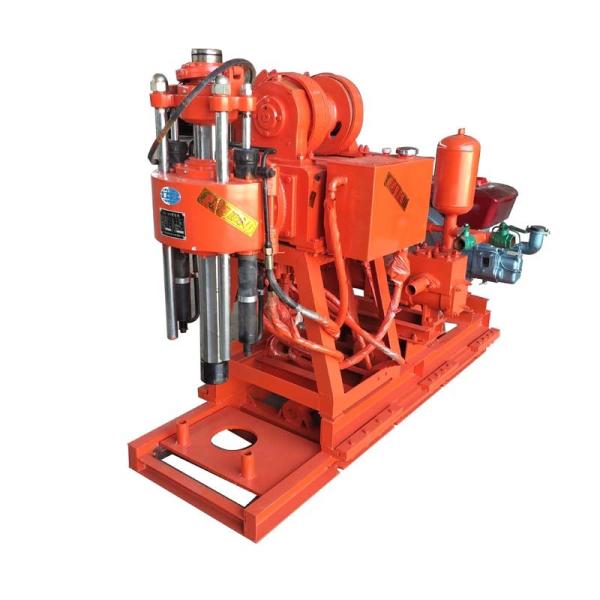
The equipment uses a "tractor+electric motor+generator" as its multi-dimensional power core, and accurately transmits power to the drilling execution components through a mechanical transmission system:
A 36 horsepower tractor provides traction power (to achieve equipment site transfer) and basic operation power, an 11 kW electric motor serves as the core drilling driving force, and a 30 kW generator ensures stable power supply for the entire equipment (including motors, instruments, and auxiliary systems). The three work together to meet the power needs of different operation stages;
The power is transmitted to the power head at the top of the drill pipe through the gearbox and transmission shaft, converting electrical/mechanical energy into the rotational torque of the drill pipe (up to 260 N · m) and the downward drilling pressure, providing core power for formation fragmentation.
2, Principles of Formation Fracture and Drilling Formation
According to the geological conditions of the work area (soil, sand layer, soft rock, etc.), the formation is broken through the mechanical action of the drill bit, gradually forming a wellbore:
Choose a suitable drill bit (such as spiral drill bit, alloy drill bit), the drill rod drives the drill bit to rotate at high speed, and the drill bit edge crushes underground rock layers and soil into small drill slag through cutting, grinding, impact and other methods;
During the drilling process, the drill pipe is fixed by the clamping device of the equipment (maximum clamping angle of 30 °) to ensure that the drill pipe is vertically and stably drilled, avoiding wellbore inclination; At the same time, according to the drilling depth (up to 150 meters) and diameter (150-500 millimeters) requirements, drill rods are spliced section by section to continuously extend the wellbore underground.
3, Principle of drilling slag discharge and wellbore protection
Simultaneously discharge drilling debris during drilling to avoid blockage of the wellbore and ensure wellbore stability:
Adopting "dry slag discharge" or "wet slag discharge" (depending on geological conditions): The soft soil layer can be transported upwards to the surface by the spiral blades of the spiral drill bit, which rotates with the drill bit; Hard formations or sand layers can be injected with clean water/mud to form mud circulation, which carries drilling debris and is discharged from the gap between the wellbore and the drill pipe;
If encountering loose and prone to collapse formations, a wellbore pipe (casing) can be inserted during the drilling process, and the casing position can be fixed by a clamping device to prevent wellbore collapse and ensure the quality of wellbore formation.