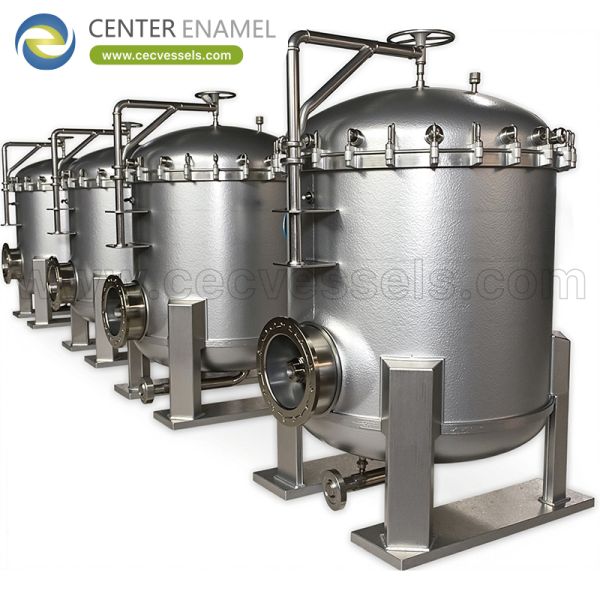
Specifications
Delivery Time :
2 months
Design Pressure :
0.1-10 Mpa
Certification :
ASME,ISO 9001,CE, NSF/ANSI 61, WRAS, ISO 28765, LFGB, BSCI, ISO 45001
Place of Origin :
China
Price :
10000 USD
Material :
Stainless Steel, Carbon Steel
Supply Ability :
200 sets / days
Applications :
Chemical, Food Processing, Beverage Processing, Brewing, Metallurgy, Oil Refining, Pharmaceuticals
Payment Terms :
L/C,T/T
Brand Name :
Center Enamel
MOQ :
1 Sets
Size :
Customized
Description
Choose the Right Brite Tank (Beer Tank) for Carbonation: Jacketed Brite Beer Tanks, BBL Sizing, and Brewery-Ready Details

Answering the core question: How do you choose the right jacketed brite beer tank for carbonation, and what BBL sizing and brewery-ready details ensure optimal cellar efficiency? A brite tank (or bright beer tank) is a pressurized stainless steel vessel where fermented beer undergoes cold-conditioning, clarification, and precise carbonation before packaging or direct draft dispense.1 Selecting a jacketed brite tank with the correct barrel (BBL) capacity, pressure rating, and auxiliary hardware is essential for maintaining product clarity, flavor stability, and packaging speed.

1. The Importance of Jacketed Design and Temperature Control

Temperature control is non-negotiable when conditioning and carbonating beer:2

  • Glycol-Jacketed Efficiency: Jacketed brite tanks feature integrated cooling channels (dimple jackets) wrapped around the cylinder and sometimes the cone. Connected to a glycol chiller, these zones allow brewers to rapidly cold-crash beer down to 0°C to 2°C, forcing yeast and proteins to drop out of suspension.

  • Thermal Stability During Carbonation: Maintaining a stable, cold temperature is vital because carbon dioxide absorption rates increase significantly at lower temperatures. A jacketed design ensures consistent temperature distribution throughout the vessel volume.

2. Calculating BBL Sizing and Headspace Requirements

Matching your brite tank capacity to your brewhouse output prevents workflow bottlenecks:

  • Accounting for Headspace: Always choose a brite tank with approximately 10% to 25% extra headspace above your standard batch volume. For example, a 10 BBL brewhouse batch requires an 11 to 12 BBL brite tank to safely accommodate foaming, cleaning solutions, and carbonation head pressure without risking blow-off.

  • Double-Batching Considerations: If your cellar operations involve double-batching lagers or high-turnover ales into a single vessel, size your brite tank to match the combined output (e.g., a 20 BBL brite tank for two 10 BBL turns).

3. Essential Brewery-Ready Hardware and Specifications

A commercial brite tank must be equipped with specialized fittings to ensure safety and precision:

  • Pressure Ratings: Standard commercial brite tanks are engineered to handle a design pressure of 15 to 30 PSI (1 to 2 bar), allowing for safe forced carbonation and counter-pressure transfers.3

  • Sintered Carbonation Stones: Positioned near the bottom dish, a 1-to-2-micron stainless steel porous carb stone diffuses CO2 into micro-bubbles, accelerating gas absorption into the beer.4

  • Safety Mechanisms: Every tank must include a calibrated pressure relief valve (PRV), a pressure gauge, a sanitary sample valve, and a clean-in-place (CIP) spray ball to maintain sterile operating standards.5

Jacketed Brite Tank Sizing and Technical Specifications Matrix
Tank Capacity (BBL)Typical Shell DiameterOverall Height (approx.)Design PressureInsulation & Cooling
5 BBL42 inches80 inches15–30 PSIPolyurethane insulated, dual-zone glycol jacket
7 BBL45 inches81 inches15–30 PSIPolyurethane insulated, dual-zone glycol jacket
10 BBL49 inches91 inches15–30 PSIPolyurethane insulated, dual-zone glycol jacket
15 BBL52 inches94 inches15–30 PSIPolyurethane insulated, dual-zone glycol jacket
20 BBL60 inches104 inches15–30 PSIPolyurethane insulated, dual-zone glycol jacket
Frequently Asked Questions (FAQ)

Q: What is the main purpose of a jacketed brite tank in a brewery?

A: A jacketed brite tank provides a temperature-controlled, pressurized environment to cold-crash, clarify, mature, and carbonate beer before it is sent to packaging or draft lines.6

Q: How do I calculate the right size brite tank for my brewhouse?

A: Your brite tank should match your single-batch brewhouse volume plus an additional 10% to 25% for headspace, or double that capacity if you regularly double-batch.

Q: What pressure rating is standard for commercial brite tanks?

A: Commercial brite tanks are typically rated for 15 to 30 PSI (1 to 2 bar) to safely withstand forced carbonation procedures and backpressure during transfers.7

Q: Why is a sintered carbonation stone important?

A: A sintered carbonation stone features microscopic pores (typically 2 microns) that break incoming carbon dioxide into ultra-fine bubbles, allowing the gas to dissolve rapidly and evenly into the cold beer.8

Send your message to this supplier
Send Now

Choose the Right Brite Tank (Beer Tank) for Carbonation: Jacketed Brite Beer Tanks, BBL Sizing, and Brewery-Ready Details

Ask Latest Price
Delivery Time :
2 months
Design Pressure :
0.1-10 Mpa
Certification :
ASME,ISO 9001,CE, NSF/ANSI 61, WRAS, ISO 28765, LFGB, BSCI, ISO 45001
Place of Origin :
China
Price :
10000 USD
Material :
Stainless Steel, Carbon Steel
Contact Supplier
Choose the Right Brite Tank (Beer Tank) for Carbonation: Jacketed Brite Beer Tanks, BBL Sizing, and Brewery-Ready Details

Shijiazhuang Zhongzheng Technology Co., Ltd.

Verified Supplier
1 Years
hebei, shijiazhuang
Since 2008
Business Type :
Manufacturer
Total Annual :
100,000,000-200,000,000
Employee Number :
400~500
Certification Level :
Verified Supplier
Contact Supplier
Submit Requirement