CUSTOM LiFePO4 BATTERIES | EQUIPMENT INTEGRATION
LiFePO4 battery options for passenger and cargo tricycles, with 51.2 V or 64 V configurations, 60-314 Ah capacity choices, RS485 communication and 15-level BMS protection for compatible vehicle projects.
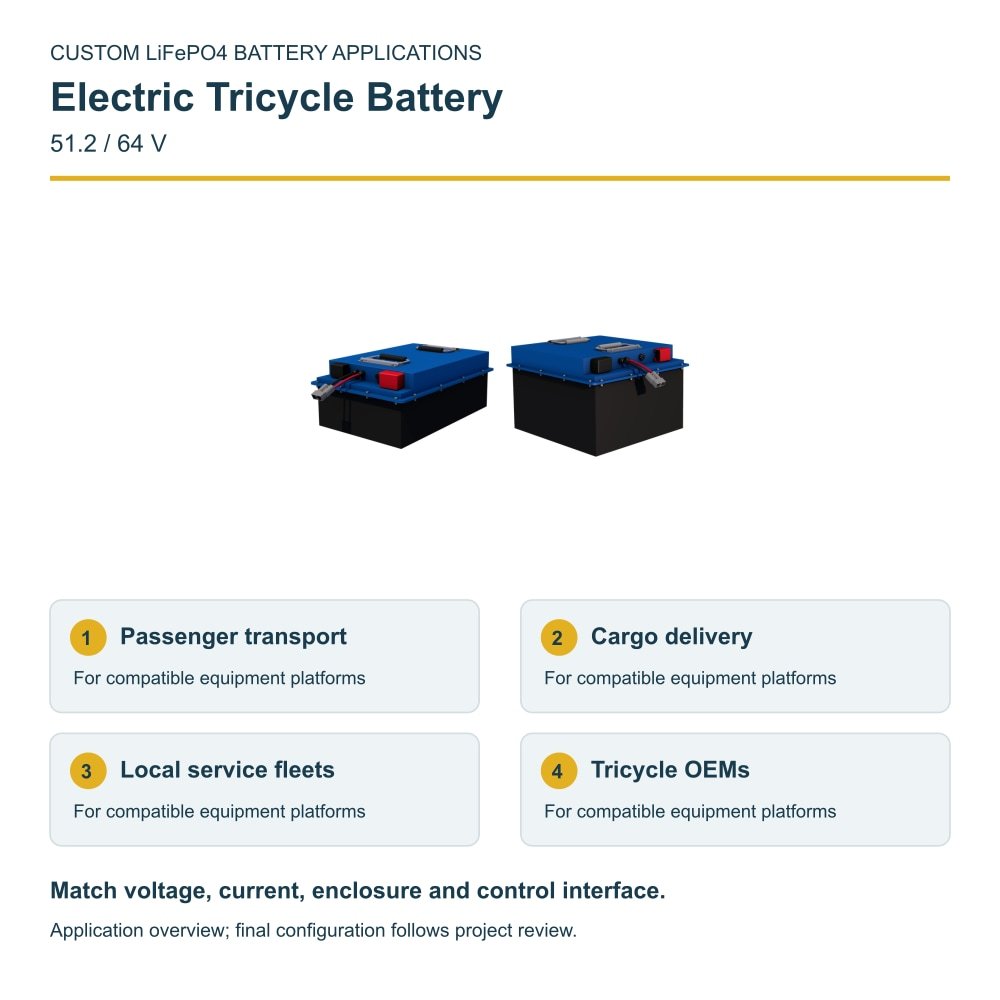
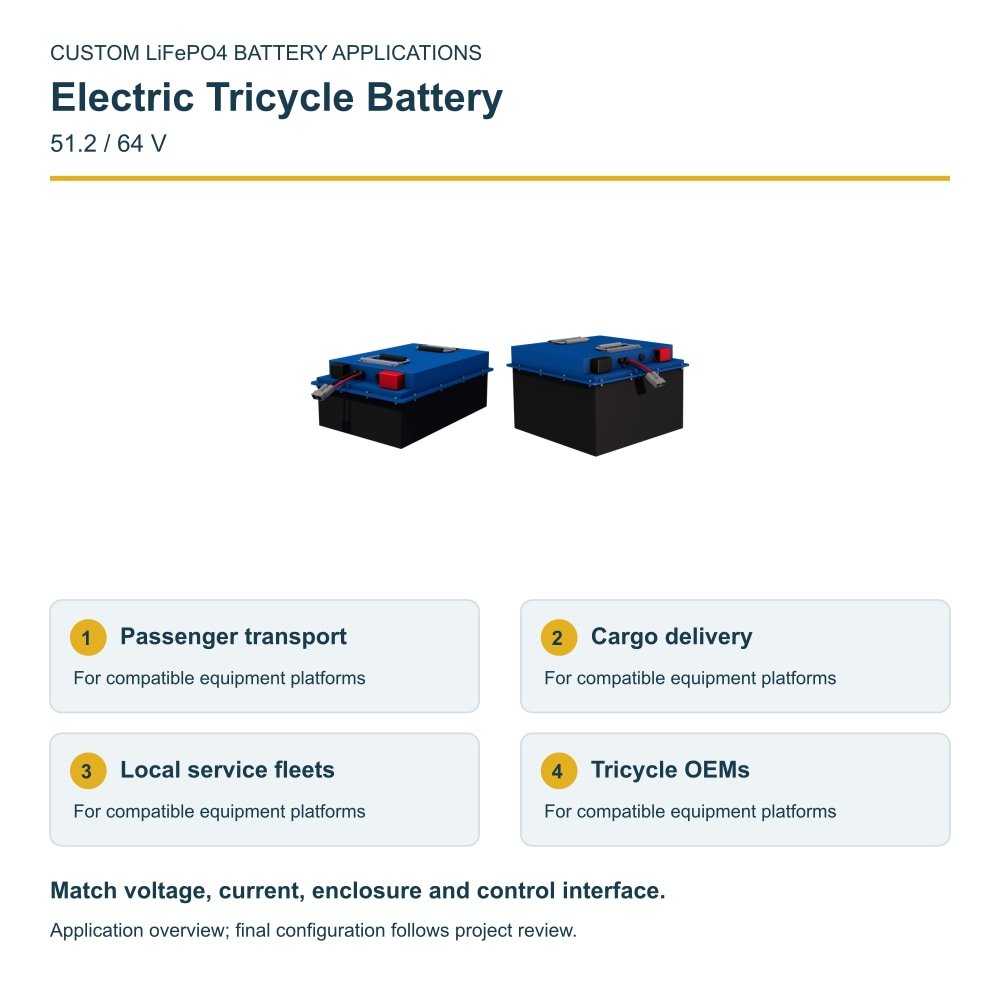
Choose battery capacity around the route, payload and available charging time. The electric tricycle series spans compact 60 Ah packs through 280/314 Ah options, with 51.2 V and 64 V configurations for compatible vehicle platforms. YINTU helps vehicle builders and fleet buyers connect electrical specifications with practical packaging and daily service requirements.
YINTU is an energy storage and battery solution provider. We work with capable manufacturing partners to coordinate product selection, technical clarification and the agreed supply scope for customer equipment projects.
The series offers 60, 100, 150 and 280/314 Ah choices depending on voltage. Match stored capacity to the route and charging schedule; a larger Ah rating does not establish a guaranteed driving distance.
Maximum discharge ranges from 60 A to 150 A across the listed packs. Check controller demand during acceleration, hill climbing and loaded operation when choosing the appropriate version.
The datasheet specifies 15-level BMS protection and RS485 communication. Integration requires agreement on the controller interface, communication messages and protective operating limits for the selected vehicle.
Five table columns describe different enclosure sizes, weights and charging limits. The 64 V 280/314 Ah column covers two capacity choices, so the exact mechanical configuration must be confirmed with the selected version.
Support compatible passenger vehicles operating scheduled local routes. Select capacity around occupancy, gradients, stop frequency and planned charging breaks to develop an appropriate battery proposal for the service.
Provide traction battery options for last-mile delivery and goods transport. Review payload variation, acceleration demands and battery-bay limits alongside daily energy use, keeping the pack selection tied to actual route conditions.
Equip suitable market, maintenance or neighborhood service vehicles with a defined battery configuration. A consistent pack and charger specification can simplify procurement and service planning across an approved fleet platform.
Choose the voltage, capacity, enclosure and cable interface around the vehicle design. YINTU coordinates technical clarification and sample requirements with manufacturing partners so vehicle integration can be evaluated before a production order.
| Parameter | 51.2V60Ah | 51.2V100Ah | 64V100Ah | 64V150Ah | 64V280/314Ah |
|---|---|---|---|---|---|
| Battery chemistry | LiFePO4 | LiFePO4 | LiFePO4 | LiFePO4 | LiFePO4 |
| Nominal voltage | 51.2 V | 51.2 V | 64 V | 64 V | 64 V |
| Rated capacity | 60 Ah | 100 Ah | 100 Ah | 150 Ah | 280 / 314 Ah |
| End-of-charge voltage | 58.0 V | 58.0 V | 73.0 V | 73.0 V | 73.0 V |
| End-of-discharge voltage | 42.0 V | 42.0 V | 54.0 V | 54.0 V | 54.0 V |
| Maximum charge current | 30 A | 50 A | 75 A | 75 A | 100 A |
| Maximum discharge current | 60 A | 100 A | 100 A | 100 A | 150 A |
| Communication | RS485 | RS485 | RS485 | RS485 | RS485 |
| Dimensions (mm; source order) | 365 x 305 x 190 | 497 x 337 x 200 | 585 x 337 x 220 | 410 x 310 x 275 | 765 x 415 x 275 |
| Approximate weight | 23 kg | 40 kg | 50 kg | 68 kg | 128 kg |
The 64V280/314Ah column includes both capacity choices. Confirm enclosure and weight for the selected version. Dimensions retain the source order. Driving range depends on vehicle efficiency, payload, route and operating conditions.
The battery is selected as part of an equipment power system. A matched charging source supplies the pack, and the approved equipment interface connects it to the intended load. Communication and monitoring functions follow the selected configuration. Protection, cable sizing, switching and installation details belong to the final equipment design.
Start with the equipment requirements: controller voltage, payload, route distance and gradients, daily charging windows, battery bay, charger, RS485 interface and the exact 280 Ah or 314 Ah choice. We use this information to compare the listed configurations and identify the technical points that need alignment with the manufacturing partner.
Charger, display, wiring, connectors, monitoring services and installation support are included only where specified in the quotation. Certification requirements, warranty and performance commitments are confirmed for the selected configuration; the series listing does not establish a blanket approval for every application.
The datasheet does not provide a validated range. Distance depends on vehicle efficiency, payload, terrain, speed, usable battery capacity and operating conditions; sizing should use the actual route profile.
Share the equipment model or design, voltage and current requirements, duty cycle, available installation space, charger information and the required control interface. Include any destination-specific testing or approval requirements.
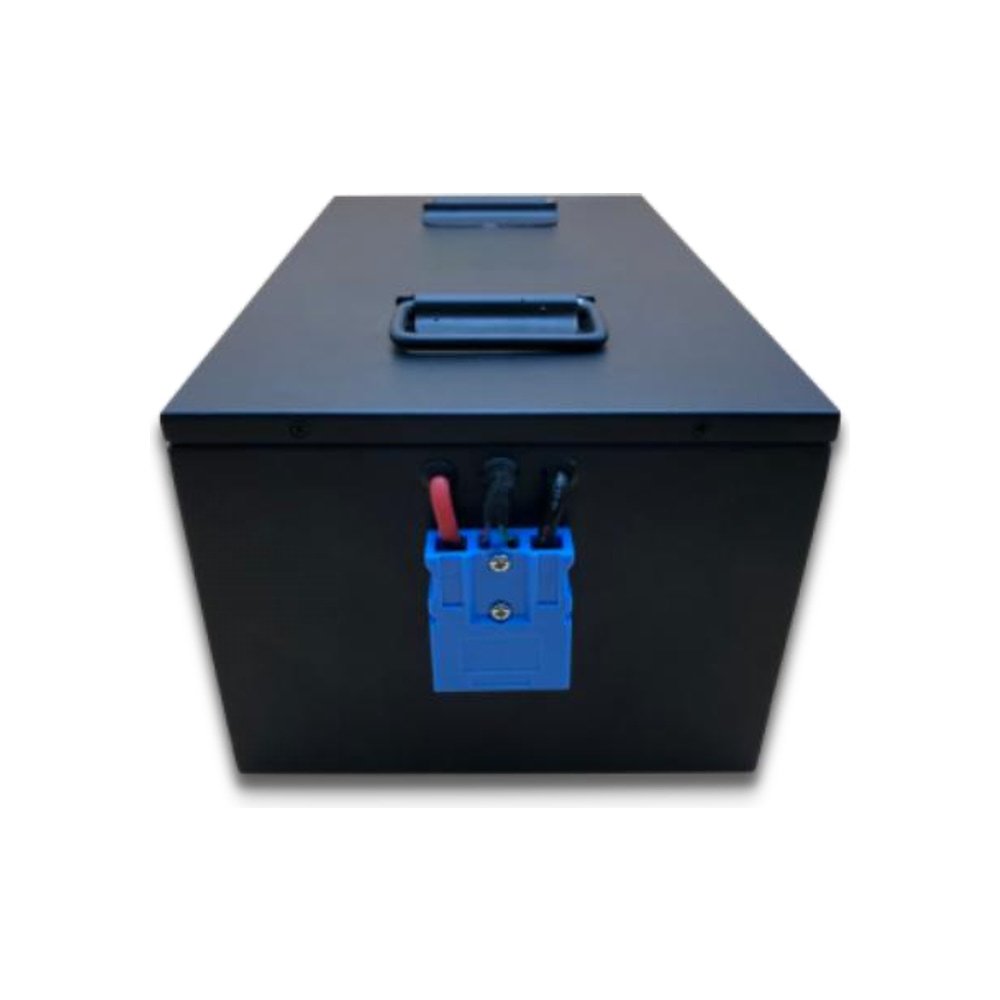
The source images illustrate the product series. Enclosure, terminals, cables and accessories follow the selected configuration and approved drawing. Dimensions in the table retain the source order unless otherwise confirmed.
Send YINTU your equipment requirements and quantity plan. We will coordinate a suitable battery configuration and a clear technical and supply proposal with our manufacturing partners.
Reference: YT-Electric Tricycle Battery Series datasheet, V1.0, October 2026. The original PDF is attached. Where a value is marked with an asterisk, the engineering recommendation in this page requires manufacturer confirmation before order and does not amend the original source document.