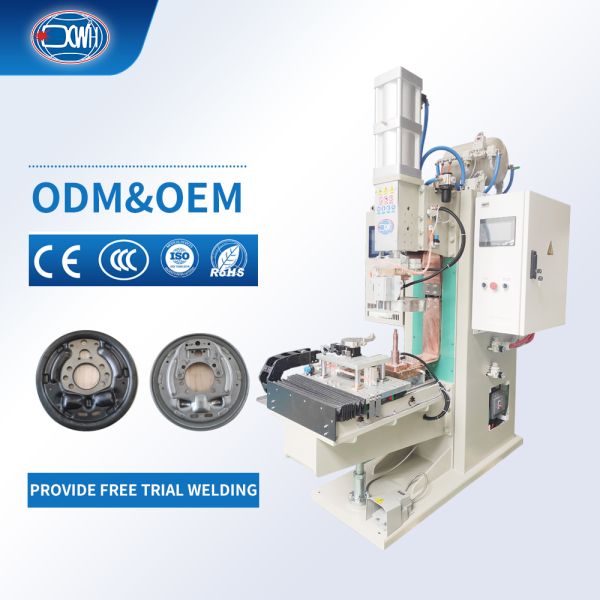
Engineered for high-volume fastener projection welding, this semi-automatic nut resistance welder delivers repeatable joint quality for bolts, studs, and nuts across stainless steel, aluminum, and coated sheet metals. The standing heavy-duty frame with a 100-250 KVA rated capacity handles frequent production cycles while maintaining consistent electrode force and weld timing, making it a practical upgrade for job shops and assembly lines that need dependable throughput without complex robotic integration.
Built around a precision servo drive and digital constant-voltage control, the machine compensates for grid fluctuation and surface oxidation to minimize spatter and weak spots. Quick-change tooling allows operators to switch between nut and bolt specifications in minutes, reducing changeover downtime and supporting mixed-batch production for automotive, appliance, and metal furniture manufacturers.
Mid-frequency direct current technology achieves over 90% conversion efficiency, cutting energy use by 30-50% versus conventional AC resistance welders. Millisecond-level discharge timing shortens weld cycles so operators can complete more parts per shift while reducing strain on the plant electrical network.
Stabilized DC output produces uniform weld nuggets with minimal expulsion, eliminating intermittent weak joints. This is especially important for highly conductive workpieces, aluminum sheets, and multi-layer assemblies where heat balance is difficult to maintain with traditional AC power sources.
Microprocessor-based control stores multiple welding schedules for current, time, and pressure, so changing jobs does not require manual recalibration. Automatic compensation reacts to line-voltage variation and electrode wear, preserving weld strength over long production runs and reducing operator-dependent adjustments.
The compact mid-frequency transformer runs cooler than conventional units, extending service life even under a 50% duty cycle. An integrated water-cooling loop keeps the copper windings and thyristors at a stable temperature, which lowers maintenance frequency and protects your production schedule.
Standard I/O connectors allow straightforward interfacing with conveyors, pneumatic feeders, or a six-axis robot for semi-automated unloading. Optional photoelectric or vision sensors can guide precise electrode positioning, enabling a smooth path to full automation as your order volume grows.
| Industry | Typical Workpiece | Welding Mode |
|---|---|---|
| Automotive | Door hinges, seat frames, battery connectors | Projection welding of nuts and bolts |
| Home Appliance | Sheet metal casings, brackets, internal supports | Spot welding and projection welding |
| Metal Fabrication | Mesh panels, enclosures, mounting plates | Metal mesh and cross-wire welding |
| Electrical & Electronics | Battery straps, terminal lugs, copper connectors | Projection welding of high-conductivity alloys |
The machine directs a controlled mid-frequency DC current through the workpiece while the servo-driven electrode applies preset force. Projection points on the nut or bolt concentrate current density, generating localized resistance heat that rapidly melts the interface. The constant-voltage control loop senses secondary-side conditions and adjusts the pulse profile in real time, so each weld reaches the same penetration depth regardless of minor plate spacing or coating differences. After the weld current is cut off, electrode force is briefly maintained to allow the nugget to solidify under pressure, producing a clean, crack-resistant joint.
| Parameter | Unit | DN(B)-100 | DN(B)-160 | DN(B)-200 | DN(B)-250 |
|---|---|---|---|---|---|
| Rated power | KVA | 100 | 160 | 200 | 250 |
| Power input | V | 3φAC 380V | 3φAC 380V | 3φAC 380V | 3φAC 380V |
| Max. short circuit current | KA | 30 | 35 | 40 | 45 |
| Duty cycle | % | 50 | 50 | 50 | 50 |
| Max. force | N | 6000 | 6000 | 10000 | 15000 |
| Electrode length | MM | 450 | 450 | 450 | 500 |
| Working stroke | MM | 80 | 80 | 80 | 80 |
| Cooling consumption | L/min | 20 | 20 | 20 | 20 |
| Max. welding capacity | MM | 3.0+3.0 | 4.0+4.0 | 5.0+5.0 | 6.0+6.0 |
Yes, the MFDC inverter power source produces a stable DC current that works well on stainless steel, aluminum, and coated steel. The recommended capacity depends on your material thickness and stud size, so please share your workpiece details with our engineers for an accurate model selection.
With the quick-change tooling system, an operator can complete a changeover in about 10 to 15 minutes, including recalling the stored welding program from the control panel. This makes mixed-batch production efficient without a dedicated setup technician.
The machine requires a continuous supply of clean cooling water at a rate of approximately 20 L/min. A closed-loop chiller or a clean factory water supply with adequate pressure is acceptable. Detailed connection diagrams are included in the installation manual.
Yes. The control cabinet includes standard I/O ports that allow connection to a PLC, robot controller, or conveyor system. Optional vision-based weld joint locating can be added to ensure precision alignment for full automation compatibility.
Send us your workpiece drawings and production requirements. Our engineering team will evaluate your application, configure the optimal solution, and provide a detailed proposal with electrode design and automation integration options.
Send Drawing | Request Welding Test | Get Custom Solution