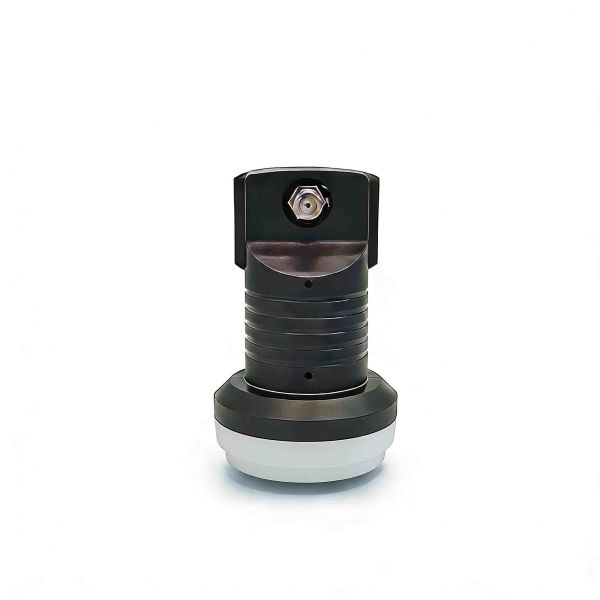
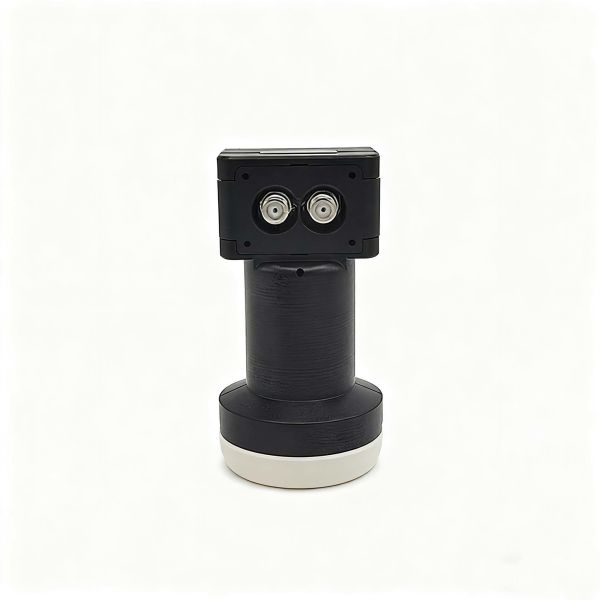
Product model:ST-K21WN(Universal Single PLL LNB)
Input: 10.7~12.75 GHz
LO: 9.75 GHz and 10.6 GHz
Polarization: Vertical and Horizontal
- Wide Compatibility: Works with any modern receiver.
- Access to Full Range: Can receive all KU Band channels (free and encrypted).
- Cost-Effective: The simplest and cheapest type for a single TV setup.
Technical Specification
| ITEM | SPECIFICATION | UNIT |
|---|
| Low Band I/P Frequency Range | 10.7 ~ 11.7 | GHz |
| O/P Frequency Range | 950 ~ 1950 | MHz |
| LO Frequency | 9.75 | GHz |
| Noise Figure | 1.0 [ max.] | dB |
| High Band I/P Frequency Range | 11.7 ~ 12.75 | GHz |
| O/P Frequency Range | 1100 ~ 2150 | MHz |
| LO Frequency | 10.6 | GHz |
| Noise Figure | 0.2[typ] | dB |
| LO Initial Accuracy | ± 0.5 | MHz |
| LO Temperature Drift( - 30 ~ + 60℃) | ± 0.75 | MHz |
| LO Phase Noise @ 1K Hz | -55 | dBc / Hz |
| LO Phase Noise @ 10K Hz | -80 | dBc / Hz |
| LO Phase Noise @ 100K Hz | -90 | dBc / Hz |
| Conversion Gain | 58(min) | dB |
| Gain Flatness | ± 4[max] | dB |
| Gain Variation | ± 1.0 | dB/27 MHz |
| Image Rejection | -40 [min.] | dB |
| O/P 1 dB Compression Point(P1dB) | 0.0 [min.] | dBm |
| Crosstalk Isolation | 18 [min.] | dB |
| Control Signals Ca ( V ) | 11.0 ~ 14.5 | V |
| Control Signals Cb ( H ) | 16.0 ~ 20.0 | V |
| Control Signals Cc | 22 ± 4 | KHz |
| O/P VSWR | 2.5 : 1 | ~ |
| DC Power | 11 ~ 20V/120(max) | Vdc*mA |
| Working Temperature | - 30 ~ + 6 | ℃ |
| Output Impedance | 75 | Ω (F-Type) |
What is an LNB?
An LNB (Low Noise Block, also called LNC - Low Noise Converter) is used for broadcast satellite reception. The LNB is typically mounted on the satellite dish and serves to collect and amplify the satellite signal received from the dish, then down-converts the signal to a lower, more manageable IF frequency that can be carried over standard coaxial cabling to the receiver. LNBs are categorized into C-Band, Ku-Band, and Ka-Band according to their operating frequency ranges.
What is KU BAND?
This refers to the specific portion of the radio frequency spectrum it's designed to receive.
- KU Band frequencies range from approximately 10.7 GHz to 12.75 GHz
- This band is widely used for direct-to-home (DTH) satellite television across Europe, the Middle East, Africa, and many parts of Asia
- Distinct from C Band (older, larger dishes) and KA Band (used for high-speed internet)
What is Universal?
A "Universal" LNB is designed to cover the entire KU Band range (10.7 - 12.75 GHz) and is compatible with virtually all modern digital satellite receivers.
It has two internal local oscillators (LO):
- Low Band (10.7 - 11.7 GHz): Uses a 9.75 GHz oscillator.
- High Band (11.7 - 12.75 GHz): Uses a 10.6 GHz oscillator.
- How it switches? Your satellite receiver sends a special 22 kHz tone along the coaxial cable. When the tone is OFF, the LNB listens to the Low Band. When the tone is ON, it switches to the High Band.
- It also uses DiSEqC (Digital Satellite Equipment Control) commands (also sent from the receiver) to handle other functions, but the 22 kHz switch is the core of the "Universal" definition.
What is Single?
This refers to the number of independent outputs the LNB has.
- A Single LNB has one output (one coaxial connector).
- It can therefore feed only one satellite receiver (one TV tuner) at a time.
Alternatives are:
- Twin LNB: Has two independent outputs to feed two separate receivers.
- Quad LNB: Four outputs.
- Octo LNB: Eight outputs.
- Quattro LNB: Four outputs with fixed polarities, used for larger communal distribution systems.