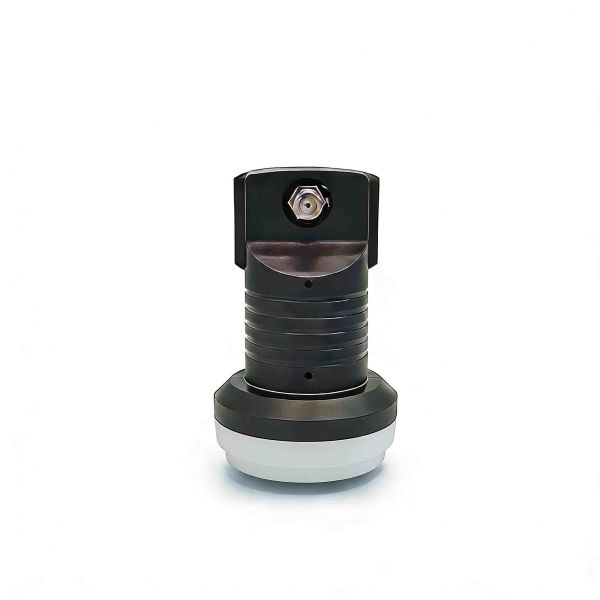
Specifications
Brand Name :
SETON
Model Number :
ST-K21WA
Certification :
CE, ISO, ROHS, POP, REACH
Place of Origin :
CHINA
MOQ :
2000pcs
Payment Terms :
T/T,Western Union
Supply Ability :
15 million pieces
Delivery Time :
30-35 days
Packaging Details :
CARTON
Input Frequency Range (Low-Band) :
10.7 ~ 11.7 GHz
Input Frequency Range (High-Band) :
11.7 ~ 12.75GHz
Output Frequency Range (Low-Band) :
950 ~ 1950 MHz
Output Frequency Range (High-Band) :
1100 ~ 2150MHz
Low band LO frequency :
9.75GHz
High band LO frequency :
10.6GHz
Noise figure :
0.7dB (Typ.)/ 1.0dB(Max.)
Conversion Gain :
55dB~65dB/ 60dB (Typ.)
Description
KU Band Universal LNBF Single LNB Satellite Dish
Operating Frequency: 10.7 - 12.75GHz
Product Overview
Ku-Band Universal LNBF ST-K21WA - Professional satellite signal reception component designed for reliable broadcast satellite reception.
Key Features
  • Input Frequency: 10.7~12.75 GHz
  • Local Oscillator: 9.75 GHz and 10.6 GHz
  • Polarization: Vertical and Horizontal
Technical Specifications
Parameter Specification
Input Frequency Range 10.7GHz ~ 11.7GHz (Low-Band)
11.7GHz ~ 12.75GHz (High-Band)
Output Frequency Range 950MHz ~ 1950MHz (Low-Band)
1100MHz ~ 2150MHz (High-Band)
Low Band LO Frequency 9.75 GHz (Low-Band)
10.6GHz (High-Band)
Noise Figure 0.7dB (Typ.)/ 1.0dB(Max.)
LO Initial Accuracy 0.5MHz
LO Temperature Drift (-30~+60℃) 0.75MHz
LO Phase Noise @ 1 KHz -75dBc/Hz
LO Phase Noise @ 10 KHz -80dBc/Hz
LO Phase Noise @ 100 KHz -90dBc/Hz
Conversion Gain 55dB~65dB/ 60dB (Typ.)
Gain Flatness 3.0dB (Max.)
Gain Variation 0.5dB/26MHz
O/P 1dB Compression Point (P1 dB) 0.0dBm (Min.)
Image-Rejection -40dBc (Min.)
Crosstalk Isolation 20dB (Min.)
O/P VSWR 2.5:1
Control Signals Ca V 10.0V~14.0V
Control Signals Cb H 16.0V~20.0V
Control Signals Cc 22±4KHz
DC-Power 10~20V/100Vdc*mA (Max.)
Output Impedance 75Ω (F-Type)
Working Temperature -30℃~+60 ℃
Frequently Asked Questions
What is an LNB?
An LNB (Low Noise Block, also called LNC - Low Noise Converter) is used for broadcast satellite reception. The LNB is typically mounted on the satellite dish and serves to collect and amplify the satellite signal received from the dish, then down-converts the signal to a lower, more manageable IF frequency that can be carried over standard coaxial cabling to the receiver. LNBs are categorized into C-Band, Ku-Band, and Ka-Band according to their operating frequency ranges.
What is KU BAND?
This refers to the specific portion of the radio frequency spectrum it's designed to receive.
  • KU Band frequencies range from approximately 10.7 GHz to 12.75 GHz
  • This band is widely used for direct-to-home (DTH) satellite television across Europe, the Middle East, Africa, and many parts of Asia
  • Distinct from C Band (older, larger dishes) and KA Band (used for high-speed internet)
What is Universal?
A "Universal" LNB is designed to cover the entire KU Band range (10.7 - 12.75 GHz) and is compatible with virtually all modern digital satellite receivers.
Universal LNB Operation
  • Two Internal Local Oscillators: 9.75 GHz for Low Band (10.7 - 11.7 GHz) and 10.6 GHz for High Band (11.7 - 12.75 GHz)
  • Band Switching: Satellite receiver sends a 22 kHz tone - OFF for Low Band, ON for High Band
  • Advanced Control: Uses DiSEqC (Digital Satellite Equipment Control) commands for additional functions, but the 22 kHz switching mechanism is the core of the "Universal" LNB definition.
Send your message to this supplier
Send Now

KU Band Universal LNBF Single LNB Satellite Dish with 10.7 - 12.75GHz Frequency Range and 0.7dB Noise Figure

Ask Latest Price
Watch Video
Brand Name :
SETON
Model Number :
ST-K21WA
Certification :
CE, ISO, ROHS, POP, REACH
Place of Origin :
CHINA
MOQ :
2000pcs
Payment Terms :
T/T,Western Union
Contact Supplier
video
KU Band Universal LNBF Single LNB Satellite Dish with 10.7 - 12.75GHz Frequency Range and 0.7dB Noise Figure

Chenzhou Seton Technology Co., Ltd

Verified Supplier
2 Years
hunan, chenzhou
Since 2019
Main Products :
, ,
Employee Number :
100~200
Certification Level :
Verified Supplier
Contact Supplier
Submit Requirement