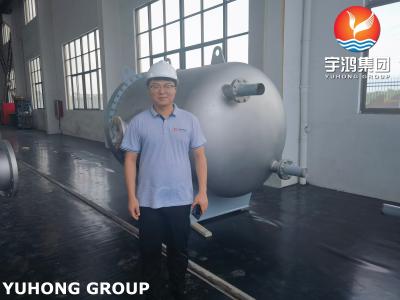
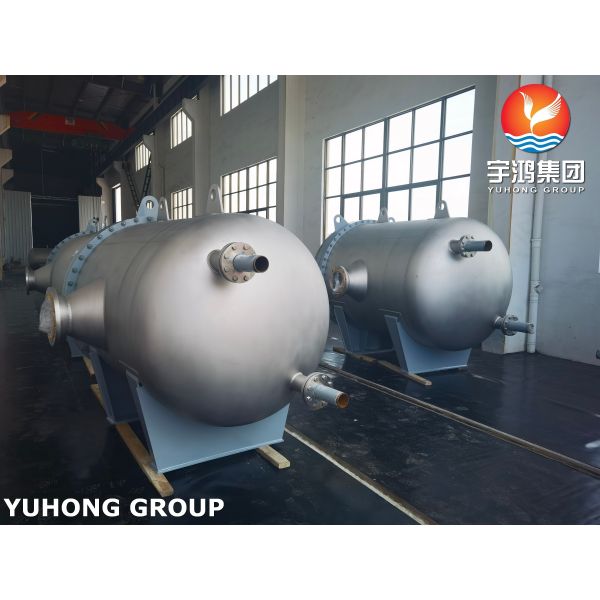
Yuhong Group Co., Ltd. designs and manufactures a comprehensive range of pressure equipment for global industries. Our core offerings include shell and tube heat exchangers, pressure vessels, air coolers, and process separators – including gas separators, scrubbers, knock-out drums, and two-phase/three-phase separators for oil, gas, and chemical processing. We also supply critical components: finned tube bundles, U-tube bundles, heat exchanger tubesheets, and all related parts – ensuring full support for new projects and maintenance.
Shown in the attached photographs are examples of our gas separators – including a hydrogen/oxygen separator and a natural gas separator – demonstrating our capability to fabricate ASME-coded separation vessels for gas processing, hydrogen production, and refining applications.
A gas separator (also called a scrubber, knock-out drum, or mist eliminator) is a pressure vessel designed to remove entrained liquid droplets, solids, or mist from a gas stream. These vessels are critical in gas processing, hydrogen production, natural gas treatment, and compressor stations to protect downstream equipment from liquid carryover and erosion.
Based on the images, these separators exhibit:
| Component | Function | Role in Equipment Performance |
|---|---|---|
| Inlet Diverter / Impingement Plate | Redirects incoming gas flow; reduces velocity | Prevents liquid carryover; protects downstream internals from erosion |
| Baffle Plates | Direct flow; promote gravity settling | Enhance liquid/gas separation; prevent short-circuiting |
| Demister / Mist Eliminator Pad | Removes entrained liquid droplets from gas | Ensures clean gas outlet; prevents liquid carryover to downstream equipment |
| Level Control Nozzles | Provide connections for level instruments | Enable liquid level control and interface control |
| Shell | Pressure-containing boundary | Contains process gas and liquids; designed for pressure/temperature |
| Dished Heads | End closures | Provide pressure containment; designed per ASME |
| Nozzles (Gas In/Out, Liquid Out) | Process fluid inlet and outlets | Enable gas inlet, clean gas outlet, and liquid discharge |
| Manway | Access for inspection and cleaning | Enables internal maintenance and inspection |
| Liquid Drain / Boot | Collection of separated liquids | Provides liquid storage and removal |
| Heat Exchanger Tube Bundle (internal) | Heating for gas temperature control | Can be installed for temperature control |
| Finned Tube Bundle (external) | External heating/cooling | For temperature control of outlet streams |
| U-Tube Bundle (internal) | Internal heat exchange | For heating/cooling within the vessel |
| Type | Description | Best For |
|---|---|---|
| Vertical Gas Separator | Gas flows upward; liquid drops to bottom | High gas flow rates; limited floor space; good for liquid slug handling |
| Horizontal Gas Separator | Gas flows horizontally; liquid settles | High liquid loading; large liquid capacity required |
| Knock-Out Drum | Removes large liquid droplets | Compressor suction scrubbers; upstream of filters |
| Mist Eliminator / Demister | Removes fine liquid mist (sub-micron droplets) | Downstream of separators; high-quality gas required |
| Filter Separator | Coalesces fine liquid mist | Natural gas processing; downstream of compressor stations |
The demister (or mist eliminator) is one of the most critical components in a gas separator:
| Industry | Application | Why Gas Separator |
|---|---|---|
| Hydrogen production | Hydrogen/oxygen separation (as shown) | Removes moisture from hydrogen stream before compression/storage |
| Natural gas processing | Dehydration, compressor suction scrubbers | Removes water and hydrocarbon liquids from gas |
| Refining | Overhead gas separators, knockout drums | Removes condensate from refinery gas streams |
| Chemical processing | Reactor gas separation, distillation overheads | Ensures clean gas for downstream processing |
| Power generation | Steam separation, gas turbine fuel gas conditioning | Protects turbines and compressors from liquid carryover |
| Cryogenic / LNG | Gas/liquid separation in liquefaction | Removes liquids before cryogenic heat exchange |
| Parameter | Consideration | Impact on Design |
|---|---|---|
| Gas flow rate | Must be below critical velocity for liquid carryover | Determines vessel diameter and demister sizing |
| Liquid loading | Amount of liquid entering with the gas | Determines liquid capacity and drain sizing |
| Droplet size | Larger droplets settle faster | Determines demister requirements |
| Pressure and temperature | Affects gas density and liquid properties | Determines wall thickness and material selection |
| Operating pressure | Higher pressure = smaller vessel | Affects wall thickness and flange ratings |
| Corrosivity | H₂S, CO₂, or chlorides in gas | Determines material selection and corrosion allowance |
| Slugging | Inlet flow surges | May require larger vessel or slug catcher upstream |
If your existing gas separator needs replacement parts, we supply individual components without ordering a complete new vessel:
| Issue | Cause | Prevention / Solution |
|---|---|---|
| Liquid carryover | Demister fouled; gas velocity too high; inlet diverter damaged | Replace/clean demister; check flow conditions |
| High liquid level | Drain valve malfunction; level control failure | Inspect level control system; check drain valve |
| Erosion at inlet | High-velocity gas with liquid droplets or solids | Install or replace inlet diverter; consider erosion-resistant material |
| Demister fouling | Solid particles or heavy liquid deposits | Regular inspection and cleaning; replace if damaged |
| Corrosion | H₂S, CO₂, or chlorides in gas | Proper material selection; corrosion allowance; coatings |
| Interface measurement issues | Level control nozzles blocked | Clean nozzles; check instrument calibration |
Every gas separator we fabricate includes:
To quote a gas separator like the ones in your photographs, send the following to jimmy@steelseamlesspipe.com:
We will respond with a technical proposal, general arrangement drawing, and competitive price – typically within 72 hours.