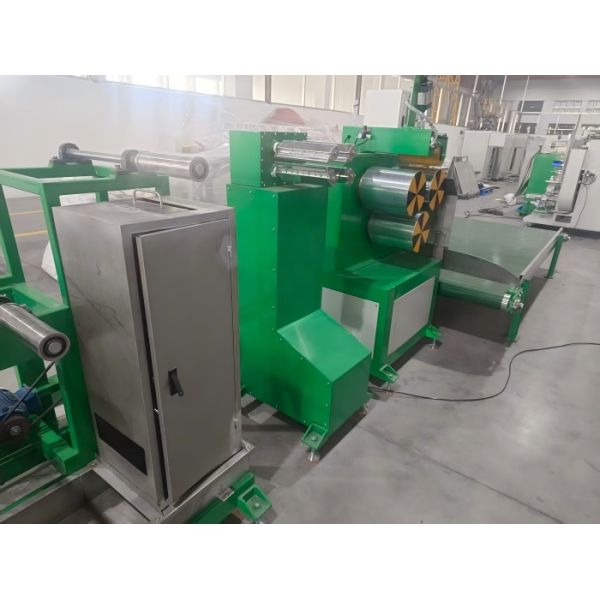
1. Product Introduction
The birth of a high-performance PP strapping is a precise "tension ballet." Constant tension is the soul that runs through the entire process: from molecular orientation during stretching, stable transportation during haul-off, to perfect formation during winding. This production line is equipped with a full-servo tension solution for this purpose: the drawing machine uses an 11KW servo motor for precise speed synchronization; the haul-off machine maintains stable gripping via pneumatic pressure rollers and speed feedback; the winder features independent 1.2KW servo gear motors for each station, working with tension sensors to achieve constant tension or taper tension control as the roll diameter changes. This ensures uniform product strength, no internal stress distortion, and tight, neat roll formation.
2. Main Specifications
Servo Stretching Control: The drawing machine's driving roller is powered by a servo motor, allowing speed to precisely follow the extruder and maintaining a constant speed ratio (draw ratio) to the haul-off via PID adjustment.
Closed-Loop Tension Sensing: Tension sensors (e.g., dancer arm or load cell) can be optionally installed at key stations (e.g., post-stretching, pre-winding) to provide real-time tension feedback to the control system.
Servo Winding Core: Four-axis independent servo winding employs torque control mode, automatically adjusting output torque based on set tension value and real-time roll diameter (calculated or measured) for true constant tension winding.
Roll Formation Optimization: The winding system supports taper tension setting, gradually decreasing tension linearly as the roll diameter increases to prevent a "hard core" and outer "edge collapse," achieving ideal roll shape.
3. Technical Parameters Table
| Parameter Category | Parameter Item | Specification / Description |
|---|---|---|
| Stretching Tension | Stretching Drive | 11KW Servo Motor |
| Draw Ratio Control Accuracy | ≤ ±0.5% | |
| Tension Display & Control | Magnetic Powder Tension Controller, Range 0.5-5N | |
| Haul-Off Stability | Haul-Off Pressure Control | Pneumatic Proportional Valve or Pressure Regulating Valve |
| Haul-Off Speed Sync Accuracy | ≤ ±0.1% | |
| Winding Tension | Winding Drive | 4 x 1.2KW Servo Gear Motor |
| Tension Control Mode | Constant Tension / Taper Tension Optional | |
| Tension Control Accuracy | ≤ ±3% FS (Full Scale) | |
| Maximum Roll Diameter | φ300mm (Standard, customizable) | |
| Roll Formation Quality | Edge Alignment | ≤ ±1 mm |
| No Edge Collapse, Telescoping | Achieved via Taper Tension Control |
4. FQA:
Q1: What are the advantages of servo winding over ordinary torque motor winding?
A1: Ordinary torque motors approximate torque control by adjusting current, but their linearity, response speed, and low-speed stability are poor, especially with large diameter changes, leading to significant tension fluctuations. Servo motors are fundamentally different: 1) Precise Control: True closed-loop torque control with highly consistent torque output to command. 2) Extremely Fast Response: Millisecond-level response to tension changes instantly suppresses tension spikes caused by speed variations or material unevenness. 3) Excellent Low-Speed Performance: Provides smooth torque even at very low winding speeds, ensuring tight winding. 4) High Intelligence: Easy integration with PLC for complex diameter calculation and taper control.
Q2: How to set the appropriate stretching tension and winding tension?
A2: Stretching tension primarily affects the product's final strength and elongation. It usually requires experimentation within the equipment's allowable range (0.5-5N) based on raw material properties, product specifications, and target performance to find the optimal point. Winding tension should ensure neat roll formation without damaging the product. Initial tension (on empty core) must be tight enough to prevent slippage but not excessive to avoid crushing the strap. As the roll diameter increases, applying taper tension to gradually reduce tension (e.g., linearly from full tension down to 70%) effectively prevents inner layers from deforming under excessive pressure. We provide initial process parameter recommendations and assist customers in optimization during commissioning.