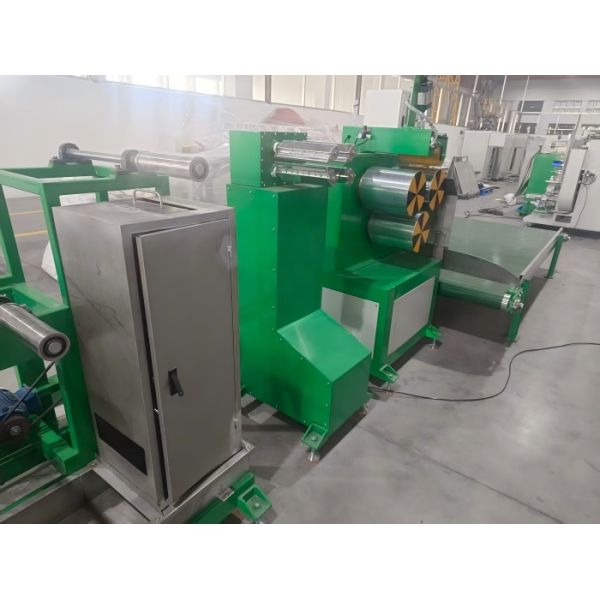
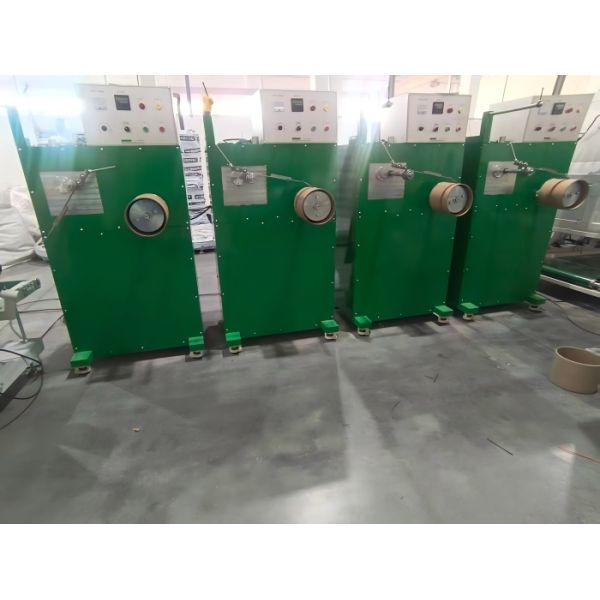
1. Product Introduction
This is not merely an efficiency improvement; it's a revolution in production mode. The daily output that traditionally required four separate single-line machines running side-by-side can now be achieved with just this one "1-out-4" synchronous production line. The core lies in the unique "1-out-4 flow diverging die head," which evenly splits the melt from a single high-performance extruder into four streams for simultaneous shaping, cooling, stretching, and winding. This means you gain nearly four times the output with only a modest increase in equipment investment, floor space, and energy consumption. It is your strategic solution for handling large-volume orders, breaking through capacity bottlenecks, and maximizing return on investment.
2. Main Specifications
Synchronous Production Principle: An integrally formed flow diverging die head designed based on fluid dynamics ensures the melt is uniformly distributed to four independent die lips within the head, enabling the synchronous output of four strands from the source.
Capacity Design Matching: The φ80mm large-diameter extruder (max output 200kg/h) provides ample melt supply for four channels; subsequent cooling, stretching, haul-off, and winding units are all designed for synchronous four-strand operation, ensuring balanced line capacity.
Space & Energy Efficiency Optimization: Compared to four independent lines, this single line significantly saves workshop layout space and reduces duplication of auxiliary equipment (e.g., control system, feeding system), leading to notably lower energy consumption per unit product.
Production Management Simplification: Operators only need to manage one production line to monitor and control the production status of four products, greatly simplifying production scheduling, quality monitoring, and inventory management.
3. Technical Parameters Table
| Parameter Category | Parameter Item | Specification / Description |
|---|---|---|
| Core Output | Synchronous Production Quantity | 4 strands |
| Single Strand Std. Capacity Ratio | ~95-100% of a traditional single line | |
| Theoretical Productivity Increase | ~280%-300% increase vs. single line | |
| Extrusion Supply | Extruder Specification | φ80mm, L/D 28:1 |
| Maximum Output | 200 kg/h | |
| Matching Design | Cooling Water Tank Width | 0.8 meters (accommodates 4 strands) |
| Winder Stations | 4 independent stations | |
| Efficiency Metrics | Operator Requirement | Can be reduced by ~50-60% (vs. running 4 independent single lines) |
| Floor Space Saving | Can save ~30-40% (vs. layout of 4 independent single lines) |
4. FQA:
Q1: Compared to four separate single machines, what are the real advantages of "1-out-4" besides saving space?
A1: The core advantages are investment efficiency, operational cost, and control consistency. 1) Lower Investment: You purchase one large extruder and one complex die head, not four complete extrusion and control systems. 2) Better Energy Efficiency: One large motor often runs more efficiently than the sum of four smaller ones, with less heat loss. 3) Unmatched Consistency: The four strands originate from the same melt source and experience identical process conditions (temperature, pressure, cooling), yielding far superior consistency in performance and appearance compared to four independent machines. 4) Simpler Maintenance: Only one set of core main equipment needs maintenance.
Q2: If one die lip clogs or one strap breaks, will it affect the other three? Does the whole line need to stop?
A2: Since the four strands enter independent channels after divergence (the cooling tank has separation guidance), the physical breakage of a single strap does not directly affect the others. However, from production management and quality perspectives, a brief full-line stop is recommended for handling. Because: 1) A clog may indicate a potential issue within the die head flow channels. 2) Continuing production of the remaining three strands leads to material waste. Our system allows independent control of single winding shafts; when handling a break, only the faulty shaft can be stopped. But for thorough troubleshooting, a brief full-line stop is the most efficient approach.