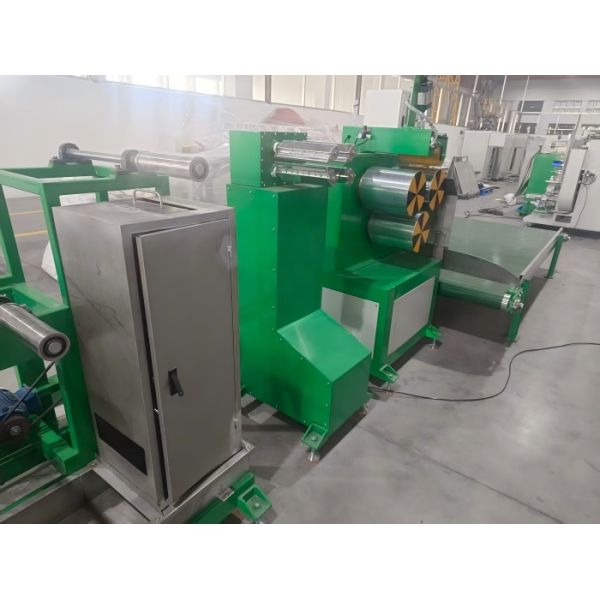
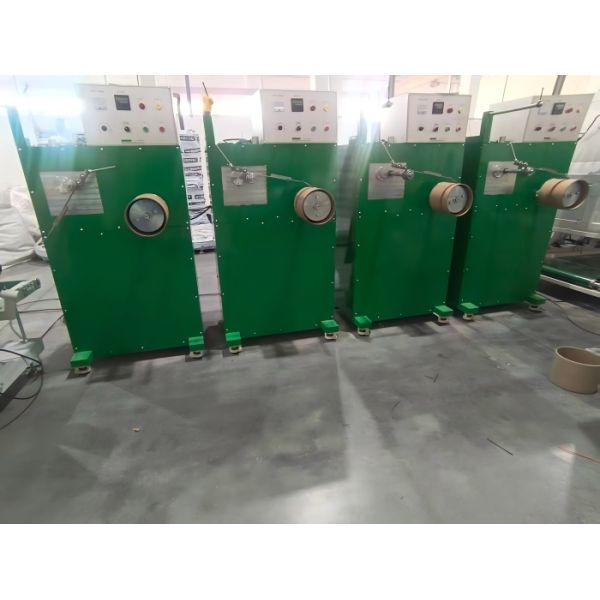
1. Product Introduction
We offer not just a machine, but a complete, seamlessly connected PP strapping production value chain. Starting from PP raw material pellets being fed into the hopper, the process encompasses drying pretreatment, high-temperature melting and plasticization, precise flow distribution and shaping, stepwise cooling and setting, molecular chain biaxial stretching, heat treatment for crystallization stabilization, surface embossing for enhancement, multi-stage haul-off for speed definition, and finally neat winding into finished rolls by servo winders—all key processes are integrated into this continuous line. This integrated design eliminates material handling, waiting, and secondary processing between stages, ensures continuous and stable product quality, and maximizes production efficiency. What you receive is a finished product ready for market.
2. Main Specifications
Full-Process Coverage: Includes raw material handling (feeding, drying), extrusion forming (extrusion, flow division), heat treatment (stretching, oven setting), post-processing (cooling, embossing), and finished product handling (haul-off, winding) — five core process sections.
Seamless Process Connection: All units share a unified centerline height (1100mm) and precise speed linkage control, ensuring smooth and steady material transfer without over-stretching or accumulation.
In-Line Quality Formation: The product's main physical properties (e.g., strength, elongation) and appearance (width, thickness, pattern) are "shaped" and "fixed" as it flows through the line, requiring no offline secondary processing.
Turnkey Delivery: We are responsible for the integrated commissioning of the entire line, ensuring the entire process from raw material input to qualified finished roll output is unobstructed and meets design capacity and quality standards.
3. Technical Parameters Table
| Parameter Category | Parameter Item | Specification / Description |
|---|---|---|
| Process Chain Length | Approx. Total Line Length | 25 – 35 meters (depending on configuration) |
| Number of Main Functional Units | ≥ 10 | |
| Process Continuity | Centerline Height | Unified 1100 mm |
| Inter-Unit Speed Synchronization | Closed-loop control, linked start/stop | |
| Final Product State | Product Form | Finished rolls with completed stretching, setting, embossing |
| Roll Weight Range | Up to 20 – 50 kg/roll (depending on specification) | |
| Delivery Standard | Trial Run Output Requirement | Continuous stable production of finished products meeting sample standards |
| Capacity Fulfillment | Meets or exceeds contracted capacity |
4. FQA:
Q1: What are the main differences and advantages of an integrated production line versus purchasing equipment in segments and integrating them ourselves?
A1: The core differences are "unified responsibility" and "performance guarantee." 1) Technical Responsibility: Integration means we, as a single supplier, assume responsibility for the entire line's process matching and technical support, avoiding blame-shifting between multiple vendors in segmented procurement. 2) Performance Optimization: We consider coupling relationships between units from the initial design phase (e.g., matching extruder output to stretch speed, cooling capacity to line speed), ensuring overall optimum performance—difficult to achieve with segmented integration. 3) Commissioning Efficiency: We provide integrated line commissioning, quickly resolving interconnection issues. Self-integration has long, risky commissioning cycles. 4) Service Convenience: One-stop after-sales service with minimal communication cost.
Q2: The line is so long. If a component in the middle breaks down, does the entire line have to stop?
A2: Physically, since material is continuously transferred, a failure in any critical unit indeed necessitates a full-line stop. However, this is precisely the characteristic of integrated line quality assurance—any instability in any link is immediately exposed, prompting you to resolve it, thereby ensuring continuous qualification of the final product. To minimize downtime impact, we adopt the following measures: 1) High-reliability equipment design (as in this line); 2) Rapid diagnostic system to quickly locate faults; 3) Provision of critical spare parts list for customer stock. From a management perspective, preventive maintenance is more important than reactive repair.