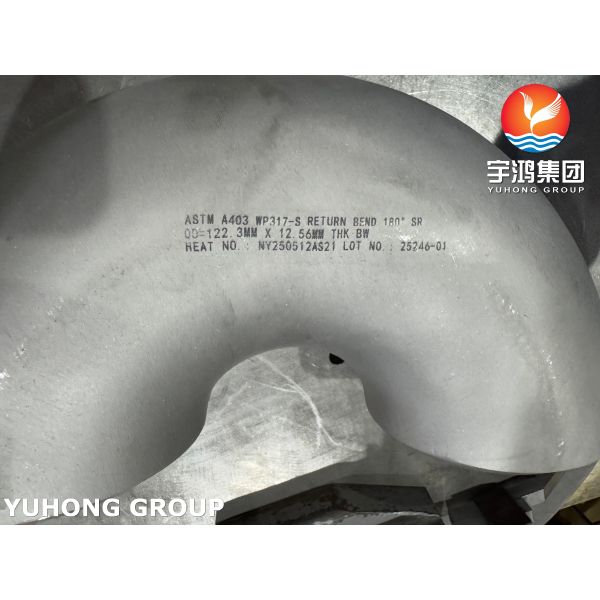
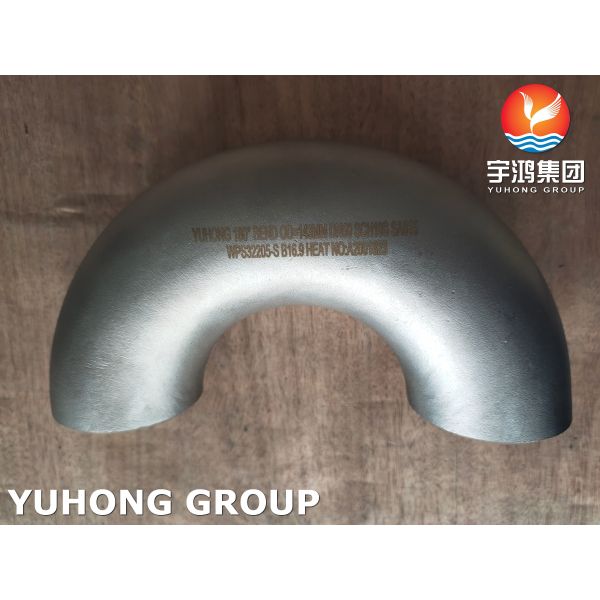
ASTM A403 WP317-S Return Bend Composition
| UNS Designation | C | Mn | P | S | Si | N | Cr | Mo |
| S31700 | 0.08 | 2.00 | 0.045 | 0.03 | 1.00 | 11.0–15.0 | 18.0–20.0 | 3.0-4.0 |
ASTM A403 WP317-S Return Bend Strength
The production of ASTM A403 WP317-S return bends follows strict industrial standards to ensure dimensional accuracy and material integrity:
- Forming: Seamless fittings: Billets are heated to 1100-1250°C, then extruded or forged into the 180° bend shape using die casting.
- Welded fittings: Flat plates are rolled into a cylindrical shape, welded (using TIG/MIG welding), then bent to 180°; welds are 100% radiographed to detect defects.
- Heat Treatment: Solution annealing at 1010-1120°C, followed by rapid quenching (water or air cooling) to dissolve carbides, prevent intergranular corrosion, and restore austenitic microstructure.
- Finishing: Deburring, grinding, and polishing (surface finish Ra ≤ 0.8 μm); pressure testing (hydrostatic or pneumatic) to verify leak tightness.
- Quality Control: Chemical analysis (spectroscopy), mechanical testing (tensile, hardness), non-destructive testing (NDT: UT, RT, MT), and dimensional inspection (per ASME B16.9).
ASTM A403 WP317-S Return Bend Key Advantages
- Superior Corrosion Resistance: High chromium (18-20%), nickel (11-15%), and molybdenum (3-4%) content provides excellent resistance to pitting, crevice corrosion, and general corrosion in aggressive media (e.g., seawater, acidic/alkaline solutions, chlorides).
- Enhanced Machinability: Low sulfur content (≤ 0.030%) improves cutting, drilling, and threading performance compared to standard 317 stainless steel, reducing tool wear.
- Strong Mechanical Properties: High tensile strength and ductility enable use in high-pressure (up to Class 600) and high-temperature applications without deformation.
- Weldability: Compatible with common welding processes (TIG, MIG, SMAW); post-weld heat treatment is not required for most applications (due to low carbon content), simplifying installation.
- Durability: Austenitic microstructure offers excellent toughness (even at cryogenic temperatures) and resistance to stress corrosion cracking (SCC), extending service life in harsh industrial environments.
ASTM A403 WP317-S Return Bend Typical Applications
ASTM A403 WP317-S return bends are widely used in industries requiring corrosion resistance and high performance:
- Oil & Gas: Offshore platforms, subsea pipelines, and refineries (handling crude oil, natural gas, and corrosive process fluids).
- Chemical Processing: Chemical plants (processing acids, alkalis, solvents, and chlorinated compounds).
- Pharmaceutical & Food Processing: Sanitary piping systems (resistant to cleaning agents and non-toxic, complying with FDA standards).
- Water Treatment: Desalination plants, seawater cooling systems, and wastewater treatment facilities (resistant to saltwater corrosion).
- Power Generation: Thermal power plants and nuclear power plants (handling high-temperature steam and coolant fluids).
- Marine Engineering: Shipbuilding and offshore structures (withstanding saltwater and humid marine environments).
ASTM A403 WP317-S Return Bend FAQ
Q1: What is the difference between WP317-S and standard WP317?
- The key difference is sulfur content: WP317-S has S ≤ 0.030% (for improved machinability), while standard WP317 has S ≤ 0.040%. Both share the same Cr/Ni/Mo composition and corrosion resistance, but WP317-S is preferred for applications requiring extensive machining (e.g., threaded fittings).
Q2: Can ASTM A403 WP317-S return bends be used in seawater applications?
- Yes. The high molybdenum content (3-4%) makes WP317-S highly resistant to pitting corrosion in seawater (chloride concentration ~35,000 ppm), making it suitable for offshore and marine piping systems.
Q3: What pressure rating does this return bend have?
- Pressure ratings comply with ASME B16.9 and depend on pipe size, wall thickness (SCH 10, 40, 80, 160), and operating temperature. For example:
- 2-inch SCH 40: Max working pressure = 10.3 MPa (1500 psi) at 20°C.
- 4-inch SCH 80: Max working pressure = 17.2 MPa (2500 psi) at 20°C.
- Always refer to the manufacturer’s pressure-temperature (P-T) chart for specific applications.
Q4: Is post-weld heat treatment (PWHT) required after installing WP317-S return bends?
- Generally, no. WP317-S has low carbon content (C ≤ 0.08%) and is stabilized with molybdenum, so it is resistant to intergranular corrosion even without PWHT. PWHT may be required only for thick-walled fittings (wall thickness > 20 mm) or in extremely corrosive environments—consult ASME BPVC Section VIII for guidance.
Q5: What are the common sizes and end connections for this return bend?
- Sizes range from ½ inch to 24 inches (DN 15 to DN 600) per ASME B16.9. End connections include:
- Butt weld (most common for industrial piping).
- Threaded (NPT, BSPP) for small-diameter, low-pressure applications.
- Flanged (per ASME B16.5) for easy assembly/disassembly.
Q6: How to maintain ASTM A403 WP317-S return bends?
- Regularly clean the surface to remove dirt, scale, or corrosive residues (use mild detergents; avoid abrasive cleaners).
- Inspect for signs of corrosion (pitting, discoloration) or leaks during routine maintenance.
- Avoid contact with incompatible metals (e.g., carbon steel) to prevent galvanic corrosion (use insulation or dielectric unions if necessary).
- Operate within the specified pressure and temperature limits to prevent material fatigue.