UNS S31603 Seamless Pipe for Chemical Processing and Industrial Water Systems
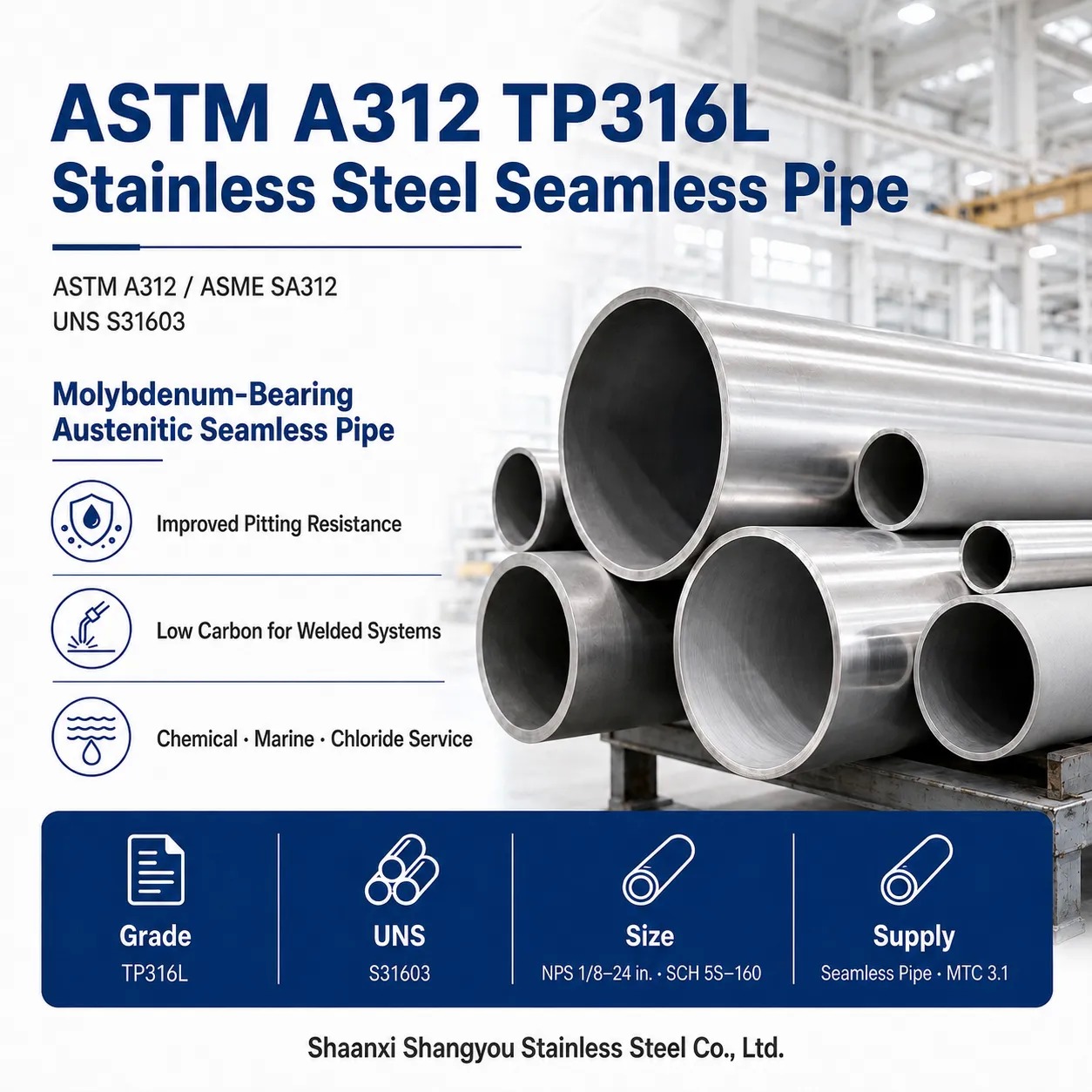
TP316L is a low-carbon, molybdenum-alloyed austenitic stainless steel selected for process piping where localized corrosion resistance and resistance to weld-related sensitization are important.
ASTM A312/A312M · UNS S31603
SCH 10S · SCH 40S · SCH 80S
Solution Annealed · Annealed and Pickled
Fixed Length · Plain or Beveled Ends
XRF PMI · Carbon Verification · MTC 3.1
Request TP316L Pipe Quote
RFQ Prompt:
Send the NPS or outside diameter, schedule or wall thickness, required length, quantity, end preparation, inspection requirements and destination.
Quick Product Specification
| Item |
Supply Information |
| Product |
Stainless Steel Seamless Pipe |
| Material Grade |
ASTM A312 TP316L |
| UNS Designation |
S31603 |
| Product Specification |
ASTM A312/A312M |
| Manufacturing Route |
Seamless, hot finished or cold finished |
| Dimensional Standard |
ASME B36.19 or approved project specification |
| Common Wall Schedules |
SCH 10S, SCH 40S and SCH 80S |
| Heat-Treated Condition |
Solution annealed in accordance with the ordered specification |
| Standard Surface |
Annealed and pickled |
| Available Ends |
Plain ends or beveled ends |
| Length |
Random length or project-specific fixed length |
| Material Documentation |
EN 10204 3.1 inspection certificate available |
| Optional Verification |
XRF PMI, OES or other carbon-capable analysis |
| Optional Inspection |
Dimensional inspection, NDT, hydrostatic testing and third-party inspection |
| Packing |
End protection, waterproof wrapping, steel bundles or wooden cases |
ASTM A312/A312M is the product specification for seamless, straight-seam welded and heavily cold-worked welded austenitic stainless steel pipe. Standardized stainless steel pipe dimensions are referenced separately through ASME B36.19, while nonstandard dimensions may be supplied when they satisfy the remaining requirements of ASTM A312 and the approved purchase specification.
What Is ASTM A312 TP316L Seamless Pipe?
ASTM A312 TP316L seamless pipe is a pressure-piping product manufactured from UNS S31603, a low-carbon chromium-nickel-molybdenum austenitic stainless steel.
The molybdenum addition gives TP316L better resistance to localized corrosion than non-molybdenum-bearing grades such as TP304L in many industrial environments. Its controlled low-carbon content reduces chromium-carbide precipitation during welding and helps preserve resistance to intergranular corrosion in the heat-affected zone.
The seamless manufacturing route eliminates a longitudinal weld seam. It is commonly specified for process systems where pipe integrity, wall uniformity, pressure service or project specifications favor seamless construction.
ASTM currently identifies A312/A312M-25 as the active edition and describes the specification as covering austenitic stainless steel pipe for high-temperature and general corrosive service. It also requires pipes to be furnished in a heat-treated condition and subjected to either hydrostatic testing or nondestructive electric examination.
Why Specify TP316L?
1. Molybdenum-Enhanced Localized Corrosion Resistance
TP316L contains molybdenum in addition to chromium and nickel. Molybdenum improves resistance to localized attack and gives 316L an advantage over 304L in many chloride-bearing, acidic and industrial process environments.
This advantage is conditional rather than universal. Corrosion performance still depends on:
- Chloride concentration
- Operating temperature
- pH and oxidizing conditions
- Fluid velocity
- Deposits and stagnant zones
- Crevice geometry
- Surface condition
- Cleaning and disinfection chemicals
Molybdenum is recognized as an alloying element that increases resistance to both uniform and localized corrosion.
2. Low Carbon for Welded Piping Systems
The “L” designation identifies a controlled low-carbon grade.
Lower carbon reduces chromium-carbide precipitation during welding or other thermal exposure. This helps limit sensitization and reduces the risk of intergranular corrosion in welded piping that will remain in the as-welded condition.
The main benefit is therefore not simply “easier welding.” The more precise benefit is improved resistance to weld-related sensitization and intergranular attack.
3. Austenitic Structure
TP316L has an austenitic microstructure that provides:
- Good formability
- Good toughness
- Practical weld fabrication
- Non-hardening response to conventional heat treatment
- Broad use in industrial piping systems
Cold working can increase strength, but final pipe properties and dimensional tolerances must comply with the ordered product specification
ASTM A312 TP316L Reference Chemistry
| Element |
ASTM A312 TP316L Reference Limit |
| Carbon, C |
0.035% max. |
| Manganese, Mn |
2.00% max. |
| Phosphorus, P |
0.045% max. |
| Sulfur, S |
0.030% max. |
| Silicon, Si |
1.00% max. |
| Chromium, Cr |
16.00–18.00% |
| Nickel, Ni |
10.00–14.00% |
| Molybdenum, Mo |
2.00–3.00% |
| Nitrogen, N |
0.10% max. |
The ordered ASTM edition and the final material test certificate govern contractual compliance. Chemical composition should not be accepted solely from a generic website table or grade name.
Reference minimum mechanical properties commonly associated with TP316L pipe:
- Tensile strength: 485 MPa minimum
- Yield strength: 170 MPa minimum
Final mechanical requirements, elongation values, test orientation and acceptance criteria must follow the applicable ASTM A312 edition and purchase order.
ASTM A312, ASME B36.19 and Project Specifications
These documents have different functions and should not be treated as interchangeable.
| Document |
Function |
| ASTM A312/A312M |
Product material, manufacture, heat treatment, testing and acceptance specification |
| ASME B36.19 |
Standardized outside diameters, wall thicknesses and pipe schedules |
| Project Piping Code |
Design, allowable stress, fabrication, examination and system-level acceptance |
| EN 10204 3.1 |
Inspection document requirement when specified in the purchase order |
| Purchase Specification |
Project-specific dimensions, testing, marking, documentation and acceptance criteria |
ASME B36.19 standardizes the dimensions of welded and seamless wrought stainless steel pipe. The “S” suffix distinguishes certain stainless steel schedules from ASME B36.10M schedules, and some wall thicknesses are not identical between the two dimensional systems.
TP316 vs TP316L: Which Grade Should Be Specified?
| Procurement Factor |
TP316 |
TP316L |
| UNS designation |
S31600 |
S31603 |
| Molybdenum alloying |
Yes |
Yes |
| Principal difference |
Standard carbon grade |
Controlled low-carbon grade |
| General localized corrosion resistance |
Similar when correctly solution annealed |
Similar when correctly solution annealed |
| Weld-related sensitization risk |
Relatively higher |
Reduced |
| Extensive field welding |
Requires project review |
Commonly preferred |
| As-welded corrosive service |
Requires careful evaluation |
Commonly preferred |
| Carbon verification by handheld XRF |
Not possible |
Not possible |
| Elevated-temperature selection |
Check design requirements |
Must not automatically replace TP316 or TP316H |
| Dual certification |
Depends on actual test results |
Depends on actual test results |
TP316L is normally selected when extensive welding is expected and the finished piping will not receive a post-weld solution treatment.
TP316L should not automatically be substituted for TP316, TP316H or a dual-certified grade without reviewing:
- Design temperature
- Applicable piping code
- Allowable stress requirements
- Project material specification
- Actual heat chemistry
- Mechanical test results
- MTC certification
“316/316L dual certified” is a certification result, not a separate material grade. It should only be claimed when the heat chemistry and mechanical properties satisfy the requirements stated on the MTC and in the purchase specification.
Corrosion Performance and Material-Selection Boundaries
Resistance Compared with TP304L
The molybdenum content of TP316L generally provides better resistance than TP304L to pitting and localized corrosion in many chloride-bearing environments.
This does not mean that TP316L is immune to:
- Pitting corrosion
- Crevice corrosion
- Chloride stress-corrosion cracking
- General corrosion in incompatible chemicals
- Corrosion beneath deposits
- Corrosion caused by poor drainage or stagnant fluid
Chemical Processing
TP316L may be considered for:
- Selected organic chemicals
- Process water
- Solvents
- Dilute chemical solutions
- Chemical transfer lines
- Pulp and paper process systems
- General corrosive utility piping
Material suitability must be checked against the actual chemical composition, concentration, temperature, pressure, contaminants and operating cycle.
Laboratory corrosion tables are useful for preliminary selection, but they do not fully reproduce actual process conditions, impurities, deposits, oxygen content or flow conditions. Exposure testing using the actual process medium provides stronger evidence where corrosion risk is significant.
Water Treatment
TP316L may be used in selected industrial water-treatment systems, including:
- Filter and dosing lines
- Process-water piping
- Treated-water systems
- Utility piping
- Low-to-moderate chloride water
- Reverse-osmosis auxiliary systems
The water analysis should be reviewed when chloride concentration, disinfectants, temperature or stagnant service could increase localized-corrosion risk.
Coastal and Marine Environments
TP316L is widely used in coastal atmospheric environments and selected marine-related equipment. However, it should not be described as universally suitable for continuous seawater service.
Higher risk conditions include:
- Warm seawater
- Stagnant seawater
- Tight crevices
- High chloride concentration
- Deposits and biofouling
- Chlorinated seawater
- Elevated temperature under tensile stress
For continuous or demanding seawater exposure, duplex 2205, super duplex 2507, 6Mo stainless steel or another higher-alloy material may be more appropriate. Standard 316L is also susceptible to chloride stress-corrosion cracking at elevated temperatures.
PMI and Grade Verification
XRF Positive Material Identification
Handheld XRF is useful for:
- Verifying chromium, nickel and molybdenum
- Distinguishing 304-series from 316-series material
- Detecting material mix-up
- Confirming the Cr-Ni-Mo alloy family
- Supporting heat-number traceability
XRF PMI can help verify that the pipe belongs to the 316 alloy family, but it cannot independently prove that the material is TP316L.
Why XRF Cannot Confirm the “L” Grade
The difference between TP316, TP316L and TP316H depends principally on carbon content.
Conventional handheld XRF cannot measure carbon. It therefore cannot independently distinguish 316 from 316L or 316H.
Verification of the low-carbon grade should be based on:
- Traceable heat number
- Original material test certificate
- Product marking
- OES analysis
- Qualified carbon-capable LIBS
- Laboratory chemical analysis
Specifically notes that XRF can identify the 316 alloy family but cannot measure the carbon required to distinguish L and H grades; OES can measure carbon and other light elements.
Recommended Verification Levels
| Verification Level |
Recommended Scope |
| Standard Traceability |
Heat number, pipe marking and MTC review |
| Alloy-Family Verification |
Random or heat-based XRF PMI |
| Project PMI |
Agreed percentage or 100% piece-by-piece XRF |
| Low-Carbon Verification |
OES, qualified LIBS or laboratory carbon analysis |
| Third-Party Release |
Witness inspection and signed inspection report |
The instrument, calibration, test locations, sampling frequency and reporting format should be agreed before production.
Corrosion Testing Options
Corrosion testing should not be offered as an undefined certificate. The test method and acceptance criteria must be written into the purchase order.
ASTM A262 Intergranular Corrosion Testing
ASTM A262 contains several practices for detecting susceptibility to intergranular attack in austenitic stainless steels.
The buyer should specify:
- Required ASTM A262 practice
- Base metal or welded specimen
- As-received or sensitized condition
- Specimen preparation
- Sampling frequency
- Acceptance criteria
- Reporting requirements
ASTM A262 evaluates susceptibility to intergranular attack. It does not predict general corrosion, pitting corrosion or stress-corrosion cracking in other environments.
ASTM G48 Localized Corrosion Testing
ASTM G48 provides six ferric-chloride methods for evaluating or ranking pitting and crevice-corrosion resistance in oxidizing chloride environments.
A complete order requirement should identify:
- ASTM G48 method
- Test temperature
- Exposure duration
- Specimen condition
- Surface preparation
- Welded or unwelded specimen
- Weight-loss or visual criteria
- Maximum permitted pit depth, where applicable
- Sampling and reporting requirements
ASTM G48 is an accelerated comparative laboratory test. Its results do not guarantee service life in every chloride-containing system, and surface preparation can significantly affect the result.
Pipe Dimensions and Purchasing Information
Standard stainless steel pipe dimensions are normally specified by:
- NPS or DN
- Outside diameter
- Schedule or nominal wall thickness
- Length
- End preparation
- Dimensional standard
Common purchasing options:
- SCH 10S
- SCH 40S
- SCH 80S
- Fixed-length cutting
- Plain ends
- Beveled ends
- Annealed and pickled surface
- Custom marking
- Project-specific packing
Other schedules, heavy-wall dimensions and nonstandard outside-diameter combinations should be confirmed against the required quantity and production route.
Never request only “4-inch 316L pipe.” A complete inquiry should identify whether “4 inch” refers to NPS, outside diameter or another dimensional convention.
Inspection and Quality-Control Plan
Standard Production Control
- Heat-number and material-record review
- Outside-diameter measurement
- Wall-thickness measurement
- Length inspection
- Straightness inspection
- Visual and surface examination
- Pipe-end inspection
- Marking and traceability check
- Hydrostatic or nondestructive electric examination in accordance with the ordered specification
- Final documentation review
ASTM A312 requires each pipe to undergo either hydrostatic testing or nondestructive electric testing, while supplementary requirements may be ordered when a higher level of examination is required.
Optional Project Inspection
Subject to prior agreement:
- XRF PMI
- OES carbon verification
- Ultrasonic testing
- Eddy-current testing
- Hydrostatic testing
- Intergranular corrosion testing
- Localized-corrosion testing
- Surface roughness measurement
- Independent laboratory analysis
- Third-party inspection
- Pre-shipment dimensional inspection
The inspection method, applicable standard, coverage, calibration requirements and acceptance criteria should be confirmed before order placement.
Processing Services
Available processing may include:
- Fixed-length cutting
- Plain-end preparation
- Beveled ends
- Deburring
- Pickling and passivation
- External polishing
- Internal surface treatment for selected dimensions
- Custom identification
- Color coding
- Protective end caps
- Project shipping marks
Fabricated pipe spools, welded assemblies and special end connections require separate technical review because fabrication introduces additional welding, dimensional and inspection requirements.
Typical Applications
ASTM A312 TP316L seamless pipe is commonly considered for:
- Chemical transfer piping
- Process-fluid lines
- Petrochemical utility piping
- Industrial water-treatment systems
- Pulp and paper process lines
- Cooling and process-water systems
- Coastal industrial facilities
- General corrosive process piping
- Heat-transfer and equipment connection lines
ASTM A312 is an industrial pipe specification. Other standards may be more appropriate for different product functions:
| Requirement |
Standard That May Be More Appropriate |
| Sanitary or hygienic tubing |
ASTM A270 |
| General-purpose or instrumentation tubing |
ASTM A269 |
| Boiler or heat-exchanger tubing |
ASTM A213 or project-specific standard |
| Large-diameter electric-fusion-welded pipe |
ASTM A358 or project specification |
| Duplex stainless steel pipe |
ASTM A790 |
Final material and product-standard selection remains the responsibility of the system designer and should consider the medium, pressure, temperature, chloride level, flow conditions, fabrication route and applicable design code.
Documentation Package
Available documentation should be defined in the contract and may include:
- EN 10204 3.1 inspection certificate
- Heat-number traceability record
- Chemical analysis results
- Mechanical test results
- Heat-treatment record
- Dimensional inspection report
- PMI report
- OES or laboratory chemistry report
- NDT report
- Hydrostatic test report
- Corrosion test report
- Third-party inspection release
- Packing list
- Certificate of origin
Document availability should be confirmed before order placement, particularly when the project requires original mill documents, third-party endorsement or special test reports.
Export Packing and Identification
The packing plan can be adjusted according to pipe size, surface condition, transportation method and destination.
Available options include:
- Plastic or protective end caps
- Waterproof wrapping
- Steel-strapped bundles
- Protective separators
- Wooden skids
- Fumigated wooden cases
- Customized shipping marks
- Container-loading protection
- Packing and loading photographs
Each bundle or pipe should remain traceable to the applicable grade, size, heat number and order identification.
Why Shaanxi Shangyou Stainless Steel Co., Ltd.
- ASTM A312 TP316L seamless pipe supply coordination
- Technical review of grade, dimensions and inspection requirements
- SCH 10S, SCH 40S and SCH 80S procurement support
- Fixed-length cutting and pipe-end preparation
- Heat-number traceability and MTC documentation
- XRF PMI with clear technical limitations
- Carbon-capable grade verification when specified
- Third-party inspection coordination
- Export packing for international industrial orders
We do not recommend a material solely from the product name. For corrosive or safety-critical service, provide the operating medium, concentration, temperature, pressure and inspection specification for technical review.
Frequently Asked Questions
Is TP316L more corrosion-resistant than TP316?
Their general and localized corrosion resistance is usually similar when both are correctly solution annealed. TP316L’s principal advantage is its lower carbon content, which reduces sensitization and improves resistance to intergranular corrosion after welding.
Can XRF PMI confirm TP316L?
No. XRF can verify the Cr-Ni-Mo 316 alloy family but cannot measure the carbon required to distinguish TP316L from TP316 or TP316H. Carbon verification requires MTC traceability, OES, qualified LIBS or laboratory analysis.
Is TP316L suitable for seawater?
It may be considered for coastal atmospheres and selected low-risk marine services, but it is not universally suitable for continuous seawater exposure. Temperature, chloride concentration, crevices, flow, deposits and chlorination must be evaluated.
What is the difference between ASTM A312 and ASME B36.19?
ASTM A312 is a product specification covering material, manufacture, heat treatment and testing. ASME B36.19 is a dimensional standard covering stainless steel pipe outside diameters, wall thicknesses and schedules.
Can you provide ASTM A262 testing?
ASTM A262 testing can be arranged when the required practice, specimen condition, sampling frequency and acceptance criteria are stated in the purchase order.
Can you provide ASTM G48 testing?
ASTM G48 testing may be arranged according to an agreed method, temperature, exposure time, surface condition and acceptance criteria. A general request for “G48 passed” is not sufficiently defined for quotation.
Can TP316L be supplied with dual certification?
Dual certification may be possible when the actual chemistry and mechanical properties satisfy the requirements of both specified grades. The certification must be supported by the MTC and accepted by the project specification.
What information is required for a quotation?
Provide:
- Standard and grade
- Seamless construction requirement
- NPS, DN or outside diameter
- Schedule or wall thickness
- Required length
- Quantity
- Pipe-end preparation
- Surface condition
- Inspection and testing requirements
- Documentation requirements
- Operating medium, when material review is required
- Destination port
Request a Technical and Commercial Quote
Send a complete pipe specification for dimensional confirmation, inspection review, production assessment and quotation.
Recommended RFQ Format
ASTM A312 TP316L
UNS S31603
Seamless Pipe
NPS 4 · SCH 40S · ASME B36.19
6,000 mm Fixed Length
Beveled Ends
Annealed and Pickled
Quantity: 15 MT
100% XRF PMI
Carbon Verification by OES
EN 10204 3.1
Third-Party Inspection: Required
Destination: [Port and Country]
Request Price and Delivery Review
Shaanxi Shangyou Stainless Steel Co., Ltd.