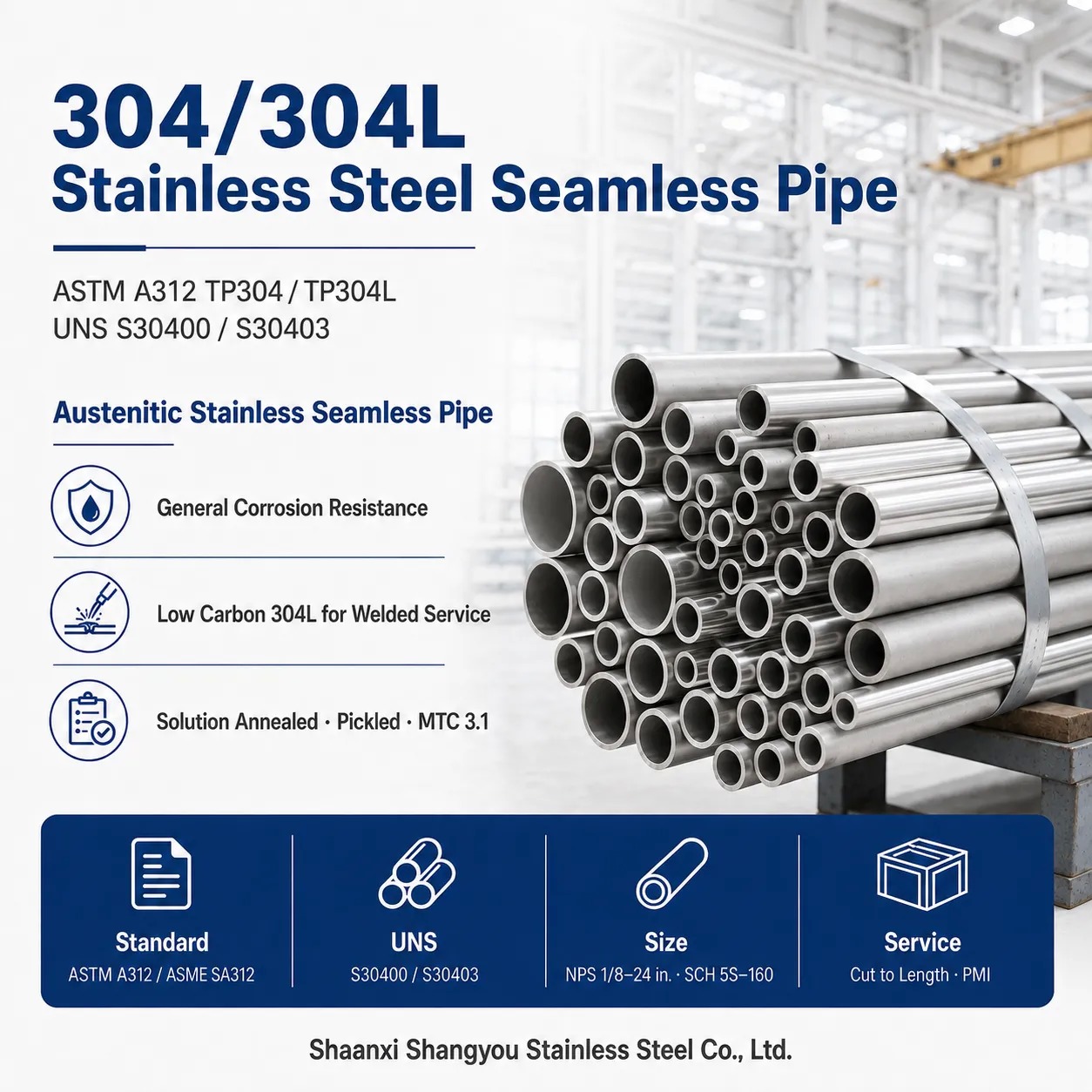
ASTM A312 TP304/TP304L Stainless Steel Seamless Pipe
General-Purpose Stainless Process Pipe for Corrosive and Welded Piping Systems
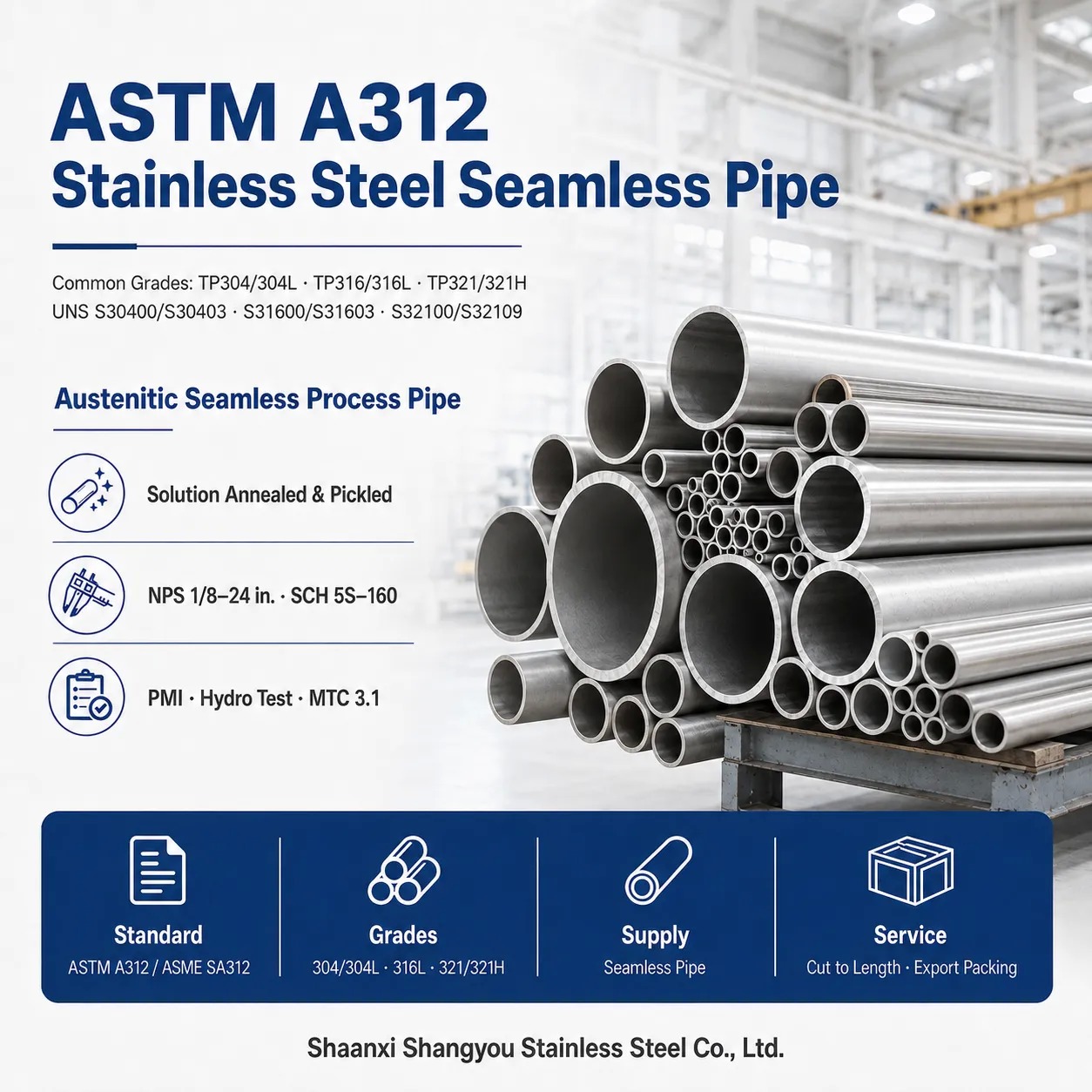
Shaanxi Shangyou Stainless Steel Co., Ltd. supplies ASTM A312 TP304 and TP304L stainless steel seamless pipe for chemical processing, water treatment, food equipment, utility piping and general industrial fluid transfer.
Available supply options include SCH 10S, SCH 40S and SCH 80S, solution-annealed and pickled surfaces, custom lengths, plain or beveled ends, threading, grooving and project-specific inspection documentation.
ASTM A312 covers seamless, welded and heavily cold-worked austenitic stainless steel pipe intended for high-temperature and general corrosive service. The current ASTM committee listing identifies A312/A312M-25 as the active edition.
Quick Product Information
| Item |
Available Supply |
| Product |
Stainless Steel Seamless Pipe |
| Grades |
TP304, TP304L, dual-certified TP304/304L subject to MTC |
| UNS |
S30400, S30403 |
| Main Standard |
ASTM A312/A312M |
| Optional Certification |
ASME SA312, subject to order confirmation |
| Dimension Standard |
ASME B36.19M, ASME B36.10M where specified |
| Typical Size Range |
NPS 1/8–24 in. |
| Main Schedules |
SCH 10S, SCH 40S, SCH 80S |
| Additional Walls |
SCH 5S, SCH 160, XXS and custom wall thickness by review |
| Manufacturing |
Hot-finished or cold-finished seamless |
| Heat Treatment |
Solution annealed |
| Surface |
Annealed and pickled, white pickled, bright annealed where available |
| Length |
Random length, 5.8 m, 6 m, 11.8 m, 12 m or cut to length |
| Ends |
Plain, beveled, threaded, grooved or machined to drawing |
| Testing |
Chemical analysis, tensile test, dimensional inspection, hydrostatic or NDT |
| Optional Inspection |
PMI, UT, ET, intergranular corrosion test, third-party inspection |
| Documentation |
EN 10204 3.1 MTC, packing list and inspection records |
| Packing |
Plastic end caps, waterproof wrapping, steel bundles and wooden cases |
What Is 304/304L Stainless Steel Seamless Pipe?
304 and 304L are chromium-nickel austenitic stainless steel grades widely selected for general industrial piping because of their balanced corrosion resistance, fabrication performance, weldability and commercial availability.
Type 304, UNS S30400, is a general-purpose “18-8" stainless steel containing approximately 18–20% chromium and 8–10.5% or more nickel depending on the applicable product specification. Type 304L, UNS S30403, is the low-carbon version developed to reduce sensitization and intergranular corrosion risk during welding.
Unlike welded pipe, seamless pipe does not contain a longitudinal weld seam. It is commonly specified where the purchaser requires:
- Uniform pipe-wall construction
- Higher confidence for pressure piping
- Improved suitability for repeated thermal or pressure cycles
- Small-diameter or heavy-wall configurations
- Project specifications that explicitly require seamless manufacturing
- Additional machining, bending or high-integrity fabrication
ASME B36.19M standardizes dimensions for wrought stainless steel pipe and uses the suffix “S" to differentiate stainless pipe schedules such as 10S, 40S and 80S.
TP304 vs TP304L Stainless Steel Pipe
The principal difference between TP304 and TP304L is the maximum permitted carbon content. Under ASTM A312, TP304 permits up to 0.08% carbon, while TP304L limits carbon to 0.035% maximum.
Low-carbon 304L delays chromium-carbide precipitation at grain boundaries during typical welding operations, improving resistance to post-weld intergranular attack. However, long-term exposure within a sensitizing temperature range must still be evaluated by the piping engineer.
Choose TP304 When
- The pipe will have limited welding
- General corrosion resistance is sufficient
- Higher minimum room-temperature strength is preferred
- The piping operates in a mild industrial environment
- The project specification explicitly requires TP304
Choose TP304L When
- The piping system includes extensive field or shop welding
- Post-weld solution annealing is impractical
- Welded areas will remain exposed to a corrosive process medium
- Intergranular corrosion resistance is an important design consideration
- The purchaser requires UNS S30403 or TP304L certification
Dual-Certified TP304/TP304L
A pipe may be supplied as dual-certified TP304/TP304L only when its actual chemistry satisfies the TP304L carbon limit and its mechanical properties satisfy the requirements applicable to both grades.
The wording “304/304L" on a quotation does not by itself prove dual certification. Buyers should verify the grade statement, heat number, chemical analysis and mechanical properties on the EN 10204 3.1 material certificate.
ASTM A312 Chemical Composition
The current ASTM A312/A312M-25 material data lists a maximum carbon content of 0.035% for TP304L. General stainless composition references may show 0.03% for UNS S30403 because limits can differ between product specifications; the ordered ASTM pipe specification and MTC remain controlling.
Important Procurement Note
Chemical composition limits should be checked against the specific ASTM edition, ASME code requirement and purchase order. Do not approve a material based only on a commercial grade name such as “304L."
ASTM A312 Mechanical Properties
TP304 generally has higher specified minimum tensile and yield strength than TP304L. Where a low-carbon product is supplied as dual-certified TP304/TP304L, the test results must also satisfy the TP304 mechanical requirements.
Final acceptance must follow the ordered ASTM edition because elongation requirements can vary with nominal pipe size, wall ratio, manufacturing route and test orientation.
Size and Schedule Selection
304/304L seamless pipe can be supplied according to nominal pipe size and schedule or according to an exact outside diameter and wall thickness.
Standard Supply Range
| Parameter |
Typical Range |
| Nominal Pipe Size |
NPS 1/8–24 in. |
| Outside Diameter |
Approximately 10.3–610 mm |
| Wall Thickness |
Schedule wall or custom wall by technical review |
| Main Schedules |
SCH 10S, SCH 40S, SCH 80S |
| Heavy Wall |
SCH 160 and XXS by size |
| Standard Lengths |
5.8 m, 6 m, 11.8 m and 12 m |
| Custom Cutting |
Available according to purchase list |
| Length Tolerance |
To be confirmed before production |
| Dimensional Standard |
ASME B36.19M or specified project standard |
Common Schedule Dimensions
Dimensions should be verified against the selected edition of ASME B36.19M or the project piping specification before ordering. Certain stainless “S" schedule dimensions differ from corresponding ASME B36.10M dimensions.
How to Select SCH 10S, SCH 40S or SCH 80S
SCH 10S
SCH 10S has a relatively light wall and lower unit weight.
Common selection reasons include:
- Low- to moderate-pressure liquid service
- Utility water piping
- Process drain and return lines
- Systems where corrosion allowance is limited
- Projects prioritizing lower material weight
Do not select SCH 10S only because it is less expensive. Confirm pressure, temperature, external loads, corrosion allowance, joining method and mechanical handling requirements.
SCH 40S
SCH 40S is a widely specified general-purpose stainless pipe schedule.
It is commonly selected for:
- Chemical process lines
- Water-treatment systems
- Food-processing utility piping
- Compressed-air lines
- General industrial fluid transfer
- Plant utility and service piping
SCH 80S
SCH 80S provides a heavier wall and additional mechanical allowance.
It is commonly considered for:
- Higher design pressures
- Heavy-duty industrial service
- Threaded connections where permitted
- Piping exposed to mechanical impact
- Systems requiring additional corrosion or erosion allowance
The final pipe schedule must be determined by the piping designer in accordance with design pressure, design temperature, applicable code, material allowable stress, corrosion allowance and joint efficiency.
Manufacturing and Supply Condition
Typical Seamless Pipe Production Route
- Billet Inspection
Raw-material chemistry and heat traceability are reviewed before production.
- Hot Piercing or Extrusion
A solid stainless steel billet is pierced or extruded to create the hollow pipe shell.
- Hot Finishing or Cold Working
The pipe is reduced to the specified outside diameter and wall thickness by hot finishing, cold drawing or cold rolling.
- Solution Annealing
Heat treatment restores the austenitic structure and corrosion performance after forming.
- Rapid Cooling
The pipe is rapidly cooled according to the applicable material and product specification.
- Pickling and Cleaning
Heat tint and surface scale are removed to obtain a clean stainless surface.
- Straightening and Sizing
Outside diameter, wall thickness, ovality and straightness are controlled.
- Testing and Inspection
Mechanical tests, dimensional checks and required nondestructive examinations are completed.
- Cutting and End Preparation
Pipes are cut to ordered lengths and supplied with specified end preparation.
- Marking and Packing
Heat number, grade, standard and dimensions are marked before export packing.
A seamless TP304L reference product from Alleima is supplied in solution-annealed and white-pickled condition or by a bright-annealing process, illustrating common international supply conditions for this material family.
Heat Treatment and Surface Condition
Solution Annealed
Solution annealing dissolves chromium carbides and restores the corrosion-resistant austenitic structure after hot working or severe cold working.
The final solution heat-treatment temperature and cooling method must comply with the ordered ASTM specification and manufacturing procedure.
Annealed and Pickled
This is the most common industrial finish for ASTM A312 stainless steel seamless pipe.
Features include:
- Clean metallic surface
- Removal of most oxide scale and heat tint
- Suitable for general process piping
- Practical for welding and site fabrication
- Easier visual inspection of surface defects
Bright Annealed
Bright annealing is performed in a controlled atmosphere to reduce oxidation and provide a smoother, brighter surface.
Availability depends on:
- Outside diameter
- Wall thickness
- Production route
- Required internal surface
- Order quantity
Passivation
Chemical passivation can be specified after fabrication or final cleaning. The purchaser should identify the required passivation standard, cleanliness level and acceptance method.
Surface Specification Recommendation
Avoid writing only “smooth surface" in the inquiry. Specify:
- Annealed and pickled or bright annealed
- Internal and external surface requirement
- Maximum roughness where applicable
- Whether heat tint is acceptable
- Cleaning and passivation standard
- Oil-free or special-cleaning requirement
Custom Cutting and End Processing
Shaanxi Shangyou Stainless Steel Co., Ltd. can supply pipe prepared for fabrication, installation or project assembly.
Available Processing
- Cut to fixed length
- Multiple-length cutting
- Plain ends
- Beveled ends
- Threaded ends
- Grooved ends
- Deburring
- Internal and external chamfering
- CNC end machining
- Drilling or fabrication according to drawing
- End caps and identification marking
Beveled Ends
Beveled ends are commonly required for butt-welded piping systems. The bevel angle, root face and tolerance should be stated on the purchase order.
Threaded Ends
Before requesting threading, confirm:
- Pipe schedule
- Thread standard
- Design pressure
- Corrosion allowance
- Whether the wall is suitable for threading
- Required coupling material
Light-wall pipe should not be threaded without engineering approval.
Corrosion Performance
304 and 304L offer good resistance to many atmospheric environments, organic substances, moderately corrosive solutions and general industrial fluids. Low-carbon 304L provides better resistance to intergranular corrosion after welding than standard 304.
Suitable Service Environments
- Fresh and treated water
- Moderately corrosive process liquids
- Food and beverage ingredients
- Organic acids under controlled conditions
- Utility water
- Compressed air
- Clean steam and condensate where approved
- General atmospheric exposure
- Mild chemical-processing environments
Chloride Service Limitation
304/304L can be vulnerable to:
- Chloride pitting
- Crevice corrosion
- Chloride stress-corrosion cracking
- Corrosion beneath deposits or gaskets
Austenitic 304L-type materials may be susceptible to stress-corrosion cracking when tensile stress, elevated temperature and chloride-bearing solutions occur together.
For seawater, brine, concentrated chloride solutions, coastal process systems or aggressive chemical media, evaluate:
- TP316L
- 904L
- Duplex 2205
- Super Duplex 2507
- Nickel alloy pipe
Material suitability must be confirmed using the actual process composition, chloride concentration, temperature, pressure, flow velocity, cleaning chemical and shutdown condition.
Main Applications
Chemical Processing
304L seamless pipe is used for general chemical transfer lines, organic chemical systems, process-water lines and equipment connections where severe chloride or reducing-acid conditions are absent.
Typical equipment includes:
- Process skids
- Reactor utility lines
- Pump connections
- Storage and transfer piping
- Heating and cooling loops
Water Treatment
Typical applications include:
- Filtered-water piping
- Municipal water-treatment equipment
- Reverse-osmosis pretreatment lines
- Pure-water utility piping
- Wastewater-treatment equipment
- Pump and valve manifolds
For seawater desalination or high-chloride concentrate lines, 316L or duplex stainless steel should normally be evaluated instead of 304L.
Food and Beverage Equipment
304L is widely used for food-processing equipment and general food-industry piping because of its corrosion resistance and cleanability. A seamless 304L material datasheet lists food, beverage and pharmaceutical production among typical industrial applications.
Typical uses include:
- Ingredient-transfer lines
- Beverage equipment
- Dairy utility piping
- Cleaning-system utility lines
- Kitchen and catering equipment
- General food-processing machinery
For hygienic product-contact piping requiring controlled internal roughness, orbital-weld quality or sanitary fittings, specify ASTM A270 sanitary tubing rather than relying only on ASTM A312 pipe.
Utility Piping
- Plant water
- Compressed air
- Inert gas
- Cooling water
- Heating water
- Low-pressure steam utility lines
- Condensate return
- General plant-service piping
General Industrial Equipment
- Heat-exchanger connections
- Instrument manifolds
- Equipment nozzles
- Pump and valve systems
- Fabricated skids
- Machinery piping
- Building-service systems
Quality Inspection
Standard Inspection Items
- Heat-number traceability
- Chemical composition verification
- Tensile testing
- Outside-diameter measurement
- Wall-thickness measurement
- Length inspection
- Ovality inspection
- Straightness inspection
- Visual surface inspection
- End-condition inspection
- Hydrostatic or nondestructive electric testing as required
- Marking verification
- Final packing inspection
Optional Project Inspection
- Positive Material Identification
- Ultrasonic testing
- Eddy-current testing
- Intergranular corrosion testing
- Surface roughness measurement
- Ferrite measurement where technically applicable
- Third-party inspection
- Witness testing
- Additional dimensional reports
- Customer-approved Inspection and Test Plan
PMI Verification
PMI can help confirm that the supplied material belongs to the expected chromium-nickel stainless family. However, conventional handheld PMI equipment may not accurately distinguish TP304 from TP304L because the primary difference is carbon content.
The distinction between 304 and 304L should therefore be verified through:
- Heat-number traceability
- Mill chemical analysis
- Carbon analysis
- EN 10204 3.1 MTC
- Independent laboratory testing when required
Material Certificate and Traceability
Each pipe bundle can be identified with:
- Manufacturer or supplier identification
- ASTM A312/A312M
- Grade TP304 or TP304L
- UNS designation where required
- NPS or outside diameter
- Schedule or wall thickness
- Heat number
- Length
- Production lot
- Inspection status
Available Documentation
- EN 10204 3.1 material certificate
- Chemical composition report
- Mechanical test results
- Heat-treatment record
- NDT report where ordered
- PMI report where ordered
- Dimensional inspection report
- Packing list
- Certificate of origin
- Third-party inspection report
All document requirements should be stated before order confirmation. Additional certificates requested after production may not be available retrospectively.
Packing and Export Loading
304/304L seamless pipes are packed to reduce contamination, deformation and transport damage.
Standard Export Packing
- Plastic end caps
- Waterproof wrapping
- Protective plastic sheet
- Steel-strapped bundles
- Bundle identification tags
- Lifting straps where required
- Wooden cases for small-diameter or precision-cut pipes
- Wooden supports for container loading
- Shipping marks according to purchase order
Special Packing Options
- Seaworthy wooden cases
- Fumigated wooden cases
- Individual pipe wrapping
- Internal cleanliness protection
- End-sealed packaging
- Moisture-resistant barrier material
- Custom labels and project tags
- Bundle weight limitations
- Container-loading photographs
Why Choose Shaanxi Shangyou Stainless Steel Co., Ltd.
ASTM and Project-Specification Supply
Orders can be reviewed against the specified grade, standard, schedule, heat treatment, end condition and inspection requirements before production.
Seamless Pipe Size Selection
We support standard schedule pipe and custom outside-diameter/wall-thickness combinations for project purchasing.
Cutting and End Preparation
Fixed-length cutting, beveling, threading, grooving and machining reduce additional fabrication work after delivery.
Traceable Quality Documentation
Heat-number traceability, MTC 3.1, PMI and additional inspection documents can be arranged according to the purchase specification.
Export-Oriented Packing
Pipe bundles, end caps, waterproof wrapping, wooden cases and container loading are prepared for international transportation.
Frequently Asked Questions
1. What is the main difference between 304 and 304L seamless pipe?
The main difference is carbon content. ASTM A312 TP304 permits up to 0.08% carbon, while TP304L limits carbon to 0.035%. The lower carbon content reduces the risk of sensitization and intergranular corrosion after welding.
2. Is 304L always better than 304?
No. TP304L is generally preferable for welded corrosive piping, but TP304 has higher specified minimum room-temperature strength. The correct grade depends on welding, operating temperature, corrosion environment and design-code requirements.
3. Can you supply dual-certified 304/304L pipe?
Yes, subject to mill production and MTC verification. The chemistry must meet TP304L requirements, while the mechanical properties must satisfy the requirements applicable to both grades.
4. What is the difference between ASTM A312 pipe and ASTM A269 tubing?
ASTM A312 is primarily a pipe specification for high-temperature and general corrosive piping service. ASTM A269 covers seamless and welded austenitic stainless steel tubing for general service. The dimensional system, tolerances and intended application differ.
5. Which schedule should I choose?
SCH 10S is commonly considered for lighter-duty service, SCH 40S for general industrial piping and SCH 80S for heavier-wall or higher-pressure applications. Final schedule selection must be based on pressure design calculations and the applicable piping code.
6. Can 304L seamless pipe be used for food equipment?
Yes, 304L is commonly used in food-processing equipment and utility piping. For hygienic product-contact lines requiring controlled internal roughness and sanitary fittings, specify ASTM A270 sanitary tubing.
7. Is 304L suitable for seawater?
304L is generally not the preferred grade for continuous seawater or high-chloride service because of pitting, crevice-corrosion and stress-corrosion-cracking risks. TP316L, duplex 2205, super duplex 2507 or a higher alloy should be evaluated.
8. What surface condition is normally supplied?
The standard industrial condition is solution annealed and pickled. Bright-annealed pipe may be available for selected dimensions and quantities.
9. Can the pipe be cut and beveled before shipment?
Yes. Fixed-length cutting, plain ends, beveling, threading, grooving, deburring and CNC end machining can be supplied according to the approved purchase list or drawing.
10. Can PMI distinguish 304 from 304L?
Standard handheld PMI normally confirms the principal alloy elements but may not accurately measure the low carbon difference between 304 and 304L. The MTC and laboratory carbon analysis are the primary methods for confirming the “L" grade.
11. What documents are supplied?
Standard documentation can include an EN 10204 3.1 MTC, packing list and traceability information. PMI, NDT, dimensional inspection and third-party reports can be supplied when included in the order.
12. What information is required for a fast quote?
Send the grade, standard, NPS or OD, wall thickness or schedule, length, quantity, surface, end type, testing requirements, destination and required delivery date.
Request ASTM A312 TP304/TP304L Seamless Pipe
Send your pipe schedule, quantity and technical requirements to receive:
- Grade and standard confirmation
- Available size review
- Pipe weight calculation
- Cutting and end-processing proposal
- Inspection-document list
- Export-packing plan
- Price and estimated delivery schedule
Shaanxi Shangyou Stainless Steel Co., Ltd.
ASTM A312 Seamless Pipe · Cut to Length · Inspection · Export Packing