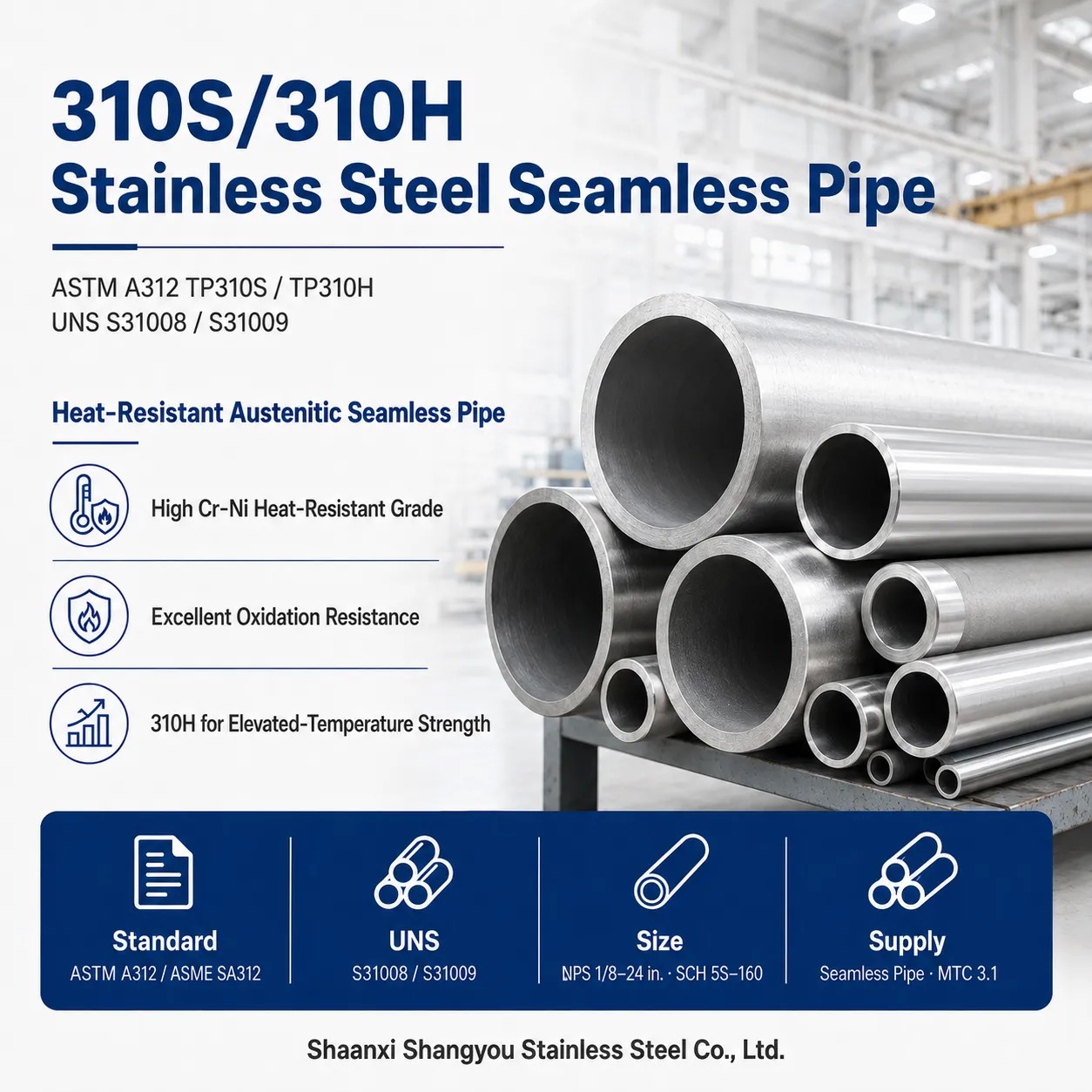
310S / 310H Stainless Steel Seamless Pipe
ASTM A312 TP310S and TP310H are 25Cr–20Ni austenitic stainless steel grades developed for piping exposed to high temperatures, oxidation, carburizing atmospheres and certain sulfur-containing process gases.
TP310S provides lower carbon for easier welded fabrication and reduced sensitization risk. TP310H uses a controlled higher-carbon range and grain-size requirements to improve creep and stress-rupture performance during sustained high-temperature service.
310S vs 310H Stainless Steel Pipe
| Selection Item |
TP310S |
TP310H |
| UNS designation |
S31008 |
S31009 |
| Carbon content |
≤0.08% |
0.04–0.10% |
| Main purpose |
Welded fabrication and general high-temperature service |
Sustained high-temperature creep service |
| Weldability |
Preferred where extensive welding is required |
Weldable, but carbon and heat input require closer control |
| High-temperature strength |
Moderate |
Higher creep and stress-rupture capability |
| Grain-size requirement |
Standard ASTM A312 requirements |
Controlled coarse grain requirement |
| Typical selection |
Thermal cycling, furnace piping, fabricated assemblies |
Continuous high-temperature pressure piping and tube hangers |
ASTM A312 specifically identifies TP310H as a modification of TP310S for temperatures where creep and stress-rupture properties are important. Earlier ASTM A312 tables show a No. 6 or coarser grain-size requirement for TP310H.
Can 310S and 310H Be Dual Certified?
The carbon ranges overlap between 0.04% and 0.08%, so dual certification may be technically possible for some heats. However, carbon overlap alone is not sufficient.
The material must satisfy:
- Both grade chemistry requirements
- TP310H grain-size requirements
- Ordered mechanical properties
- Heat-treatment requirements
- The exact ASTM or ASME edition stated in the purchase order
A certificate should not describe the pipe as TP310S/TP310H dual grade unless every applicable requirement has been verified.
Applicable Standards
Material and Product Standards
ASTM A312/A312M
Primary product specification for seamless, welded and heavily cold-worked austenitic stainless steel pipe intended for high-temperature and general corrosive service. The current ASTM listing is A312/A312M-25.
ASTM A376/A376M
May be specified for seamless austenitic stainless steel pipe specifically ordered for high-temperature central-station and similar service. The project specification should determine whether ASTM A312 or ASTM A376 applies.
ASTM A213/A213M
Applies to seamless ferritic and austenitic boiler, superheater and heat-exchanger tubes. It should not automatically replace ASTM A312 when the required product is pipe. Alleima lists both ASTM A213 and ASTM A312 for 310S/310H seamless tubular products, depending on the ordered product form.
Dimensional Standards
ASME B36.19M
Standardizes dimensions for welded and seamless wrought stainless steel pipe used at high or low temperatures and pressures.
ASME B36.10M
May be used for additional wall-thickness schedules commercially supplied in stainless steel materials.
Design Codes
ASME B31.3
Used for process piping in petroleum refining, chemical, pharmaceutical, hydrogen, semiconductor and related processing plants. It governs piping-system design, fabrication, examination and testing rather than manufacturing the pipe itself.
ASME B31.1
Used for power piping in power-generation and industrial plants, including certain boiler-external piping systems.
The material standard, dimensional standard and piping design code must be stated separately in the purchase specification.
Chemical Composition
The following values represent the principal ASTM A312 limits commonly used for TP310S and TP310H. The edition stated in the purchase order remains controlling.
| Element |
TP310S, UNS S31008 |
TP310H, UNS S31009 |
| Carbon, C |
≤0.08% |
0.04–0.10% |
| Manganese, Mn |
≤2.00% |
≤2.00% |
| Phosphorus, P |
≤0.045% |
≤0.045% |
| Sulfur, S |
≤0.030% |
≤0.030% |
| Silicon, Si |
≤1.00% |
≤1.00% |
| Chromium, Cr |
24.00–26.00% |
24.00–26.00% |
| Nickel, Ni |
19.00–22.00% |
19.00–22.00% |
| Iron, Fe |
Balance |
Balance |
The defining difference is carbon control. TP310S limits carbon to reduce sensitization and improve fabrication performance, while TP310H requires a higher controlled carbon range for elevated-temperature strength.
Mechanical Properties
Typical minimum room-temperature tensile requirements for ASTM A312 TP310S and TP310H are:
| Property |
Requirement |
| Tensile strength |
≥515 MPa / 75 ksi |
| 0.2% yield strength |
≥205 MPa / 30 ksi |
| Longitudinal elongation |
≥35% |
| Transverse elongation |
≥25% |
Elongation requirements can depend on specimen orientation, wall thickness and the detailed provisions of the ordered standard. These values must not be used directly as high-temperature allowable stresses. Pressure design should use the allowable stress table contained in the governing design code and specified code edition.
High-Temperature Performance
The high chromium and nickel content gives 310S/310H strong resistance to scale formation, oxidation, carburization and selected sulfur-containing high-temperature atmospheres.
One current seamless-tube producer lists a maximum reference service temperature in air of approximately 1100°C / 2010°F for its 310S/310H material. This is a material-performance reference, not an automatic pressure-design temperature.
Actual service temperature must be evaluated according to:
- Internal pressure and mechanical load
- Required service life
- Continuous or intermittent operation
- Thermal cycling frequency
- Gas composition and oxygen potential
- Sulfur, sodium and vanadium contamination
- Carburizing or nitriding conditions
- Metal temperature rather than furnace set temperature
- Applicable ASME allowable stress
- Weld design and post-fabrication condition
Important Temperature Boundary
Long exposure around 800–900°C can reduce structural stability in conventional 310-type material. For equipment operating continuously in this range under significant stress, creep data and alternative high-temperature alloys should be reviewed rather than selecting 310H only from its nominal oxidation temperature.
Corrosion Resistance and Limitations
Suitable Environments
310S and 310H may be considered for:
- Oxidizing furnace atmospheres
- Moderately carburizing atmospheres
- Selected sulfur-containing gases
- Radiant heating systems
- Hot combustion gases
- High-temperature air
- Certain molten neutral salts
- Thermal-processing equipment
Alleima reports service in sulfur-containing atmospheres over a broad temperature range, but performance depends strongly on whether the atmosphere is oxidizing or reducing and whether sodium, vanadium or other contaminants are present.
Do Not Select 310S/310H Only by Temperature
310S and 310H are primarily heat-resistant stainless steels. They are not universal substitutes for 316L, duplex stainless steel or nickel alloy in wet chloride solutions.
Special review is required for:
- Seawater and concentrated chloride solutions
- Strong reducing acids
- Reducing sulfur-rich furnace gases
- Molten salts containing aggressive impurities
- High-temperature metal dusting
- Rapid thermal cycling under heavy load
- Pressure service near the upper temperature limit
The client should provide the gas composition, contaminants, operating pressure, normal temperature, upset temperature and expected service life before final material approval.
Manufacturing and Supply Condition
Seamless Manufacturing Route
Typical production stages include:
- Raw-material and heat-number verification
- Billet heating and piercing
- Hot extrusion or hot rolling
- Cold drawing or cold rolling when required
- Solution annealing
- Rapid cooling
- Pickling and passivation
- Straightening and dimensional inspection
- Mechanical and nondestructive testing
- Marking, packing and document review
310S/310H seamless tubular products are commonly supplied in the solution-annealed and white-pickled condition, with bright-annealed supply available for applicable dimensions and production routes.
Heat Treatment
Final heat treatment must comply with the ordered material standard.
Producer guidance for 310S/310H seamless tubular material includes solution annealing within approximately 1000–1150°C, followed by rapid cooling. Solution annealing should also be considered after hot bending or when maximum creep strength is required in heavily formed sections.
Available Specifications
|
Item
|
Supply Options
|
|
Product form
|
Seamless stainless steel pipe
|
|
Grades
|
TP310S / TP310H
|
|
Size designation
|
NPS * Schedule or OD * wall thickness
|
|
Wall schedules
|
SCH 5S, 10S, 40S, 80S, 160, XXS and custom wall
|
|
Manufacturing
|
Hot finished or cold finished
|
|
Length
|
SRL, DRL, 5.8 m, 6 m, 11.8 m, 12 m or cut length
|
|
Ends
|
Plain end, beveled end or machined end
|
|
Surface
|
Solution annealed and pickled; bright annealed where available
|
|
Processing
|
Cutting, beveling, deburring and marking
|
|
Documentation
|
EN 10204 3.1, test reports and packing list
|
|
Packing
|
Bundles, waterproof wrapping, end protection and wooden cases
|
Final availability depends on outside diameter, wall thickness, order quantity, production route and required inspection level.
Welding and Fabrication
310S/310H has good fusion weldability, with GTAW/TIG commonly selected for controlled root quality. However, the fully austenitic structure increases susceptibility to weld hot cracking when restraint, joint contamination or heat input is excessive.
Recommended fabrication controls include:
- Clean joint surfaces before welding
- Use suitable 310-type or engineering-approved filler metal
- Control heat input and interpass temperature
- Minimize joint restraint
- Maintain adequate shielding and root protection
- Remove heat tint where corrosion performance matters
- Evaluate solution annealing after severe forming
- Confirm weld strength at the actual design temperature
Because TP310H depends on carbon and grain structure for high-temperature performance, welding procedures should be qualified for the intended creep-service conditions rather than accepted only from room-temperature tensile results.
Inspection and Quality Control
ASTM A312 requires heat-treated pipe, tensile-property verification and either a hydrostatic test or nondestructive electric test. TP310H also requires grain-size determination under the applicable standard provisions.
Available inspection items can include:
- Heat-number traceability
- Chemical composition review
- Carbon verification
- Outside-diameter inspection
- Wall-thickness inspection
- Length and straightness inspection
- Tensile testing
- Flattening testing
- Hydrostatic testing
- Eddy-current or ultrasonic testing
- Grain-size verification for TP310H
- Surface and end inspection
- Third-party inspection
- EN 10204 3.1 material certificate
PMI Limitation for 310S and 310H
Handheld XRF can confirm major alloying elements such as chromium and nickel, but it cannot directly measure the carbon needed to distinguish TP310S from TP310H.
Therefore:
- XRF PMI can support 310-series alloy-family verification.
- XRF alone must not be used to certify TP310S versus TP310H.
- Carbon should be verified through the MTC, OES or an appropriate laboratory carbon-analysis method.
- TP310H grain-size compliance must also be checked separately.
Instrument manufacturers specifically note that XRF cannot measure the carbon required to distinguish low-carbon and high-carbon stainless steel grades, while OES can measure carbon.
Typical Applications
310S/310H stainless steel seamless pipe is commonly considered for:
- Furnace tubes
- Radiant tubes
- Muffle tubes
- Recuperator piping
- Thermocouple protection tubes
- Furnace burner components
- Petroleum and steam-boiler tube hangers
- High-temperature refinery piping
- Flare and catalytic-recovery systems
- Coal gasifier internals
- Pulverized-coal burners
- Heat-treatment furnace equipment
- Cement and sintering-plant piping
- Steel-melting and continuous-casting equipment
- High-temperature exhaust systems
These applications are consistent with current producer datasheets and 310H pipe application guidance.
How to Select TP310S or TP310H
Choose TP310S When
- Extensive welding or fabrication is required
- Lower carbon is preferred
- The equipment experiences thermal cycling
- Creep strength is not the controlling design factor
- Shutdown condensate corrosion is a concern
- The project specifically calls for UNS S31008
Choose TP310H When
- The pipe carries sustained mechanical load at high temperature
- Creep or stress rupture controls material selection
- The governing design code lists TP310H allowable stress
- Controlled carbon and grain size are required
- The project specifies UNS S31009
- Long-duration furnace, boiler or refinery service is expected
Do Not Finalize the Grade Until Confirming
- Operating temperature
- Design temperature
- Pressure
- Gas composition
- Sulfur and carbon activity
- Thermal cycling
- Expected service life
- Piping design code
- Required allowable stress
- Welding and bending requirements
Why Choose Shaanxi Shangyou Stainless Steel Co., Ltd.
Grade Traceability
Heat-number control and certificate review for TP310S, TP310H, UNS S31008 and UNS S31009 orders.
Technical Specification Review
Review of the material standard, dimensional standard, piping code, operating temperature and inspection requirements before quotation.
Custom Pipe Processing
Cut-to-length, beveling, end preparation, dimensional inspection and export marking.
Inspection Support
PMI, carbon-analysis coordination, hydrostatic or nondestructive testing, grain-size verification and third-party inspection options.
Export Documentation
EN 10204 3.1 certificates, inspection reports, packing lists and traceable shipping marks.
Seaworthy Packing
Plastic end protection, waterproof wrapping, steel bundles, wooden cases and container-loading support.
FAQ
What is the main difference between 310S and 310H pipe?
TP310S has a maximum carbon content of 0.08%, while TP310H has a controlled carbon range of 0.04–0.10% and additional grain-size requirements. TP310H is selected when creep and stress-rupture strength are important.
What is the maximum operating temperature?
A producer reference gives approximately 1100°C in air for its 310S/310H seamless tubular material. The permitted design temperature can be significantly lower because pressure, load, atmosphere, thermal cycling and the governing design code must also be considered.
Is 310H always better than 310S?
No. TP310H is preferred for sustained high-temperature strength. TP310S may be more appropriate for welded fabrication, cycling service or applications where lower carbon is required.
Can XRF PMI identify 310S and 310H separately?
No. XRF does not directly measure carbon and therefore cannot independently distinguish the two carbon-controlled grades. OES, laboratory carbon analysis and certificate traceability are required.
Is 310S suitable for seawater piping?
310S is not normally selected primarily for seawater or chloride-pitting resistance. The chloride concentration, temperature, flow, crevice conditions and cleaning chemicals should be reviewed before choosing a grade.
Is ASTM A213 the same as ASTM A312?
No. ASTM A213 is primarily a boiler, superheater and heat-exchanger tube standard. ASTM A312 is the main pipe specification for austenitic stainless steel pipe used in high-temperature and general corrosive service.
Can TP310S and TP310H be dual certified?
Possibly, because part of the carbon range overlaps. Dual certification is valid only when chemistry, grain size, heat treatment, mechanical properties and all requirements of both grades are satisfied.
What information is needed for a quotation?
Send the grade, standard, size, wall thickness or schedule, length, quantity, end type, operating temperature, pressure, gas composition, inspection requirements and destination port.
Request a 310S / 310H Seamless Pipe Quote
For an accurate technical review and quotation, please provide:
Grade: TP310S or TP310H
Standard: ASTM A312/A312M
Size: NPS * Schedule or OD * WT
Length: SRL, DRL or cut length
Quantity: Pieces, metres or total weight
Operating Temperature: Normal and maximum
Design Pressure: Required pressure rating
Process Atmosphere: Air, combustion gas, carburizing or sulfur-containing gas
Testing: Hydro, UT, ET, grain size, OES or third-party inspection
Documents: EN 10204 3.1 or project-specific documentation
Destination: Port or delivery location
Send Your Pipe Specification
Request Price and Delivery Time
Shaanxi Shangyou Stainless Steel Co., Ltd.