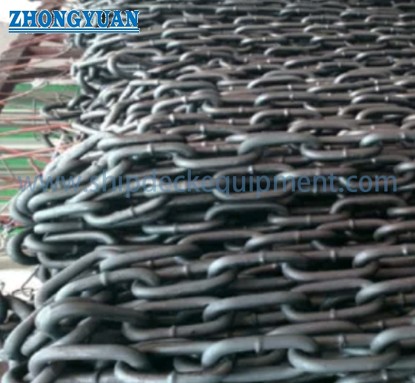
Ash Handling Conveyor Chain | Heat-Resistant Flash-Butt-Welded Round Link Chain
Product Overview
This ash handling conveyor chain is a flash-butt-welded round link chain used as the traction element in ash-removal and abrasive bulk-material conveying systems. Typical system arrangements include drag or scraper conveyors, submerged ash conveyors and bucket elevators, where the chain repeatedly engages with pocket wheels or sprockets while carrying scrapers, buckets or other attachments.
The supplied range covers nominal chain sizes from 14 × 50 mm to 30 × 120 mm in carbon steel or alloy steel, with Grade B and Grade C minimum breaking-load values listed in the supplied table. Chain selection must be based on the complete conveyor system, including operating tension, start-up and shock loading, ash temperature and abrasiveness, chain speed, sprocket geometry, attachment arrangement and expected wear allowance. The listed breaking load is not a working load limit and the chain is not presented as a lifting chain.
Quick Specifications
Main Technical Parameters
| Nominal diameter |
Pitch (mm) |
Width(mm) | Weight kg/m |
Breaking Load Min.(KN) | Total Elongation At Fracture Min % |
||
| Inside Min. | Outside Max. | B级 | C级 | ||||
| 14 | 50 | 17 | 48 | 4 | 190 | 250 | 10 |
| 16 | 64 | 22 | 58 | 5 | 250 | 320 | 10 |
| 18 | 64 | 21 | 60 | 6.6 | 320 | 410 | 10 |
| 19 | 64.5 | 22 | 63 | 7.6 | 360 | 450 | 10 |
| 22 | 80 | 31 | 83 | 10 | 480 | 610 | 10 |
| 22 | 86 | 26 | 74 | 9.5 | 480 | 610 | 10 |
| 24 | 86 | 28 | 79 | 11.6 | 570 | 720 | 10 |
| 26 | 91 | 35 | 94 | 14.3 | 670 | 850 | 10 |
| 26 | 92 | 30 | 86 | 13.7 | 670 | 850 | 10 |
| 26 | 100 | 31 | 87 | 13.3 | 670 | 850 | 10 |
| 30 | 108 | 34 | 98 | 18 | 89o | 1130 | 10 |
| 30 | 120 | 36 | 102 | 17.6 | 590 | 1130 | 10 |
Selection & Inquiry Guide
Step 1: Confirm the conveyor type and conveyed material: bottom ash, fly ash, clinker, slag or another abrasive bulk material; provide particle size, bulk density, moisture, corrosive constituents and continuous / peak temperature.
Step 2: Confirm chain geometry and system compatibility: nominal diameter, pitch, inside and outside width, number of strands, strand centre distance, pocket wheel or sprocket drawing, chain guides, connectors and scraper / bucket attachments.
Step 3: Provide the mechanical duty: normal chain tension, start-up and shock load, conveyor inclination, chain speed, drive power, centre distance, tensioning arrangement, operating hours and required design life. Grade B or C should be selected from the complete system calculation, not from breaking load alone.
Step 4: Confirm material and metallurgical requirements: carbon or alloy steel grade, heat-treatment condition, target hardness or hardness profile, weld-zone requirements, wear allowance and any low-temperature impact requirement.
Step 5: Confirm inspection and documentation scope: dimensional inspection, material certificate, heat-treatment record, proof or calibration record, tensile / breaking-load and elongation report, fatigue test or third-party witnessing when required.
Step 6: State quantity, exact strand length or number of links, matched-pair requirement, connecting links, spare links, packing method, delivery destination and required delivery date. Provide the existing chain and sprocket drawing or a representative sample for replacement projects.
Chain Construction
Round steel bar link | Formed round-link geometry | Flash-butt-welded joint | Calibrated pitch and width | Heat-treated chain body and weld zone | Interlink contact area | Pocket-wheel / sprocket engagement surface | Connector and scraper / bucket attachment interface
Manufacturing, Wear & Service-Life Considerations
Custom Attributes
How It Works
Drive wheel engages the calibrated round-link chain → Chain transmits tensile force through the conveyor circuit → Scrapers, buckets or attachments move ash through the casing → Return strand passes through the tensioning system → Routine inspection tracks link wear, weld condition, corrosion, pitch elongation and sprocket engagement
Applications
Coal-fired power plant ash removal | Bottom ash drag conveyors | Submerged ash conveyors | Scraper chain conveyors | Bucket elevators | Cement and clinker handling | Slag and abrasive bulk-material conveying | Fly-ash service where the conveyor design is suitable
Quality Control & Supply Documentation
Inspection and documentation can be arranged according to the confirmed standard and order scope, including material certificates, dimensional reports, heat-treatment records and mechanical test reports. ISO 9001, if applicable, confirms the supplier’s quality-management system rather than the chain’s product performance. Proof testing, fatigue testing, third-party witnessing and traceability must be specified before quotation. This product page does not qualify the chain for lifting or personnel-support applications.
Drawing & Photos

FAQ
Q1: How should Grade B or Grade C be selected?
A1: Select from calculated conveyor tension, dynamic factors, strand count, speed, temperature, abrasion, required life and the applicable standard. Grade C has a higher listed minimum breaking load, but breaking load is not the permissible operating tension.
Q2: Why must the chain be checked together with the sprocket or pocket wheel?
A2: Diameter, pitch, link width and accumulated pitch must match the wheel pockets. Mismatch can cause impact, uneven strand loading, tooth wear, link deformation and rapid elongation.
Q3: What information is required for an accurate quotation?
A3: Provide chain size and grade, strand length or link quantity, material and heat treatment, operating temperature, conveyor and wheel drawings, attachments, tension and speed, strand count, inspection scope, quantity, destination and delivery date.