Anchor Chain Fore RunnerSwivel | 14–162 mm
Product Overview
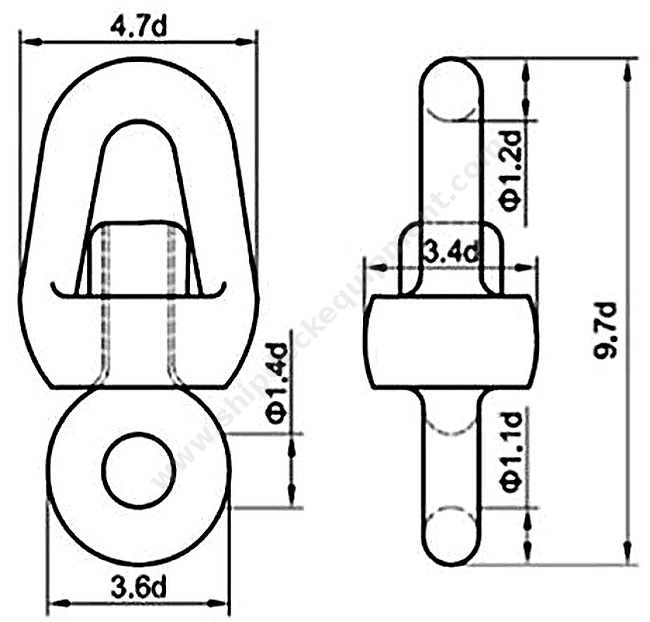
The anchor chain fore runner swivel is a rotating fitting used in a ship anchor-chain connection arrangement to reduce excessive torsional build-up when the anchor and chain change orientation. It is connected between compatible anchor-chain components and carries axial chain tension through its load-bearing eyes while allowing relative rotation around the chain axis. The item is part of the anchoring system and should not be described or selected as general lifting hardware.
The supplied specification covers forged steel or cast steel construction, galvanized or customized surface treatment, and a nominal diameter range of 14 to 162 mm. The detailed parameter table supplied for this page covers 14 to 46 mm. The applicable U2 or U3 grade schedule, material grade, heat treatment, dimensions above 46 mm, testing scope, marking, and classification documentation must be confirmed against the approved drawing and order specification before production.
Quick Specifications
Main Technical Parameters
|
Diameter d (mm) |
Length L (mm) |
Width B (mm) |
Proof Load (kN) |
Breaking Load (kN) |
|---|---|---|---|---|
| 14 | 136 | 66 | 82 | 116 |
| 16 | 155 | 75 | 107 | 150 |
| 17.5 | 170 | 82 | 127 | 179 |
| 19 | 184 | 89 | 150 | 211 |
| 20.2 | 199 | 96 | 175 | 244 |
| 22 | 213 | 103 | 200 | 280 |
| 24 | 233 | 113 | 237 | 332 |
| 26 | 252 | 122 | 278 | 389 |
| 28 | 272 | 132 | 321 | 449 |
| 30 | 291 | 141 | 368 | 514 |
| 32 | 310 | 150 | 417 | 583 |
| 34 | 330 | 160 | 468 | 655 |
| 36 | 349 | 169 | 523 | 732 |
| 38 | 369 | 179 | 581 | 812 |
| 40 | 388 | 188 | 640 | 896 |
| 42 | 407 | 197 | 703 | 981 |
| 44 | 427 | 207 | 769 | 1080 |
| 46 | 446 | 216 | 837 | 1170 |
Selection & Inquiry Guide
Step 1: Confirm the required product configuration: single swivel, swivel shackle, swivel forerunner, or complete anchor-chain connection assembly.
Step 2: Confirm nominal chain diameter and chain grade U2 or U3 from the vessel’s approved anchor-chain schedule.
Step 3: Confirm adjoining common links, enlarged links, end links, joining shackles, or anchor shackles, including eye dimensions and articulation clearance.
Step 4: Confirm forged or cast construction, exact steel grade, heat treatment, dimensional tolerance, machining, and non-destructive examination requirement.
Step 5: Confirm galvanizing or other finish, product marking, heat-number traceability, material certificate, load-test record, class society, and witness scope.
Step 6: Provide quantity, vessel type, newbuilding or replacement status, approved drawing or clear photos, delivery destination, and required delivery time.
Structure
Upper connection eye | Central rotating swivel body | Lower connection eye | Rounded load-bearing transitions | Forged or cast steel construction | Galvanized or specified finish
Material, Load Testing & Quality Advantages
Custom Attributes
How It Works
Anchor changes orientation → Torsional rotation develops in the anchor-end chain components → The swivel permits relative rotation between its connection eyes → Excessive twist transfer into the chain cable is reduced → Axial chain load remains carried through the confirmed connection arrangement
Applications
Ship bow anchoring systems | Outboard anchor-chain shots | Anchor-to-chain connection arrangements | Merchant vessels | Bulk carriers | Tankers | Container ships | General cargo vessels | Tugboats and workboats | Newbuilding and replacement projects
Certifications & Advantages
Certificates and classification inspection can be arranged according to project requirement, approved manufacturing route, material traceability, test procedure, and survey scope.
Certification: CCS, NK, BV, ABS, DNV, LR, KR, IRS, RS, RINA, CRS, Makers Test Certificate.
Drawing & Photos

FAQ
Q1: Are Proof Load and Breaking Load the same as SWL?
A1: No. Proof Load is a specified verification test value, while Breaking Load is a minimum or destructive strength value. Neither is an SWL. Selection must follow the approved chain grade, fitting schedule, and anchoring-system design basis.
Q2: Does 360° mean the swivel rotates freely under full chain tension?
A2: The designation describes the intended rotational function around the chain axis. Actual movement depends on alignment, chain tension, connection geometry, wear, corrosion, and maintenance condition. It should not be promoted as free-spinning under every loaded condition.
Q3: What information is required for quotation?
A3: Confirm product configuration, nominal diameter, U2 or U3 grade, adjoining links and shackles, forged or cast material route, surface treatment, testing and certificate scope, quantity, drawing or photos, delivery destination, and required delivery time.