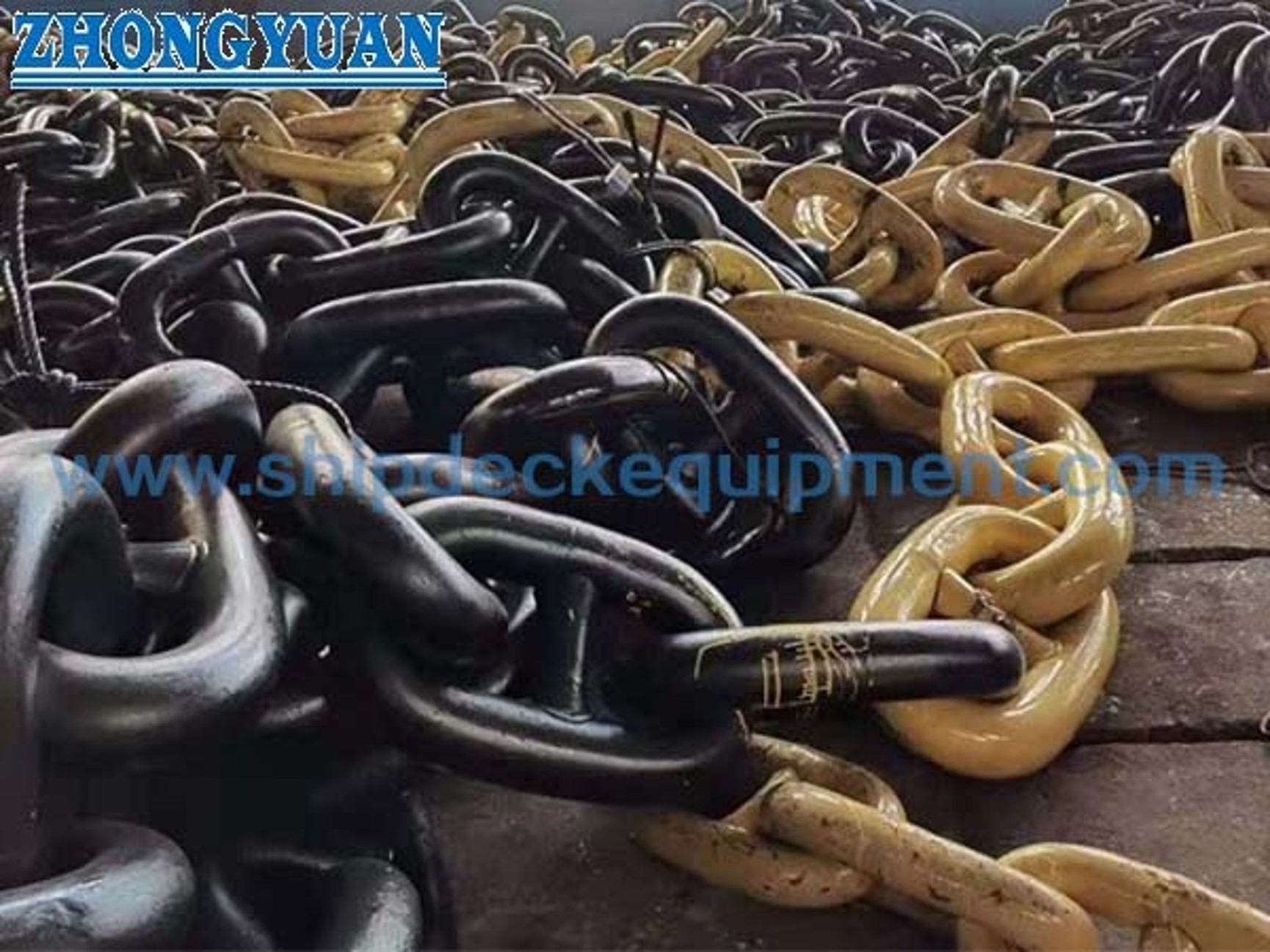
Stud-Link Marine Anchor Chain | U1 U2 U3 Flash-Butt Welded for Ship Anchoring
Product Overview
The stud-link marine anchor chain is a flash-butt welded chain cable supplied for ship anchoring systems. Each common link contains a centrally fitted stud that supports the link geometry, helps limit excessive deformation and twisting, and provides stable engagement with the windlass cable lifter. The chain is selected as part of the complete anchoring arrangement, including the anchor, windlass, chain stopper, hawse pipe, chain locker and connecting accessories.
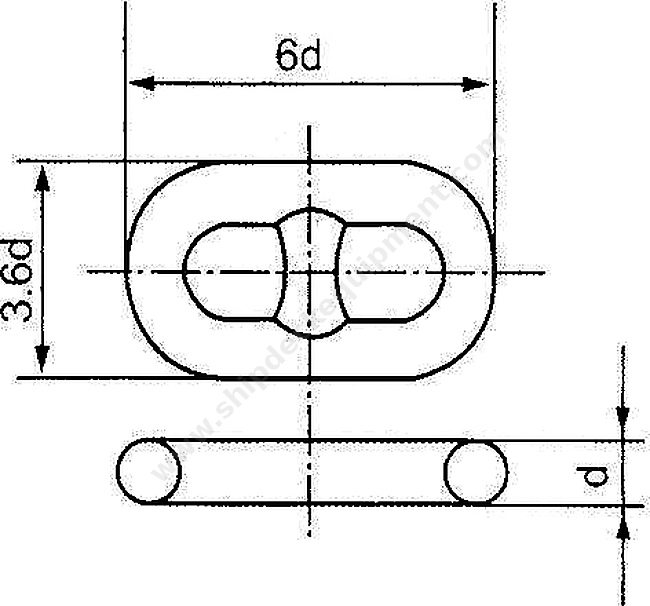
The supplied range is 12.5–70 mm in U1, U2 and U3 grades, with shot lengths normally ordered between 25.0 m and 27.5 m. ISO 1704:2022 provides the recognized dimensional basis for stud-link anchor chains, while applicable classification rules and IACS UR W18 provide requirements for approved manufacture, materials, heat treatment, proof testing, breaking-load testing, marking and certification. This page concerns ship anchor chain; offshore permanent mooring chain grades such as R3, R3S, R4 and higher are separate products and require a different specification.
Quick Specifications
Main Technical Parameters
| Nominal Size |
L | B | Proof Load |
Break Load |
Proof Load |
Break Load |
Proof Load |
Break Load |
Weight (KG/27.5M) |
| MM | MM | MM | KN | KN | KN | KN | KN | KN | KG |
| 12.5 | 75 | 45 | 28.75 | 57.81 | 41.2 | 82.6 | 56.4 | 112.8 | 85.41 |
| 14 | 84 | 50.4 | 34.78 | 69.93 | 51 | 101.9 | 70.76 | 141.51 | 106.55 |
| 16 | 96 | 57.6 | 47.1 | 94.72 | 66.2 | 132.3 | 92.42 | 184.83 | 139.43 |
| 17.5 | 105 | 63 | 56.35 | 113.31 | 78.89 | 157.78 | 110.55 | 221.1 | 178.35 |
| 19 | 114 | 68.4 | 66.42 | 133.57 | 93.6 | 187.2 | 130.32 | 260.64 | 217.68 |
| 20.5 | 123 | 73.8 | 77.33 | 155.49 | 108.64 | 217.27 | 151.7 | 303.42 | 229.14 |
| 22 | 132 | 79.2 | 89.06 | 179.08 | 125.4 | 250.9 | 174.4 | 349.4 | 264.49 |
| 24 | 144 | 86.4 | 105.98 | 213.25 | 149.9 | 298.9 | 207.9 | 415.8 | 341.82 |
| 26 | 156 | 93.6 | 124.38 | 250.12 | 175.4 | 350.8 | 244 | 488 | 369.94 |
| 28 | 168 | 100.8 | 144.26 | 290.08 | 203.8 | 406.7 | 283 | 566 | 427.04 |
| 30 | 180 | 108 | 165.6 | 333 | 234.2 | 467.5 | 324.9 | 649.8 | 490.98 |
| 32 | 192 | 115.2 | 188.42 | 378.88 | 265.6 | 531.2 | 369.6 | 739.3 | 559.65 |
| 34 | 204 | 122.4 | 212.7 | 427.72 | 299.9 | 599.8 | 417.3 | 834.6 | 671.52 |
| 36 | 216 | 129.6 | 238.46 | 479.52 | 336.1 | 672.3 | 467.8 | 935.7 | 707.85 |
| 38 | 228 | 136.8 | 265.7 | 534.28 | 374.4 | 748.7 | 521.3 | 1042.5 | 788.98 |
| 40 | 240 | 144 | 294.4 | 592 | 414.5 | 829.1 | 577.6 | 1155.2 | 869.36 |
| 42 | 252 | 151.2 | 324.58 | 652.68 | 457.7 | 915.3 | 636.8 | 1273.6 | 959.3 |
| 44 | 264 | 158.4 | 356.22 | 716.32 | 502.7 | 999.6 | 698.9 | 1398 | 1111.25 |
| 46 | 276 | 165.6 | 389.34 | 782.92 | 548.8 | 1097.6 | 763.9 | 1527.8 | 1152.07 |
| 48 | 288 | 172.8 | 423.94 | 852.48 | 597.8 | 1195.6 | 831.7 | 1663.5 | 1256.26 |
| 50 | 300 | 180 | 460 | 926.09 | 648.8 | 1239.6 | 902.5 | 1805 | 1360.41 |
| 52 | 312 | 187.2 | 497.54 | 1000.48 | 697.63 | 1395.26 | 976.14 | 1952.28 | 1485.61 |
Selection & Inquiry Guide
Step 1: Confirm that the requirement is for a ship stud-link anchor chain, then provide vessel type, class society, equipment number or anchoring arrangement data.
Step 2: Confirm nominal diameter and grade U1, U2 or U3 from the class-approved equipment calculation, anchor specification and windlass cable-lifter dimensions.
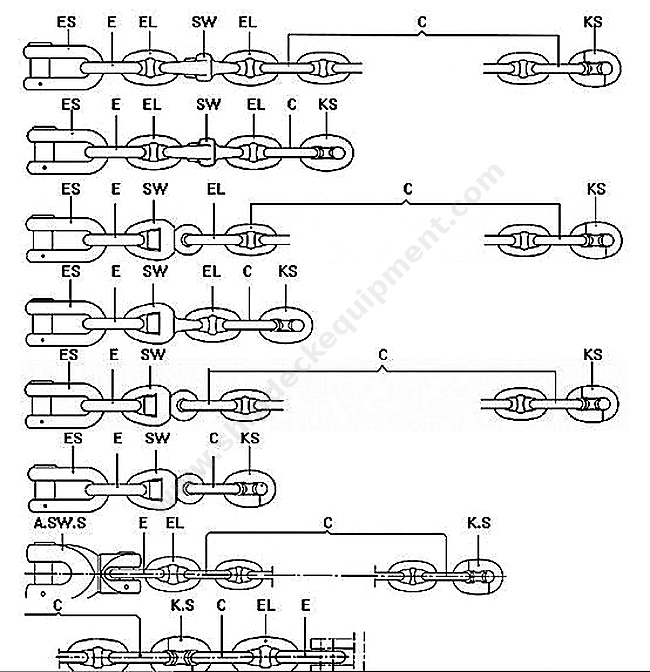
Step 3: Confirm total chain length, length per shot, odd-number link arrangement where required, and the required end links, enlarged links, Kenter joining shackles, swivel or anchor shackle.
Step 4: Confirm heat-treatment condition, surface finish, marking and whether replacement chain must match an existing chain, wildcat pocket and onboard accessory set.
Step 5: Confirm inspection and certificate scope: nominated class society, survey attendance, material traceability, proof / break tests, mechanical tests and any additional NDT requirement.
Step 6: Provide quantity, delivery destination, required delivery time, packing requirement and the existing chain certificate, drawing or clear dimensional photographs when available.
Structure
Flash-butt welded common links | Centrally fitted steel studs | Link crown and weld zone | Chain shot | End link and enlarged link | Kenter joining shackle | Swivel / anchor shackle according to anchoring arrangement
Manufacturing, Testing & Traceability Advantages
Custom Attributes
How It Works
Anchor is deployed → Stud-link chain runs through the hawse pipe and windlass cable lifter → Studs support link geometry and stable pocket engagement → Chain tension is controlled by the windlass brake and chain stopper → Anchor is recovered and chain is washed and stowed in the chain locker
Applications
Cargo ships | Bulk carriers | Tankers | Container ships | General cargo vessels | Workboats | Newbuilding anchoring systems | Replacement anchor-chain shots | Spare chain lengths and certified accessories
Certifications & Advantages
Classification certification can be arranged through the approved chain manufacturer according to the ordered grade, diameter, heat treatment, test scope and survey plan. IACS establishes unified technical requirements; the individual classification society performs or accepts the survey and issues the applicable product certificate.
Certification: CCS, NK, BV, ABS, DNV, LR, KR, IRS, RS, RINA, CRS, Makers Test Certificate.
Drawing & Photos


FAQ
Q1: How should U1, U2 or U3 anchor-chain grade be selected?
A1: Use the vessel’s class-approved anchoring equipment calculation, chain diameter, anchor specification and windlass cable-lifter design. A higher grade should not be substituted automatically because the complete chain, accessories, windlass and class approval must remain compatible.
Q2: Are UT and MT performed on every anchor-chain shot?
A2: Not as a universal default. Standard class scope includes dimensional inspection, proof-load testing, breaking-load testing, visual examination of the flash-butt weld and grade-dependent mechanical tests. UT, MT or other NDT should be stated in the inquiry and agreed with the manufacturer and class society.
Q3: Can this U1 / U2 / U3 chain be used as an offshore permanent mooring chain?
A3: Not without a separate approved specification. Offshore mooring grades such as R3, R3S, R4, R4S and higher have different material, toughness, fatigue, manufacturing and certification requirements and should be quoted as a separate product.