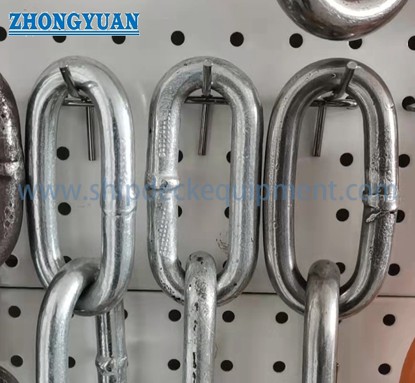
Marine Hatch Cover Pull Chain | 11-30 mm Welded Drag Chain
Product Overview
The marine hatch cover pull chain is a flash butt welded open-link chain used to transmit pulling force in compatible chain-driven cargo hatch cover systems. It runs through the original chain wheel, pocket wheel, guide or pulling arrangement to move the hatch cover during opening and closing. Typical use includes drag-type and chain-driven rolling hatch cover arrangements on bulk carriers and general cargo vessels.
Replacement selection must be based on the complete link geometry and system interface, not chain diameter alone. Chain diameter, pitch, inside width, outside width, material grade, proof load, breaking load, total length, link count and end connections should be checked against the hatch cover maker drawing or an approved original sample. This product is a hatch cover drive/pull chain; it is not an anchor chain, mooring chain or general-purpose lifting chain.
Quick Specifications
Main Technical Parameters
| Diameter |
Inside Length |
Outside Width |
Proof Load | Breaking Load |
Approx Weight |
| mm | mm | mm | kN | kN | kg/m |
| 11 | 43 | 12.5 | 57 | 116 | 2.39 |
| 14(A) | 50 | 17 | 97 | 194 | 3.95 |
| 14(B) | 42 | 18 | 97 | 194 | 4.32 |
| 15 | 42 | 21 | 106 | 212 | 5.2 |
| 16(A) | 55 | 22 | 128 | 254 | 5.34 |
| 16(B) | 55 | 18 | 128 | 254 | 5.29 |
| 18(A) | 54 | 24 | 161 | 322 | 7.12 |
| 18(B) | 64 | 25 | 161 | 322 | 6.32 |
| 19 | 57 | 24 | 164 | 330 | 7.6 |
| 20(A) | 60 | 22 | 129 | 359 | 9.5 |
| 20(B) | 62 | 22 | 179 | 359 | 8.57 |
| 22(A) | 78 | 31 | 240 | 480 | 9.86 |
| 22(B) | 86 | 30 | 240 | 480 | 9.24 |
| 22(C) | 66 | 31 | 240 | 480 | 10.6 |
| 30 | 108 | 35 | 399 | 798 | 18.22 |
Hatch Cover System Matching & Inquiry Guide
Step 1: Provide the hatch cover maker, vessel name or hull number, hatch cover type, original chain code and available system drawing or chain sample.
Step 2: Confirm chain diameter, pitch, inside width, outside width, overall length, link count, end links, connectors and any joining arrangement.
Step 3: Confirm required proof load, breaking load, material grade and test basis. Do not use proof load or breaking load as a working load limit.
Step 4: Confirm compatibility with the existing chain wheel, pocket wheel, guide, drive unit and chain storage path before ordering replacement chain.
Step 5: Confirm surface finish, corrosion environment, lubrication practice and whether black painted, self-colour or galvanized supply is required.
Step 6: State quantity or total length, packaging, inspection and certificate scope, destination, required delivery time and class requirement.
Chain Construction
Calibrated open links | Flash butt welded link joint | Controlled chain diameter and pitch | Defined inside and outside width | Continuous chain length | Optional end link or connecting arrangement | Black painted or project-specified finish
Manufacturing, Load Verification & Maintenance Advantages
Custom Attributes
How It Works
Drive unit applies pulling force → Chain engages the chain wheel / pocket arrangement → Link-by-link movement transfers force along the chain path → Hatch cover rolls or travels through its designed opening or closing sequence → Chain returns to the storage or guide arrangement
Applications
Chain-driven cargo hatch cover systems | Drag-type hatch cover arrangements | Side-rolling hatch cover pull systems | Rolling hatch cover replacement projects | Bulk carriers | General cargo vessels | Ship repair and retrofit
Inspection, Testing & Documentation
Dimensional inspection, proof-load testing, breaking-load testing, material certificates and maker test documentation can be arranged according to the purchase specification. Classification inspection is available upon request and remains subject to the applicable society rules, approved test scope and survey attendance.
Certification: CCS, NK, BV, ABS, DNV, LR, KR, IRS, RS, RINA, CRS, Makers Test Certificate.
Drawing & Photos

FAQ
Q1: What information is required to replace an existing hatch cover chain?
A1: Provide the original maker or chain code, chain diameter, pitch, inside and outside width, total length or link count, end connection, required loads and a drawing or representative sample. The chain wheel and guide condition should also be checked.
Q2: Can the proof load or breaking load be used as the chain SWL?
A2: No. Proof load and breaking load are test or strength references. They are not a working load limit. The hatch cover system designer or original equipment maker should define the operating load and required design margin.
Q3: Can a new chain section be mixed with an existing worn chain?
A3: Only after engineering confirmation. Used chain may have corrosion, wear and pitch elongation that cause uneven chain-wheel engagement. Full-chain replacement or a verified matched section is normally safer than an unassessed mixed installation.