Square Quick-Acting Watertight Hatch Cover with Handwheel for Ship Access Openings | CB/T 3842 Type B
Product Overview
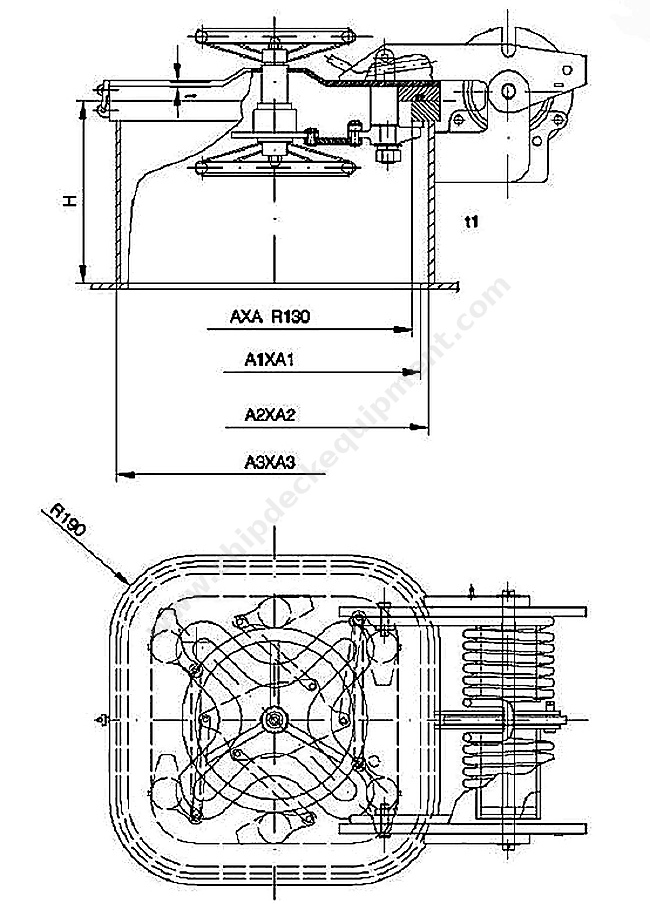
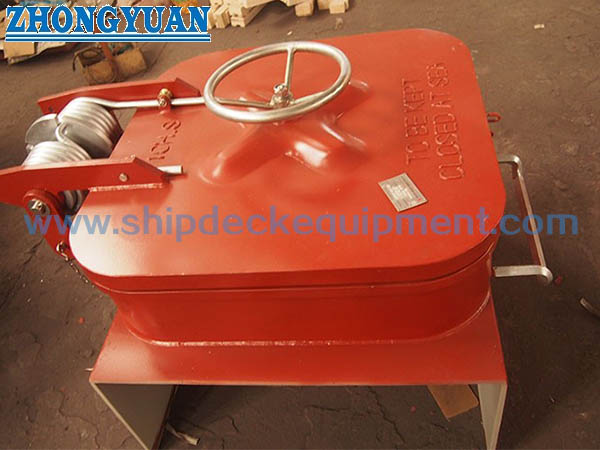
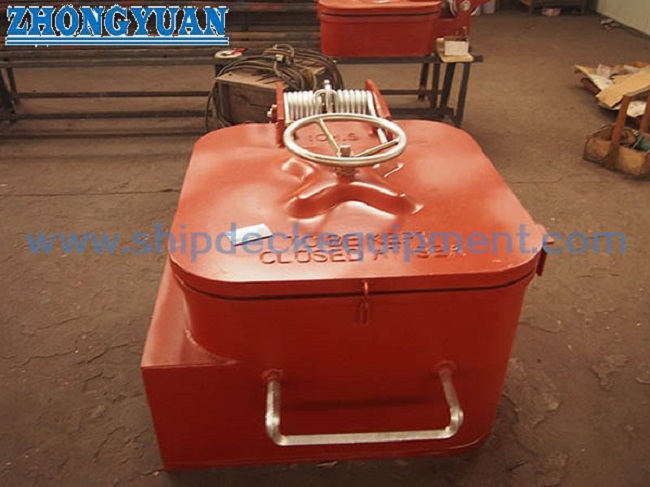
The CB/T 3842-2000 Type B quick-acting watertight hatch cover is a square hinged closure for ship access openings where reliable water containment and frequent manual operation are required. A handwheel-operated central clamping arrangement compresses the gasket against the coaming, while the spring balancing device assists opening and closing. The standard series covers nominal clear openings of 600 × 600, 700 × 700, and 800 × 800 mm.
The supplied configuration is based on a 0.2 MPa hydraulic pressure requirement and a standard 200 mm coaming height. Selection should be coordinated with the watertight boundary, installation position, deck or bulkhead opening, operating clearance, gasket medium compatibility, structural welding, and class inspection scope. Higher pressure, increased coaming height, gas-tight duty, stainless steel construction, or non-standard dimensions require project-specific engineering and approval.
Quick Specifications
Main Technical Parameters
|
Nominal Size A x A |
Deck Cutout |
Coaming Inner Size A2 x A2 |
Cover Plate Size A3 x A3 |
Cover Plate Thickness t |
Coaming | Weight | |
| Thickness | Height | ||||||
| 600x600 | 640x640 | 670x670 | 720x720 | 12 | 12 | 200 | 310 |
| 700X700 | 40X740 | 770x770 | 820X820 | 340 | |||
| 800X800 | 40x840 | 870X870 | 920x920 | 380 | |||
Selection & Inquiry Guide
Step 1: Confirm CB/T 3842-2000 Type B, the nominal clear opening, required passage size, and whether the hatch is for newbuilding or replacement.
Step 2: State the installation position and watertight boundary, design pressure or water head, opening direction, hinge side, available operating clearance, and access from one or both sides.
Step 3: Confirm deck or bulkhead cutout, coaming height, surrounding reinforcement, welding interface, structural material, and whether the supplied hatch includes loose installation parts.
Step 4: Confirm mild steel or stainless steel construction, gasket material and service medium, operating temperature, oil exposure, corrosion environment, and final coating system.
Step 5: Define the required test and inspection scope: dimensional inspection, operation test, hydraulic pressure or leakage test, material traceability, NDT, class witnessing, and certificate type.
Step 6: Provide quantity, vessel type, classification society, approved drawing or replacement sample, delivery destination, required delivery time, and packing requirement.
Structure
Square cover plate | Hinged connection | Spring balancing device | Handwheel-operated central clamping mechanism | Replaceable gasket | Welded coaming | Structural stiffening | Opening and securing components | Shop-primer or specified finish
Watertight Design, Operation & Quality Advantages
Custom Attributes
How It Works
Operator closes the hinged cover → Handwheel drives the central clamping arrangement → Closing components compress the gasket evenly against the coaming seat → The gasket and structural cover resist the specified water pressure → Handwheel is released for opening and the spring balancing device assists cover movement
Applications
Watertight ship access openings | Machinery-space access | Inspection openings | Service compartments | Deck or bulkhead penetrations according to approved arrangement | Newbuilding projects | Replacement and retrofit projects
Certifications & Advantages
Certificates and inspection can be arranged according to the project specification, material traceability requirement, approved test plan, and classification society procedure. Type approval, class product certification, or witness testing is not included by default and should be confirmed before quotation.
Certification: CCS, NK, BV, ABS, DNV, LR, KR, IRS, RS, RINA, CRS, Makers Test Certificate.
Drawing & Photos


FAQ
Q1: Is this hatch cover automatically suitable for an exposed freeboard or weather deck?
A1: Not automatically. CB/T 3842 Type B defines a quick-acting watertight hatch-cover product, but the installation position must also satisfy the vessel’s applicable Load Line, flag, and class requirements. Coaming height, structural strength, closing arrangement, accessibility, and required weathertight or watertight test must be confirmed for the actual location.
Q2: Can the hatch cover be supplied for pressure higher than 0.2 MPa?
A2: A higher-pressure design can be considered case by case. The cover plate, coaming, stiffeners, hinge supports, clamping mechanism, gasket compression, surrounding ship structure, and test pressure must be recalculated and submitted for project or class approval.
Q3: Does a watertight hatch cover also qualify as gas-tight or fire-rated?
A3: No. Gas-tightness and fire rating are separate performance requirements involving specific materials, sealing details, test procedures, and approvals. They should only be stated when the ordered configuration has been designed, tested, and certified for that duty.