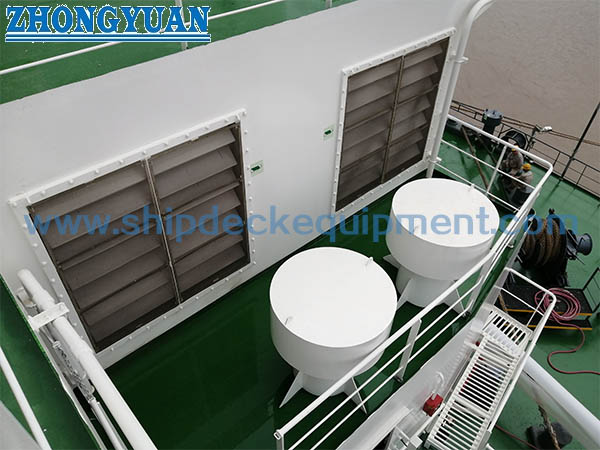
Open-Type Mushroom Ventilator with Flanged Connection | Cargo Hold and Accommodation Ventilation (Legacy CB/T 295 Type D)
Product Overview
The CB/T 295 Type D mushroom ventilator is an open-type deck ventilation terminal with a broad mushroom hood and a flanged lower connection. It is used to provide natural or fan-assisted air intake or exhaust for cargo spaces, service spaces, galleys, and accommodation-related ventilation systems, subject to the vessel ventilation plan and fire-safety arrangement.
Type D is a non-closing head: airflow is controlled by the connected fan, duct damper, fire damper, or other approved downstream device rather than by the mushroom hood itself. Where the ventilator serves a space below the freeboard deck or an enclosed superstructure, the complete installation must satisfy the applicable coaming height, weather protection, and closing-appliance requirements. A shielded ventilator cabin or weather-protected enclosure can form part of the approved arrangement, but the open mushroom head alone should not be presented as a Load Line closing device.
Quick Specifications
Main Technical Parameters
|
Nominal diameter DN |
D1 | D2 | H | H1 | H2 | t |
Weight Kg |
| 250 | 440 | 200 | 220 | 90 | 195 | 6 | 42 |
| 300 | 530 | 265 | 52 | ||||
| 350 | 620 | 310 | 65 | ||||
| 400 | 710 | 280 | 345 | 105 | 205 | 81 | |
| 450 | 800 | 375 | 8 | 99 | |||
| 500 | 890 | 320 | 405 | 122 | |||
| 550 | 980 | 435 | 147 | ||||
| 600 | 1050 | 470 | 120 | 220 | 169 | ||
| 650 | 1160 | 500 | 194 | ||||
| 700 | 1240 | 520 | 218 | ||||
| 750 | 1320 | 540 | 233 | ||||
| 800 | 1410 | 560 | 140 | 240 | 299 | ||
| 850 | 1500 | 580 | 305 | ||||
| 900 | 1580 | 360 | 600 | 334 | |||
| 950 | 1670 | 620 | 358 | ||||
| 1000 | 1760 | 640 | 402 | ||||
| 1100 | 1930 | 680 | 496 | ||||
| 1200 | 2100 | 720 | 592 | ||||
| 1300 | 2270 | 760 | 645 | ||||
| 1400 | 2440 | 400 | 800 | 701 | |||
| Record: Ventilator weight does not include the weight of air duct | |||||||
Selection & Inquiry Guide
Step 1: Confirm whether the project requires legacy CB/T 295 Type D dimensions or the current CB/T 4444 standard, and provide the vessel ventilation drawing.
Step 2: Confirm DN, required airflow, system resistance, intake or exhaust duty, natural or powered ventilation, fan connection, and permissible air velocity or noise requirement.
Step 3: Confirm installation location: cargo hold, galley, accommodation-related space, store, workshop, or other compartment; state whether the opening leads below the freeboard deck.
Step 4: Confirm deck position, required coaming height, weather exposure, shielded cabin / enclosure, closing appliance, damper, fire damper, and Load Line or class requirements.
Step 5: Confirm material grade, flange standard and drilling, mating duct size, gasket, support and reinforcement, coating system, galvanizing or polished finish, and corrosion environment.
Step 6: Provide quantity, class society, inspection scope, drawing or photo, delivery destination, required delivery time, and whether fan, damper, transition, or enclosure is included in the supply scope.
Structure
Mushroom hood | Annular air passage | Central support structure | Cylindrical coaming / trunk | Lower connecting flange | Optional separate fan or damper interface | Deck support and reinforcement | Specified coating or corrosion-resistant finish
Ventilation, Weather Protection & Installation Advantages
Custom Attributes
How It Works
Air is drawn or discharged through the connected duct → Fan or natural pressure difference drives the airflow → Air passes through the flanged trunk → Flow turns through the annular opening below the mushroom hood → Separate damper or approved closing arrangement controls or secures the ventilation system when required
Applications
Cargo-hold ventilation | Galley and service-space ventilation terminals | Accommodation-related ventilation systems | Stores and workshops | Fan-assisted deck ventilation | Natural ventilation openings | Newbuilding and legacy replacement projects
Certifications & Advantages
Material certificates, welding records, dimensional inspection, coating records, functional inspection of supplied dampers, and class witnessing can be arranged according to the project specification and agreed supply scope. The ventilator should not be described as class-approved or Load Line compliant by itself unless the complete installation and certificate scope have been approved.
Certification: CCS, NK, BV, ABS, DNV, LR, KR, IRS, RS, RINA, CRS, Makers Test Certificate.
Drawing & Photos


FAQ
Q1: Is CB/T 295-2000 still the current standard for ship mushroom ventilators?
A1: No. The official Chinese standards platform lists CB/T 295-2000 as withdrawn and CB/T 4444-2017 as the current standard that fully replaced it. Legacy Type D dimensions can still be used for replacement or compatibility when specified, but direct dimensional equivalence with the current standard should be confirmed.
Q2: Can an open Type D mushroom ventilator be used directly for cargo-hold ventilation on an exposed deck?
A2: Only as part of an approved complete arrangement. The open head is not a weathertight closing appliance. The coaming height, deck position, shielded cabin or enclosure, closing appliance, fire-safety arrangement, and Load Line / class requirements must be confirmed for the vessel.
Q3: How should the nominal diameter be selected?
A3: DN should be selected from the required airflow, allowable velocity, pressure loss, fan duty, duct size, noise target, opening location, and weather-protection arrangement. The standard dimension table confirms the product envelope but does not replace the ventilation-system calculation.