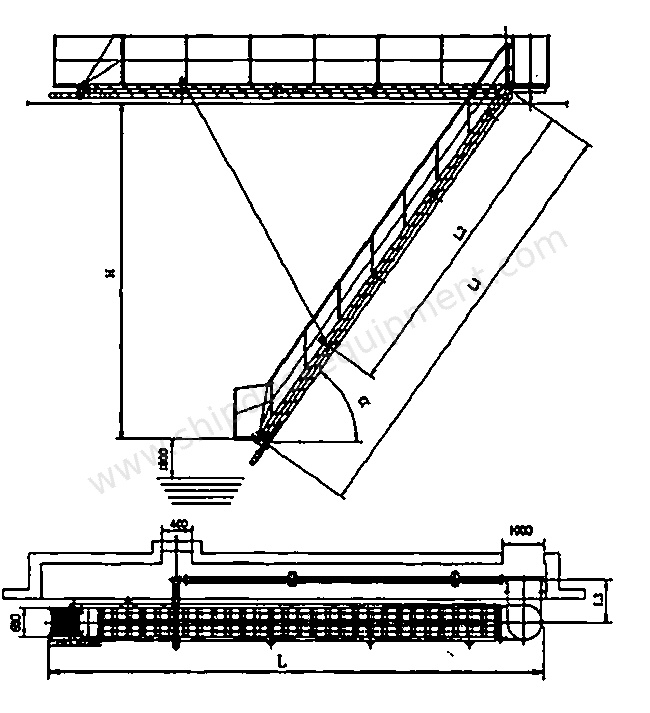
ISO 5488 Single-Flight Aluminum Accommodation Ladder with Fixed Platform | Ship Access and Pilot Transfer
Product Overview
The ISO 5488 single-flight aluminum accommodation ladder with fixed platform is a complete ship-access system for the safe embarkation and disembarkation of crew, pilots, and authorized personnel on merchant ships. The ladder body is manufactured in aluminum to reduce handling weight, while the supporting platform, davit, turning device, stowage arrangement, and foundation interfaces are configured according to the vessel’s side arrangement and approved general arrangement drawing.
The system can be supplied for normal accommodation access or as the accommodation-ladder element of a pilot transfer combination arrangement. Pilot-transfer use requires confirmation of the vessel’s draught and trim range, access height, ladder angle, lower-platform position, pilot-ladder interface, ship-side securing method, and Administration or class approval. The ladder winch is used to deploy, recover, and stow the ladder assembly; it is not a mechanical pilot hoist and is not intended to lift personnel.
Quick Specifications
Main Technical Parameters
| Number of Steps |
L1 (mm) |
Max. Height (H: mm) |
L (mm) |
H (mm) |
Weight (kg) |
| 12 | 3600 | 3500 | 5290 | 250 | 320 |
| 14 | 4200 | 4100 | 5890 | 250 | 330 |
| 16 | 4800 | 4590 | 6490 | 250 | 340 |
| 18 | 5400 | 5080 | 7090 | 250 | 530 |
| 20 | 6000 | 5800 | 7690 | 250 | 560 |
| 22 | 6600 | 6300 | 8290 | 250 | 580 |
| 24 | 7200 | 6800 | 8890 | 250 | 600 |
| 28 | 8400 | 7800 | 10090 | 250 | 780 |
| 32 | 9600 | 8800 | 11290 | 250 | 850 |
| 36 | 10800 | 9800 | 12490 | 320 | 890 |
| 40 | 12000 | 10800 | 13690 | 320 | 970 |
| 44 | 13200 | 11800 | 14890 | 350 | 1180 |
| 48 | 14400 | 12800 | 16090 | 350 | 1260 |
| 52 | 15600 | 13800 | 17290 | 420 | 1370 |
Selection & Inquiry Guide
Step 1: Confirm the intended service: normal ship accommodation access, crew access, or the accommodation-ladder component of a pilot transfer combination arrangement.
Step 2: Provide the vessel type, freeboard and access height range, operating draught and trim, required nominal ladder length, number of steps, maximum working angle, and available stowage envelope.
Step 3: Confirm the fixed-platform arrangement, upper and lower landing positions, ship-side securing or bowsing method, davit and turning arrangement, and whether a pilot-ladder interface or trapdoor platform is required.
Step 4: Confirm material grades for the aluminum ladder and steel supports, corrosion-isolation details between dissimilar metals, anodizing requirement, steel coating system, handrail type, and safety-net scope.
Step 5: Select the winch drive and controls: pneumatic, electric, explosion-protected electric, or manual; provide power supply, hazardous-area classification, brake and locking requirements, operating speed, and control-station location.
Step 6: Confirm class or statutory approval scope, EU MED requirement if applicable, load-test witnessing, quantity, delivery destination, required delivery time, and vessel-side GA or installation drawing.
Structure
Aluminum ladder frame | Fixed anti-slip arc steps | Fixed platform arrangement | Upper and lower landing interfaces | Foldable or removable handrails | Stanchions and safety net | Davit and suspension system | Turning and stowage device | Ladder winch and wire rope | Ship-side securing arrangement
Design, Operation & Quality Advantages
Custom Attributes
How It Works
Release stowage locks → Operate the winch and davit to turn out and lower the ladder → Set the approved working angle → Secure the platform and ladder to the ship’s side → Fit handrails, safety net, and pilot-ladder interface as applicable → Use under responsible-officer supervision → Recover, inspect, and lock the assembly in its stowed position
Applications
Merchant cargo ships | Bulk carriers | Tankers | Container ships | General cargo ships | Crew embarkation and disembarkation | Pilot transfer combination arrangements | Newbuilding and retrofit projects
Certifications & Advantages
Certificates, type approval, statutory acceptance, and inspection witnessing can be arranged according to the project specification, vessel flag, class requirement, notified-body scope, and approved inspection plan. They are not automatically included with every supply.
Certification: CCS, NK, BV, ABS, DNV, LR, KR, IRS, RS, RINA, CRS, Makers Test Certificate.
EU MED / EC-type examination documentation: available where applicable and subject to the selected product configuration, notified-body approval, and order scope.
Drawing & Photos


FAQ
Q1: How should the correct accommodation-ladder length be selected?
A1: Select the length from the vessel’s maximum and minimum access heights, draught and trim range, required ladder angle, fixed-platform position, and stowage envelope. For pilot-transfer combination use, the ladder angle must not exceed the applicable 45° limit and the complete ship-side arrangement must be checked.
Q2: Can a standard accommodation ladder automatically be used for pilot transfer?
A2: No. The ladder may form part of a pilot transfer combination arrangement only when the ladder, platform, pilot ladder, securing points, access route, ship-side position, and approval documentation satisfy the applicable SOLAS, IMO, Administration, and class requirements.
Q3: What information is needed to select the winch and obtain certificates?
A3: Provide the ladder dead weight, travel and stowage arrangement, drive type, power supply, hazardous-area classification, operating speed, brake and locking functions, control location, wire-rope arrangement, class society, flag requirement, EU MED scope if applicable, and required test witnessing.