Aluminum Shore Gangway with Decking Plate | ISO 7061 Type A for Ship-to-Shore Access
Product Overview
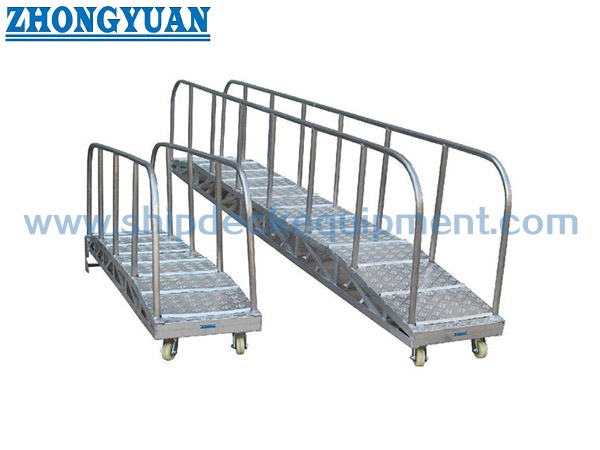
The ISO 7061 Type A aluminium shore gangway is a portable ship access bridge with a decking plate and anti-slip steps. It is carried on board to provide ship-to-shore access primarily for the vessel’s crew and may also be used between ships when conditions are favourable. The Type A walking surface is intended for horizontal service or an inclination of up to 30° from the horizontal; it is not intended for wheeled traffic such as loaded trolleys.
ISO 7061:2024 is the current fourth edition and replaces ISO 7061:2015. The updated edition retains Type A as the decking-plate configuration and revises the inclination wording, test methods, and marking requirements. A one-section or two-section body can be considered according to handling and stowage needs, while final selection should confirm gangway length, ship-side securing, shore-end support, freeboard and tidal range, handrail arrangement, testing scope, and approval requirements.
Quick Specifications
Main Technical Parameters
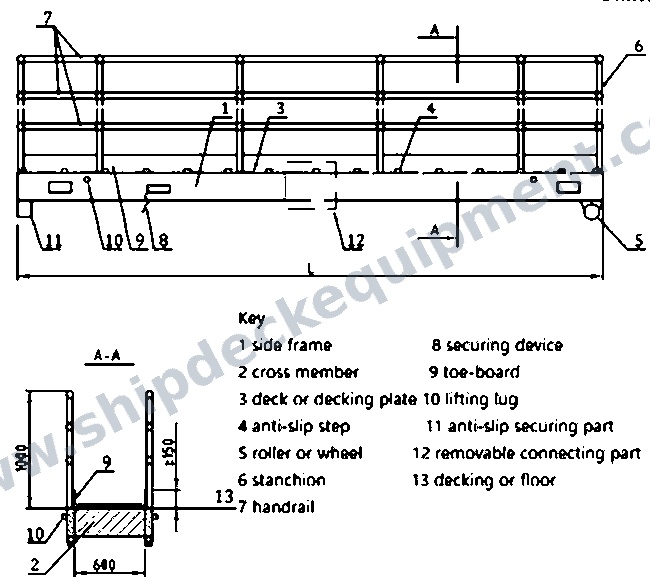
| L (mm) | 2500 | 3000 | 3500 | 4000 | 4500 | 5000 | 5500 | 6000 | 6500 | 7000 | 7500 | 8000 | 9000 | 10000 |
| Net Width (mm) | 600 | |||||||||||||
| Factor of safety | 2 on the 0,2 % proof stress of the aluminum alloy used | |||||||||||||
| Steps |
spaced at regular intervals of 300 mm to 400 mm longitudinally. a minimum height of 30 mm above the decking; hardwood steps shall have a minimum section width of 40 mm in contact with the decking |
|||||||||||||
| Stanchions | with a maximum permitted interval of 1 500 mm | |||||||||||||
|
Handrail and intermediate guides |
Handrail and 2 intermediate guides a) continuous and adequately tensioned sisal, manila, polypropylene or plastics-covered wire rope, minimum rope diameter of 16 mm; b) continuous rigid aluminum solid or hollow section |
|||||||||||||
Selection & Inquiry Guide
Step 1: Confirm ISO 7061 Type A decking plate gangway and the required standard edition; ISO 7061:2024 is the current edition.
Step 2: Provide required overall length, ship freeboard, expected tidal variation, shore landing level, and maximum operating inclination.
Step 3: Confirm one-section or two-section construction, removable connection design, onboard stowage position, handling method, and available lifting points.
Step 4: Confirm ship-side anti-slip securing part, shore-end roller or wheel arrangement, supporting interface, and any safety-net attachment requirement.
Step 5: Confirm aluminium alloy and temper, welding requirement, anodizing specification, handrail type, rope material or rigid guide option, and marking details.
Step 6: State quantity, vessel type, flag / class / EU MED requirement, inspection and test scope, delivery destination, required delivery time, and drawings or photos if available.
Structure
Aluminium side frames | Cross-members | Decking plate | Anti-slip steps | Stanchions | Handrail and two intermediate guides | Upper anti-slip securing part | Shore-end roller or wheels | Lifting lugs | Optional removable two-section connection
Design, Safety & Manufacturing Advantages
Custom Attributes
How It Works
Ship-side securing part engages the vessel support → Shore-end roller or wheels rest on the landing area → Decking plate and anti-slip steps provide the walking route → Side frames and cross-members carry the applied access load → Handrail and intermediate guides provide side protection → Gangway is inspected, recovered, and stowed after use
Applications
Merchant ships | Cargo vessels | Tankers | Bulk carriers | Container ships | Workboats | Newbuilding projects | Replacement shore gangways | Ship-to-ship access in favourable conditions
Certifications & Advantages
Certificates and approvals can be arranged according to the applicable flag-state, classification society, EU marine-equipment, and project requirements. EU MED / EC type approval and class certification are not assumed as standard supply and remain subject to the approved product configuration, testing, notified-body or class involvement, and agreed order scope.
Certification: CCS, NK, BV, ABS, DNV, LR, KR, IRS, RS, RINA, CRS, Makers Test Certificate.
Drawing & Photos


FAQ
Q1: Which ISO 7061 edition should be specified for a new gangway?
A1: ISO 7061:2024 is the current fourth edition and replaces ISO 7061:2015. The 2024 edition should normally be used for new quotations, while a legacy edition should only be retained when required by an existing vessel drawing or contract.
Q2: Can the Type A gangway be used above 30° or for loaded trolleys?
A2: Type A is the decking-plate configuration for horizontal use or an inclination up to 30° from the horizontal. It is not intended for wheeled traffic such as loaded trolleys. A higher operating angle or wheeled load requires a separately selected and approved access arrangement.
Q3: What information is required before quotation?
A3: Provide overall length, freeboard and tidal range, maximum inclination, one- or two-section requirement, ship-side and shore-end support details, stowage arrangement, aluminium alloy, handrail type, surface treatment, test and certificate scope, quantity, destination, delivery time, and an installation drawing or photo.