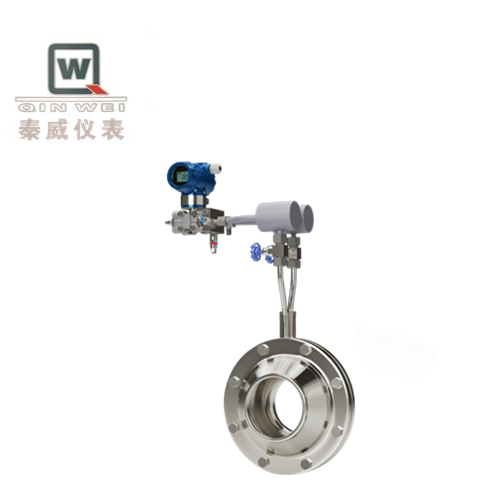
V-Cone Flowmeter Is Stable, Reliable, And Anti-Interference In Differential Pressure Flow Measurement
The V-cone flowmeter is a high-precision flow measurement instrument based on the differential pressure principle. It measures flow by suspending a V-shaped cone in the center of the pipe as a throttling element and calculating the flow based on the pressure difference generated when the fluid passes through the cone.
Structural Features
- Annular Throttling Design: Unlike the central hole throttling of traditional orifice plates, the V-cone uses a gradually contracting annular throttling on the side walls, reducing vortex and pressure loss.
- Self-straightening Function: The cone can reshape the flow velocity distribution, making the fluid uniform and lowering the requirement for straight pipe sections (0-3D upstream, 0-1D downstream).
Advantages
- High precision and stability: Accuracy can reach ±0.5% (trade grade ±0.3%), repeatability is better than ±0.1%, and long-term stability is excellent.
- Wide range ratio: Usually 10:1 to 15:1, and up to 50:1 with special design, suitable for scenarios with large flow fluctuations.
- Low maintenance requirements: No moving parts, wear-resistant, self-cleaning design to prevent accumulation of dirty media, suitable for impurity-containing fluids such as coke oven gas and sewage.
Key Points for Selection
- Medium Characteristics: It is necessary to clarify the type of fluid (liquid/gas/steam), temperature, pressure and impurity content.
- Parameter Matching: Select the appropriate β value (equivalent diameter ratio) based on the flow range, usually ranging from 0.45 to 0.85.
- Installation Method: Split type (flexible matching) or integral type (simplified installation). For high-temperature media, condensers and temperature-pressure compensation devices are required.
Maintenance suggestions:
- Regular inspection: In applications where dirt and grime are likely to accumulate, regularly check the cone for scaling or wear. Due to its self-cleaning ability, the maintenance cycle is usually longer.
- Drainage and venting: Regularly perform drainage and venting operations on the impulse lines and differential pressure transmitter to ensure accurate differential pressure measurement.
- Zero point calibration: Calibrate the zero point of the differential pressure transmitter when the fluid is stationary.
Typical application scenarios
- Energy metering: Trade settlement and process control of steam, natural gas, town gas, and fuel oil.
- Petrochemical and chemical industries: Various raw gas, process gas, and high-viscosity liquids (such as heavy oil and residue oil).
- Municipal engineering: Town gas, compressed air, reclaimed water, and sewage.
- Thermal systems: Precise measurement of high-temperature and high-pressure steam.
- Space-limited renovation projects: Situations where long straight pipe sections cannot be provided.
The V-cone flowmeter represents a significant innovation in traditional differential pressure flowmeters. Through its unique design of a centrally suspended cone, it ingeniously addresses the conventional core difficulty such as the requirement for a long straight pipe section, high pressure loss, susceptibility to blockage, and a narrow range ratio.