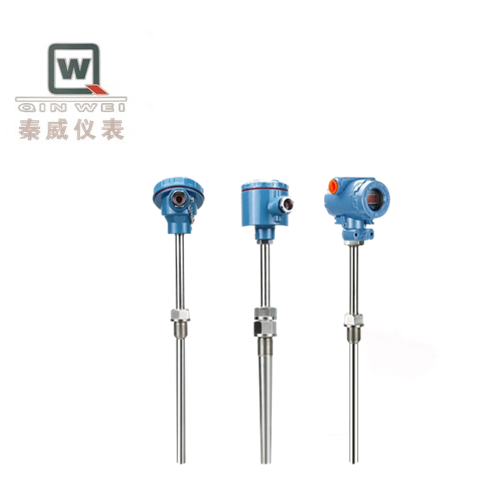
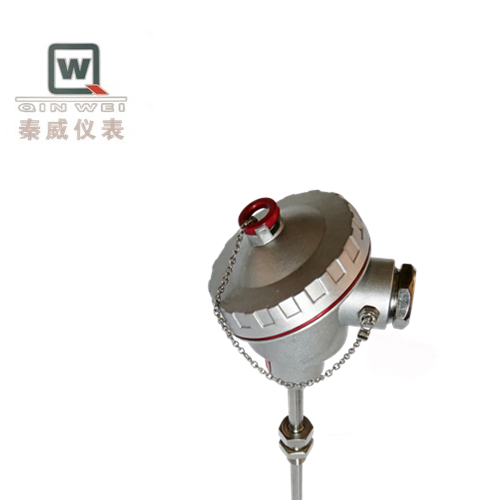
Armored Thermal Resistance High Temperature 600°C Corrosion-Resistant Protective Sleeve
Like the armored thermocouple, the armored resistance thermometer is an enhanced and more versatile structure of the standard resistance thermometer. However, it adopts the advantages of the physical structure of the armored thermocouple, offering higher mechanical strength, faster response speed, and better installation flexibility.
Structural Composition
Armored thermoresistance is a solid combination formed by integrating the platinum resistance temperature sensing element, high-density magnesium oxide insulating powder, and metal protective sleeve through one-piece drawing or assembly.
Its structure is also divided into three layers from the inside out:
- Temperature sensing element: Located at the innermost part, it is usually a platinum resistance core, with Pt100 being the most common. It is a precise ceramic substrate with platinum resistance wire etched on it and covered with a protective layer.
- Insulating material: High-purity, dense magnesium oxide powder, filled between the temperature sensing element and the metal sleeve. Its functions are electrical insulation, heat conduction, and mechanical support.
- Metal protective sleeve: The outermost armor, typically made of stainless steel, Inconel, and other alloys. It is responsible for mechanical protection, corrosion resistance, and sealing.
Main Features
- Extremely high mechanical strength: It can withstand strong impacts, vibrations and bending, making it suitable for harsh environments with high pressure and high vibration, such as pumps and compressors.
- Fast response speed: Due to the excellent thermal conductivity of magnesium oxide and the compact structure, heat can be rapidly transferred from the sheath to the internal platinum resistance core, resulting in a response time much shorter than that of ordinary assembled thermal resistors.
- Good corrosion resistance: Different sheath materials (such as 316 stainless steel, Hastelloy, etc.) can be selected according to the measured medium, extending the service life in corrosive environments.
- Long service life and good stability: The robust sealing structure prevents the intrusion of moisture and harmful gases, ensuring the long-term stability and accuracy of the platinum resistance element.
- Flexible installation and compact size: The outer diameter can be made very small (such as 3mm, 4mm, 6mm), and it has a certain bending ability, making it easy to install on equipment with limited space. The leads are also armored for better integrity.
4. Armored Resistance Temperature Detectors vs. Armored Thermocouples
This is a very common question because they look very similar in appearance.
Characteristics: Armored Resistance Thermometer vs. Armored Thermocouple
| Characteristics |
Armored Resistance Thermometer |
Armored Thermocouple |
| Core Principle |
Resistance value changes with temperature |
Thermoelectric potential changes with temperature |
| Internal Components |
Platinum resistance element (Pt100, etc.) |
Two different materials of thermocouple wire (K-type, S-type, etc.) |
| Measurement Range |
Medium and low temperatures (-200°C to +600°C approximately) |
Wide temperature range, especially high temperatures (up to +1300°C or even higher) |
| Accuracy |
High |
Relatively low |
| Signal Output |
Resistance (Ω) |
Millivolt voltage (mV) |
| System Complexity |
Requires lead resistance compensation (3-wire or 4-wire system recommended) |
Requires cold junction compensation |
| Cost Comparison |
Relatively higher component and system costs |
Lower component costs, but compensation system has costs |
| Typical Applications |
Processes requiring precise control, water, oil, steam, and gas temperatures |
High-temperature environments, boilers, furnaces, exhaust temperatures |
Selection Guide:
- If your application is below 600°C and requires high precision and stability (e.g., process control, laboratories, energy management systems), choose an armored resistance thermometer.
- If your application involves high temperatures (above 600°C), or if cost is a more significant concern and acceptable accuracy can be achieved, an armored thermocouple is a more suitable choice.
Application fields
- Chemical and petrochemical: Temperature measurement in reactors, pipelines, and high-pressure vessels.
- Power industry: Temperature monitoring of steam turbines, generator windings, and boiler feedwater systems.
- Pharmaceutical industry: Fermentation tanks and sterilization equipment with high hygiene and precision requirements.
- HVAC: High-demand industrial environmental temperature control.
- Machinery: Temperature monitoring of hydraulic systems, bearings, and gearboxes, capable of withstanding intense vibration.
- Food and beverage: Temperature control in pasteurization and cooking tanks.
Summary
Armored thermoresistance can be understood as a "precise temperature sensor wearing armor". It perfectly combines the high accuracy of platinum resistance with the robustness and durability of the armored structure. When your application scenario has high requirements for temperature measurement accuracy, mechanical strength, response speed, and service life, armored thermoresistance is an ideal choice.