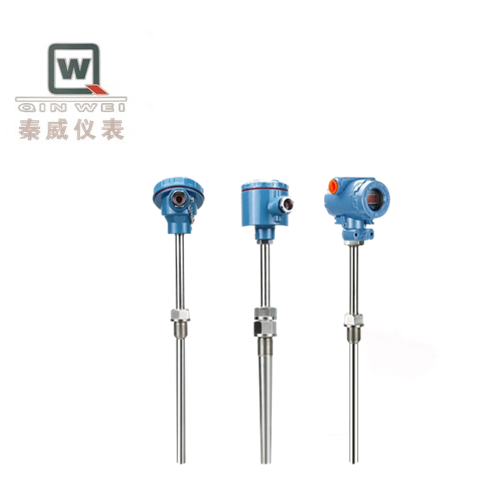
Anticorrosive 316 Material, High Temperature Resistant Thermal Resistor
A thermal resistor is a sensor that measures temperature by utilizing the characteristic that the resistance value of a metal material changes with temperature. Generally, the higher the temperature, the greater the resistance value of the metal, and there is a definite functional relationship between them.
Typical Applications
Semiconductor Thermistors (Thermistors)
-
NTC Thermistors
- Characteristics: Negative temperature coefficient, resistance decreases significantly with temperature increase, high sensitivity but poor linearity.
- Applications: Motor overheating protection, lithium battery over-temperature monitoring, environmental temperature compensation.
-
PTC Thermistors
- Characteristics: Positive temperature coefficient, resistance increases sharply after a specific temperature point, used for temperature switches and current limiting protection.
- Applications: Industrial temperature control, household appliances (such as electric heaters).
Product Advantages
- Wide measurement range: Especially for Pt100, it covers a range from near absolute zero to hundreds of degrees Celsius.
- Good linearity: The curve of resistance versus temperature is relatively smooth, facilitating signal processing.
- Good interchangeability: Standardized production allows components of the same model to be interchangeable.
Thermocouple vs. Thermal Resistance
| Characteristics |
Thermocouple |
Thermal Resistance |
| Principle |
Seebeck effect (electricity generated by temperature difference) |
Resistance changes with temperature |
| Signal |
Millivolt voltage (mV) |
Resistance value (Ω) |
| Measurement range |
Wide, especially at high temperatures (-200°C to +1800°C) |
Moderate to low temperatures (-200°C to +850°C) |
| Accuracy |
Relatively low |
High |
| Sensitivity |
Low (small output signal) |
High (large output signal change) |
| Cost |
Low (standard type) |
High |
| Core challenges |
Cold junction compensation |
Lead resistance compensation (3-wire/4-wire system) |
| System complexity |
Requires cold junction compensation circuit/instrument |
Relatively simple, usually requires constant current source |
| Response speed |
Fast |
Slow |
| Typical applications |
Boilers, furnaces, engine exhaust, and other high-temperature environments |
Process control, HVAC, and precise temperature measurement in laboratories |
Application scenarios
- High-temperature fields: Monitoring the temperature of molten iron in the metallurgical industry (1600℃), and the cooling agent system of nuclear power reactors.
- Low-temperature fields: In the cold chain transportation of vaccines (-70℃), dual-redundant thermal resistors ensure that the temperature fluctuation is ≤ ±0.5℃.
- Special environments: In deep-sea exploration (high pressure) and corrosive chemical environments, thermal resistors encapsulated in 316L stainless steel or nickel-based alloys can work stably for a long time.
- Industrial automation: Process temperature control in fields such as steel, petrochemicals, and power, such as real-time monitoring of heating furnaces and distillation columns.
- New energy industry:
- ① Thermal management of power batteries: The purchase volume of thermal resistors in the new energy vehicle field is expected to increase by 35% year-on-year in 2025.
- ② Temperature monitoring of photovoltaic inverters and wind power converters to improve power generation efficiency and equipment lifespan.
- Medical and scientific research:
- ① Temperature calibration of medical incubators and MRI equipment to ensure the activity of biological samples.
- ② High-precision temperature field control in laboratories to support material research.